



This is the latest post in my “12 Things Everyone Should Know” series. It’s a guest post by evolutionary psychologist Rob Kurzban. You can access the full 12 Things collection here.
Feelings have jobs, courtesy of evolution. Hunger measures your need for calories and motivates you to eat. Frustration measures the futility of your current approach and motivates you to try a different one. This simple idea means that answering three questions can unravel the mystery of any human feeling: What adaptive problem is being solved? What is being measured? What is being motivated?
In some cases, what’s being measured is obvious—how full your stomach is—but in other cases it has taken work to figure it out. And many feelings remain unexplained.
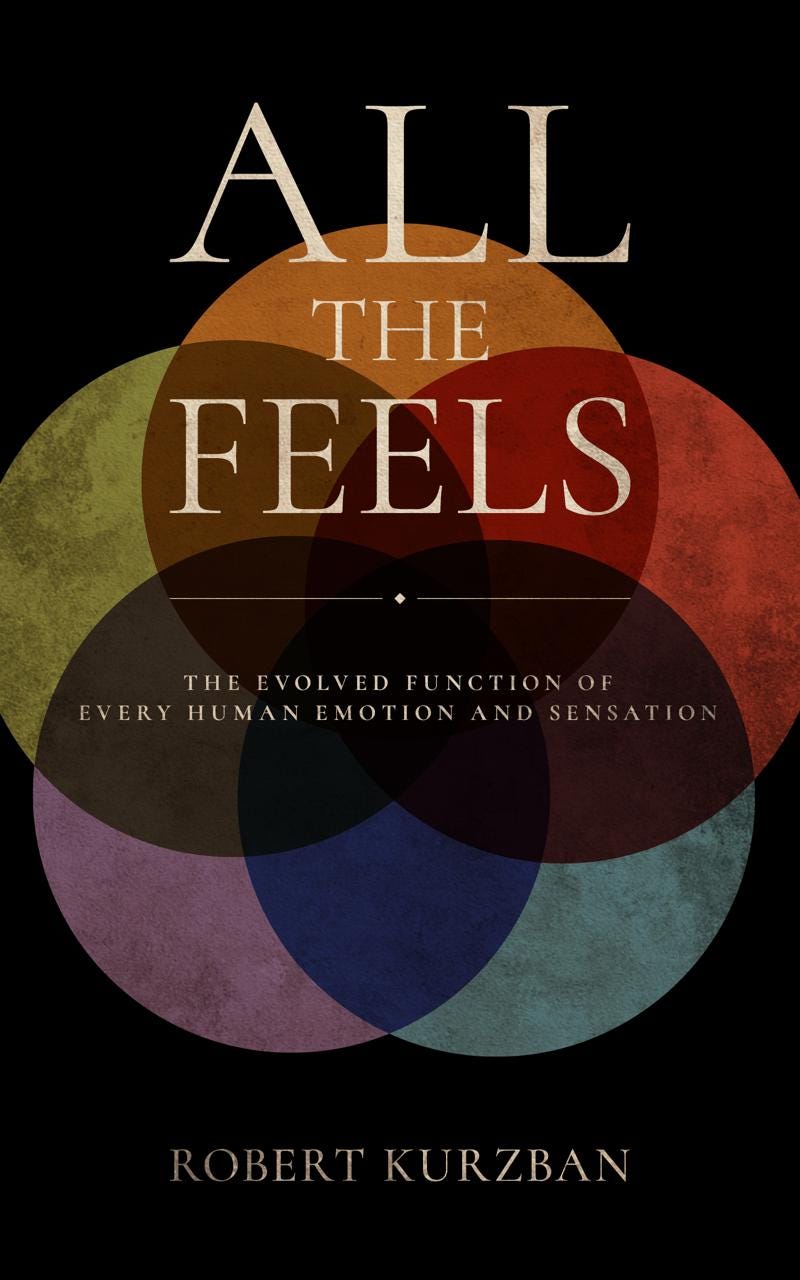
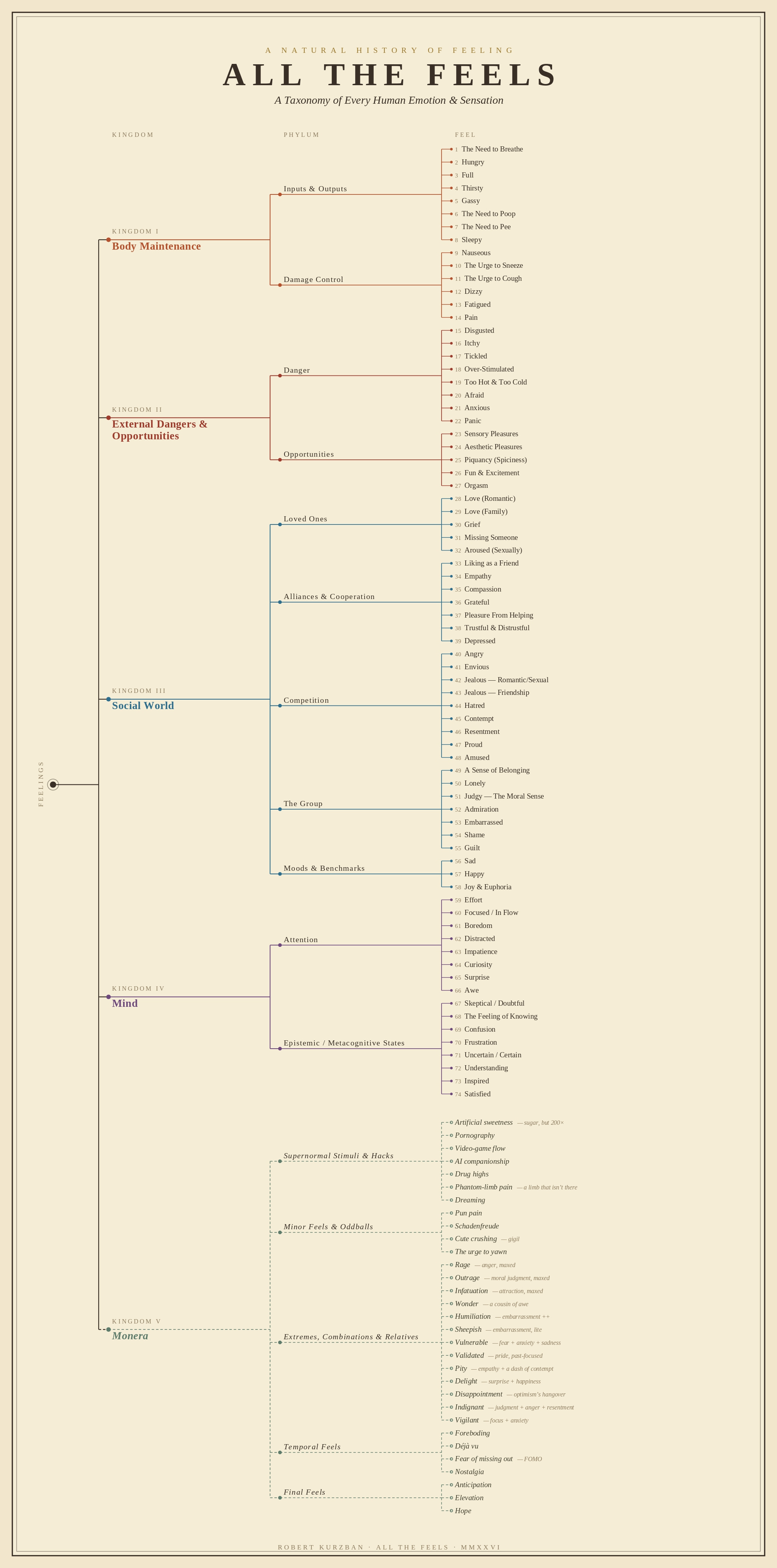
In my new book All the Feels: The Evolved Function of Every Human Emotion and Sensation, I sort all 74 feelings into five kingdoms, Linnaeus-style, by the kind of problem each one solves. Here are 12 that everyone should know about.
Kingdom I: Body Maintenance
1. Breathing isn’t only about oxygen.
If you ever find yourself in a room of pure nitrogen—which you should try very hard not to—here is what will happen. You will steadily have less oxygen in your blood, but your carbon dioxide levels won’t change much: Your cells produce the gas at the usual rate, and you exhale it at the usual rate. Because the urge to breathe depends largely on the level of carbon dioxide, not oxygen, you won’t feel the same urge you would if, for instance, you were underwater, where carbon dioxide builds up as you hold your breath. You’ll feel little or nothing before you pass out.
Measures: partial pressure of carbon dioxide in the blood. Motivates: inhaling.
2. Fatigue is more like a stop signal than a fuel constraint.
As you exercise, the risk of a catastrophic failure such as heat stroke goes up. Your body has a control system designed to persuade you to stop challenging your heart and other systems before that happens. Fatigue is the feeling that takes those measurements and estimates the chance of failure. You can overcome it—you’ll keep running even when you’re tired if you’re being chased by a bear—but the feeling is telling you to stop unless something important is at stake.
Measures: the probability of physical system failure. Motivates: reduce effort.
Kingdom II: External Dangers and Opportunities
3. Disgust is protection from parasites.
Parasites are everywhere and they are dangerous. To this day, even with antibiotics and vaccines, viruses and bacteria take an enormous toll on humanity. Disgust has long been the front-line defense. When we sense evidence that parasites are likely to be present—the smell of decay, the sight of maggots on flesh, the taste of spoilage—we feel disgust and are motivated not to touch or eat whatever triggered it.
Measures: risk of contagion from pathogens or poison. Motivates: avoid physical contact or ingestion.
4. Ticklishness is still mysterious.
Researchers still debate why humans—to say nothing of rats and chimps—are ticklish. We know that people can’t tickle themselves. We know that parents tickle their children, especially when they are very young. And we know that being tickled can result in laughter so strong that it leaves the person being tickled helpless. Could tickling be a way of saying, I’m all up in your business, but I’m not a threat? Could the laughter of tickling be a way of responding, yeah, I get it? Research continues…
Measures: the nearness of a currently harmless other. Motivates: giggle, convulse, evade.
5. You like chili because spices are antimicrobial.
If you are a plant, you cannot run away from pathogens or predators. Plants, therefore, defend themselves using chemical warfare. Many plants contain substances that kill bacteria. If you are an animal—and you are—then you can use these substances yourself by eating the plants with their chemical defenses. One intriguing piece of evidence: cultures in climates where pathogens thrive—hot, wet places—use more spices. The debate isn’t settled, but that might be why humans like spicy—but not too spicy—food.
Measures: the anti-pathogen properties of food. Motivates: eat well-spiced food.
Kingdom III: The Social World
6. Loneliness does not measure how alone you are.
You can be surrounded by people in a city and feel lonely. That’s because loneliness isn’t measuring how alone you are per se. It’s really measuring something far more relevant from an evolutionary perspective: the extent to which people, especially people nearby, value you. And, counterintuitively, being lonely doesn’t exactly motivate you to be more social. Lonely people tend to be on their guard, vigilant for slights and signs of rejection. The reason is that lonely people, everything else equal, have less social support with which to defend themselves. Be careful about giving in to that vigilance: It comes across as coldness, which can undermine the very support the feeling is telling you that you lack.
Measures: others’ beliefs about your value as a relationship partner. Motivates: watch for social threats, and work to raise your value.
7. Embarrassment is for reassuring other people.
Mark Twain famously said, “Man is the only animal that blushes. Or needs to.” He might have had a point. We humans have to struggle to follow all the various rules of etiquette: Silence your phone at the symphony. Wipe your feet when you come in. And if you do break a rule, your reputation will suffer more if people think you violated the norm intentionally, rather than by accident. Embarrassment is the feeling you get when you’ve been seen breaking a norm. The urge to signal that you know you did—quickly and visibly silencing your ringer—is there to let people know it was an accident. Blushing, being involuntary, makes the signal believable.
Measures: being seen violating a norm. Motivates: signaling it was an accident.
8. Admiration is for learning.
Admiration feels like an emotion that’s directed at other people. And in some sense, it is. But admiration’s job is actually all about you. Humans everywhere face a crucial adaptive problem: They have to learn from other people to succeed wherever they find themselves, whether in the arid heat of a desert, the frozen winds of the tundra, or the city streets of Bangalore. A key part of solving that problem is figuring out who, specifically, to learn from. Admiration does this job, directing our attention to the people who have succeeded, so we can learn the secrets of their success.
Measures: size of others’ accomplishments. Motivates: get close to the successful and learn from them.
9. Jealousy isn’t only for lovers.
When you were younger, did you notice when your best friend started spending more time with someone else? If you did, the feeling probably wasn’t a pleasant one. That’s friendship jealousy, a feeling designed to protect valuable relationships. When conflicts emerge, you want your friends to back you: That’s what friends are for. If your close friends become closer to others, that’s a threat. So when others encroach on your existing friendships, you take action, trying to bring your friend safely back into your orbit.
Measures: a friend’s increasing closeness to a rival. Motivates: increase vigilance, deter rivals, increase your appeal as a friend.
Kingdom IV: Mind
10. Boredom motivates task switching.
For many species, the best thing they can be doing is… nothing. Many animals rest or sleep most of the time to conserve energy. The less you use, the less you have to replace. Humans, however, can use their time to learn from others—see admiration, above—practice valuable skills, build social relationships, and much more. For this reason, we humans have a feeling, boredom, that motivates us to find something more rewarding to do than whatever it is we are currently doing.
Measures: the advantage of switching tasks. Motivates: find a new task.
11. Frustration is for taking a new approach.
In April 2015, Lucas Hinch was having trouble with his computer, running afoul of the so-called blue screen of death. Hinch found all of it “extremely frustrating.” At the end of his rope, he took his Dell XPS 410 into an alleyway and fired eight rounds from his 9mm pistol into the machine, ending its functional life. Far from experiencing regret, Hinch was quoted by the Los Angeles Times as saying that “Angels sung on high,” and that the death of the computer was “glorious.” Do not do this. But do remember that if you’re feeling frustration, that’s a good signal that whatever you’re doing to solve your current problem isn’t working.
Measures: the probability that a problem cannot be solved with the current method. Motivates: desist from the current strategy and either end the task or adopt a new, often more extreme, approach.
Kingdom V: Monera
Some feelings defy classification. The fifth kingdom, Monera, holds the leftovers.
12. Nobody knows why you want to squeeze something cute.
Many people report feeling the odd urge to squeeze cute babies or animals. The feeling isn’t an American quirk; Tagalog has a word for it: gigil. And while there is a tiny scientific literature on the topic, no one really knows why we have this feeling.
And that mystery is part of why learning about all human sensations and emotions remains so interesting. (See: curiosity.)
Measures: unknown. Motivates: squeezing, apparently.
Bonus Content: A Taxonomy of Every Emotion and Sensation
Robert Kurzban is an evolutionary psychologist who trained with Leda Cosmides and John Tooby. He was a professor of psychology at the University of Pennsylvania for over a decade, has published more than a hundred scientific papers, and is the author of Why Everyone (Else) Is a Hypocrite and co-author of The Hidden Agenda of the Political Mind. He writes The Living Fossils, on what evolutionary thinking explains about human suffering and well-being. The twelve feels above are drawn from All the Feels: The Evolved Function of Every Human Emotion and Sensation, out now, which does this for all 74—every claim sourced, with the references collected at allthefeelsbook.com.
Related Reading From the Archive
12 Things Everyone Should Know About Evolutionary Psychology

This is the latest post in my “12 Things Everyone Should Know” series. You can access the full collection here.
12 Things Everyone Should Know About IQ

This is the first post in my “12 Things Everyone Should Know” series. You can access the complete collection here.

