

Universities have leaned left politically since at least the 1960s. In itself, that’s not a problem. Different professions attract different kinds of people. Journalists and entertainers lean left; soldiers and farmers lean right. Why should academics have to stand bolt upright?
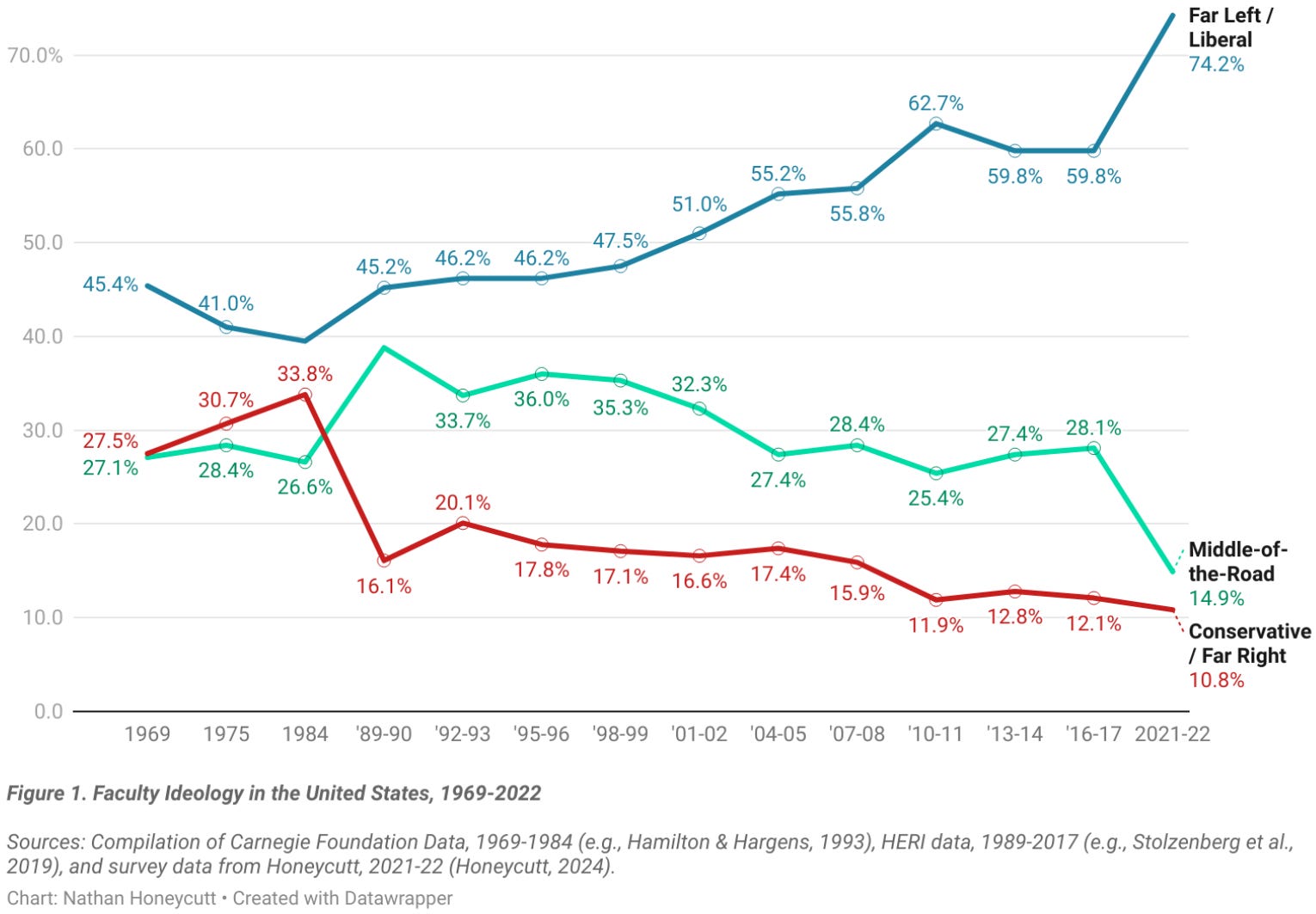
But there’s a difference between a lean and a monopoly - and American academia is rapidly approaching the latter. According to a recent paper by Nathan Honeycutt, 74% of US faculty identify as liberal, 15% as moderate, and only 11% as conservative. Remarkably, more faculty identify as “far left” or “very liberal” than with any position right of center.
This matters because intellectual progress depends on disagreement. When dissenting voices vanish, institutions become vulnerable to groupthink. And if universities lose the capacity to challenge their own assumptions, their claim to be society’s truth-seeking institutions starts to look increasingly shaky.
In this post, I’ll outline five key findings about the political makeup and trajectory of academia, captured in five fascinating graphs.
1. Even the Center is Vanishing
The first graph shows the increasing dominance of the left in academia from the late 1960s to the early 2020s. As you can see, liberals and leftists have always outnumbered everyone else, but the skew has grown increasingly strong over time. And not only have conservatives become vanishingly rare, so have centrists. That’s how complete the left’s dominance is: Even moderates are now a fringe group in academia.