



In Case You Missed It…
An analysis of data from a Swiss employment website found evidence of discrimination against women in male-dominated occupations - and discrimination against men in female-dominated occupations.
Interestingly, the penalty for crossing occupational gender lines was larger for men than for women. After controlling for qualifications and other characteristics visible to recruiters, women were around 7% less likely than men to be contacted in the five most male-dominated occupations, whereas men were around 13% less likely than women to be contacted in the five most female-dominated occupations.
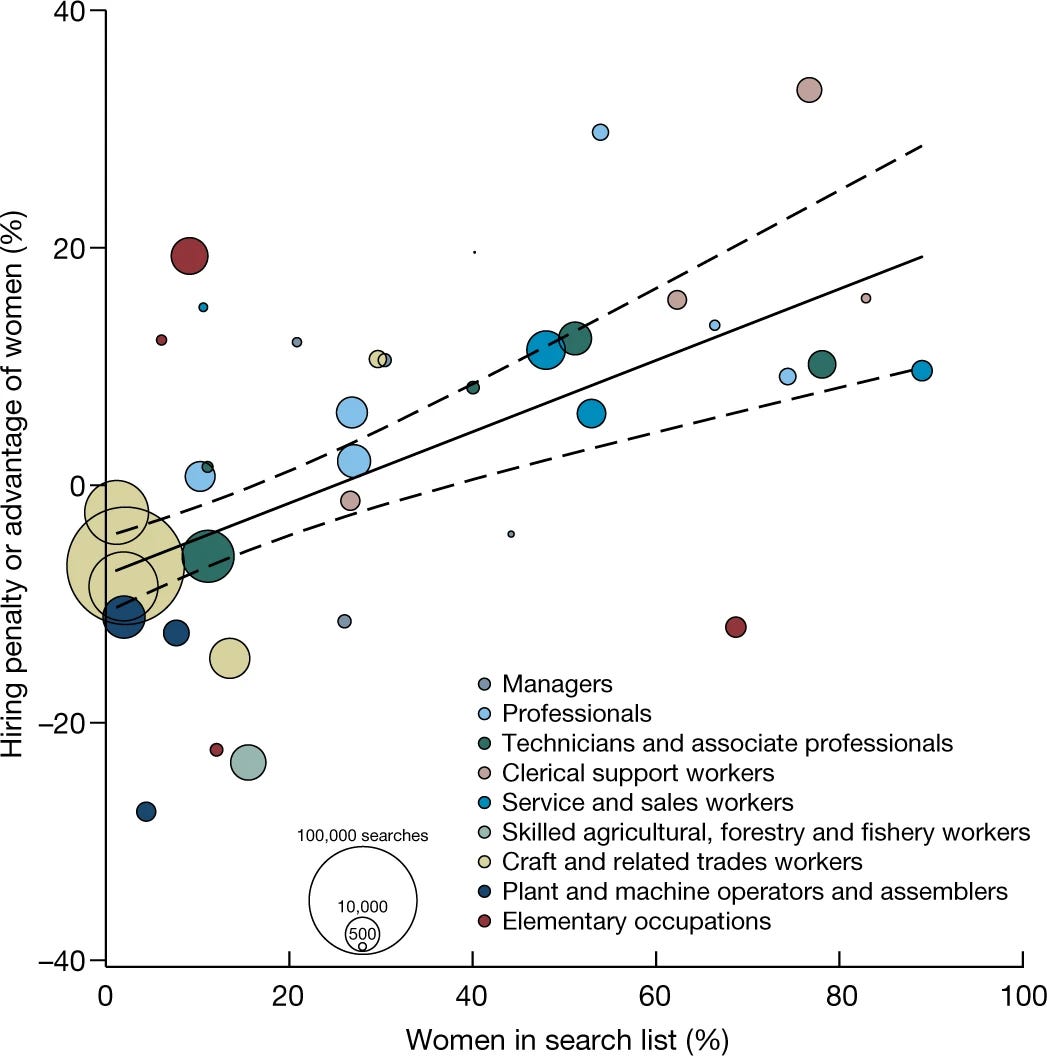
The findings come from a paper by Dominik Hangartner, Daniel Kopp, and Michael Siegenthaler, published in the journal Nature. They challenge the familiar idea that men are always the beneficiaries of gender discrimination, and women always the victims. In this case, both sexes faced a penalty for seeking work in occupations dominated by the other.
Follow me on Twitter/X for more psychology, evolution, and science.
Further Reading
I discuss occupational gender gaps in Chapter 10 of my new book, A Billion Years of Sex Differences. You can read the first chapter here for free.
I’ve also written several academic papers with Lewis Halsey on sex differences in STEM representation. The main one is this 2021 paper in the European Journal of Personality:
Stewart-Williams, S., & Halsey, L. G. (2021). Men, women and STEM: Why the differences and what should be done? European Journal of Personality, 35, 3-39. https://doi.org/10.1177/0890207020962326 [Free version]
The paper was published alongside two commentaries - one favorable, one not.
Ceci, S. J., Kahn, S., & Williams, W. M. (2021). Stewart-Williams and Halsey argue persuasively that gender bias is just one of many causes of women’s underrepresentation in science. European Journal of Personality, 35, 40-44. https://doi.org/10.1177/0890207020976778
El-Hout, M., Garr-Schultz, A., & Cheryan, S. (2021). Beyond biology: The importance of cultural factors in explaining gender disparities in STEM preferences. European Journal of Personality, 35, 45-50. https://doi.org/10.1177/0890207020980934
Here’s our response to the not-favorable commentary:
Stewart-Williams, S., & Halsey, L. G. (2022). Not biology or culture alone: Response to El-Hout et al. (2021). European Journal of Personality, 36, 991–996. https://doi.org/10.1177/08902070211022477 [Free version]
From the Archive
Fifty Years of Gender Bias

How much gender bias is there in hiring decisions? Has gender bias in hiring decisions declined over the last half-century? And how accurate are people’s beliefs about levels of gender bias in hiring decisions? These are some of the questions that inspired a fascinating new