


In Case You Missed It…
Swearing Makes You Stronger, the True Origins of Narcissism, and Sex Differences in Self-Improvement
This is the sixth excerpt from my book, A Billion Years of Sex Differences. You can access the full collection here, and pick up a copy of the book here.
In this installment, I explore three common challenges to the validity of the sex binary and the concepts of “female” and “male.”
Intersex conditions: conditions in which people - or other animals - have a mixture of female-typical and male-typical traits
Hermaphroditic species: species in which individuals have both female and male reproductive functions, or change sex during the course of their lifetimes
Within-sex variation: the fact that, within each so-called sex, we see enormous variation in every trait, and substantial overlap between the sexes
I explain why none of these phenomena undermine the female-male distinction - and indeed why they only make sense if we assume the distinction’s validity. I also argue that we can fully acknowledge biological diversity without abandoning the concepts of “female” and “male,” and that rejecting the sex binary doesn’t make biology more humane or accurate, but only less intelligible.
The Case for the Sex Binary
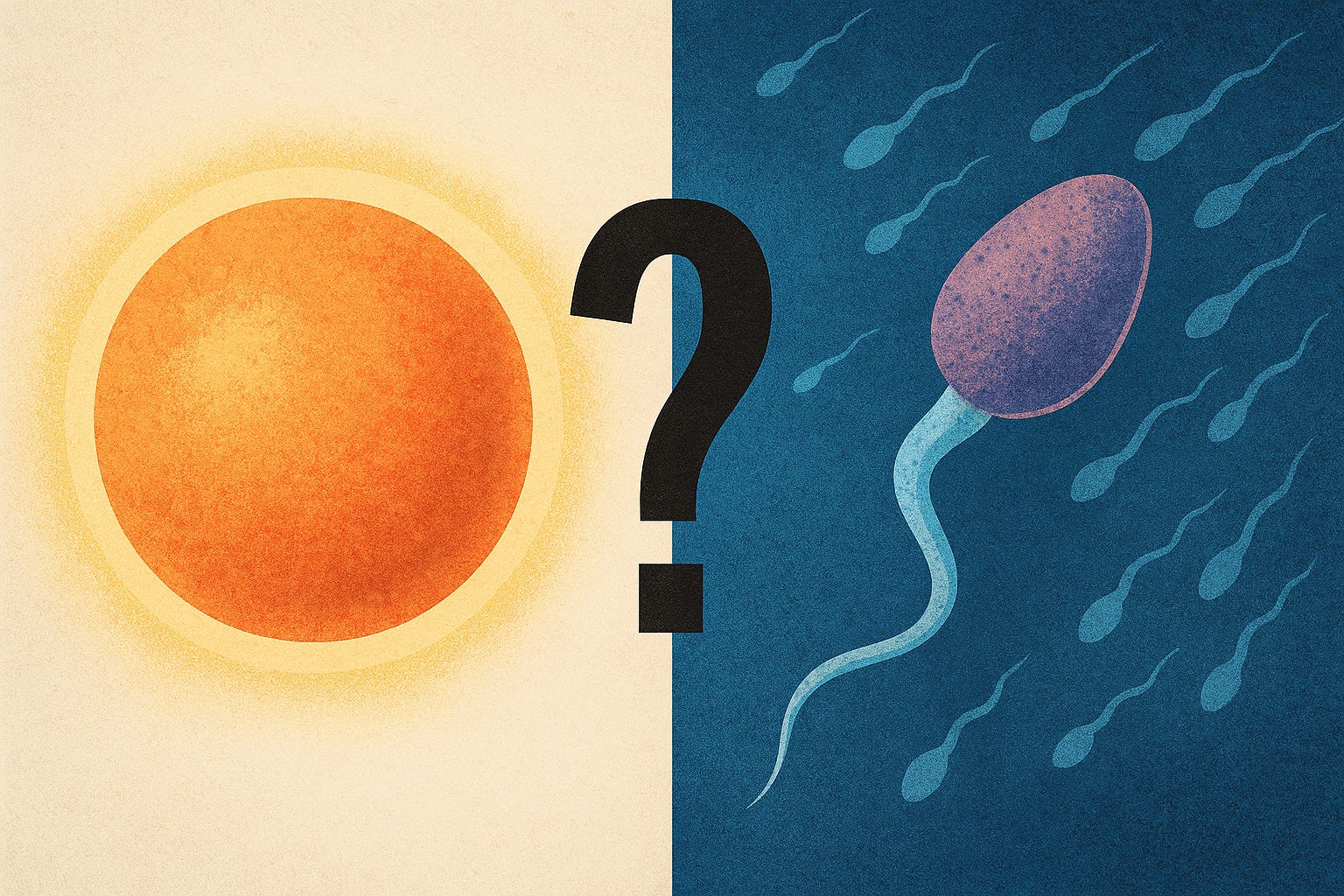
We’ve now got definitions of female and male that work not only for human beings, but for every sexually reproducing species on the planet. Long story short, individuals designed to produce eggs during the reproductive phase of life are females; individuals designed to produce sperm during the reproductive phase of life are males.
We can’t rest on our laurels just yet, though. In pursuing these definitions, we’ve assumed without question the validity of the female–male distinction and the binary concept of sex. Some, however, question the assumption. The questioners fall into two main camps: reformers and abolitionists. Reformers want to preserve the concept of sex but reconceptualize it as a spectrum rather than a binary. Abolitionists want to dismantle and discard it; in their view, female and male are merely arbitrary social constructs, or even ideological impositions of Western colonial powers designed to justify bias. The common core of both positions is the conviction that the simple female–male binary is no longer fit for purpose.
At first glance – and, as we’ll see, at later glances as well – this all seems rather implausible. Every culture has the concepts of female and male, and every language has synonyms for words assuming these concepts: boy and girl, man and woman, aunt and uncle. Sure, some cultures also have categories for people who don’t quite fit the expectations associated with their sex. But all have the Big Two categories of female and male. The most plausible explanation for this cross-cultural universality is that the categories track something real in nature, which people everywhere find it useful to track. And not only people! Other animals, including dogs and elephants, spontaneously categorize humans in terms of these supposedly arbitrary social constructs.
Still, to be fair to the critics of sex, several lines of evidence do seem to challenge the validity of the female–male distinction. Let’s consider three.