


Have you noticed that men are meatheads? More precisely, have you noticed that men and women both tend to be meatheads, but that the average level of meatheadedness is higher in men than women?
I refer, of course, not to cognitive ability or oafishness, but to the propensity to eat meat. Most men and most women like meat, and eat it from time to time. Men, however, tend to eat more of it than women, even controlling for sex differences in overall caloric intake.
Where does the meat-munching gender gap come from? For a lot of people, the automatic assumption is that it comes from culture. One popular theory, for instance, explains the difference in terms of gender norms: Eating meat is seen as a masculine tendency, and therefore men do more of it. The norm comes first and then the behavior.
But like a lot of norm-based explanations, this one has always seemed back-to-front to me. Why assume that men eat more meat because eating meat is seen as masculine, rather than that eating meat is seen as masculine because men eat more meat? More generally, why assume that the sex difference comes from culture and culture alone?
There’s another possibility: that men have a stronger inbuilt lust for meat, perhaps because men and women have somewhat different dietary needs. Sure, once people notice that men are bigger meat-eaters, this may come to be a cultural expectation, and men may play up their love of meat as a way to say “Look what a manly man I am!” But we should at least entertain the possibility that the initial sex difference has an evolutionary basis.
How can we know, though? One way to start chipping away the problem is to look at men and women’s meat-eating habits across cultures. Most of the research on meatheadedness has been done in the West. But by widening the lens to take in other regions as well, we can begin to address the nature-nurture question.
The trick is that the culture-only/gender-norm explanation makes very different predictions than the evolved-tendency-modulated-by-culture explanation. First, if the stronger male preference for meat seen in the West is purely due to culture, we’d expect to find considerable cross-cultural variation in the sex difference: In some cultures, men would eat more meat; in others women would; and in others still, there’d be no difference. On the other hand, if the difference has its roots in our evolved nature, we’d expect to find it in all or most cultures. Second, if the stronger male preference for meat is a product of traditional gender norms, we’d expect the sex difference to be larger in cultures with stricter gender norms, and smaller in those with less strict ones. And if we don’t find that pattern, this would cut against any explanation invoking gender norms.
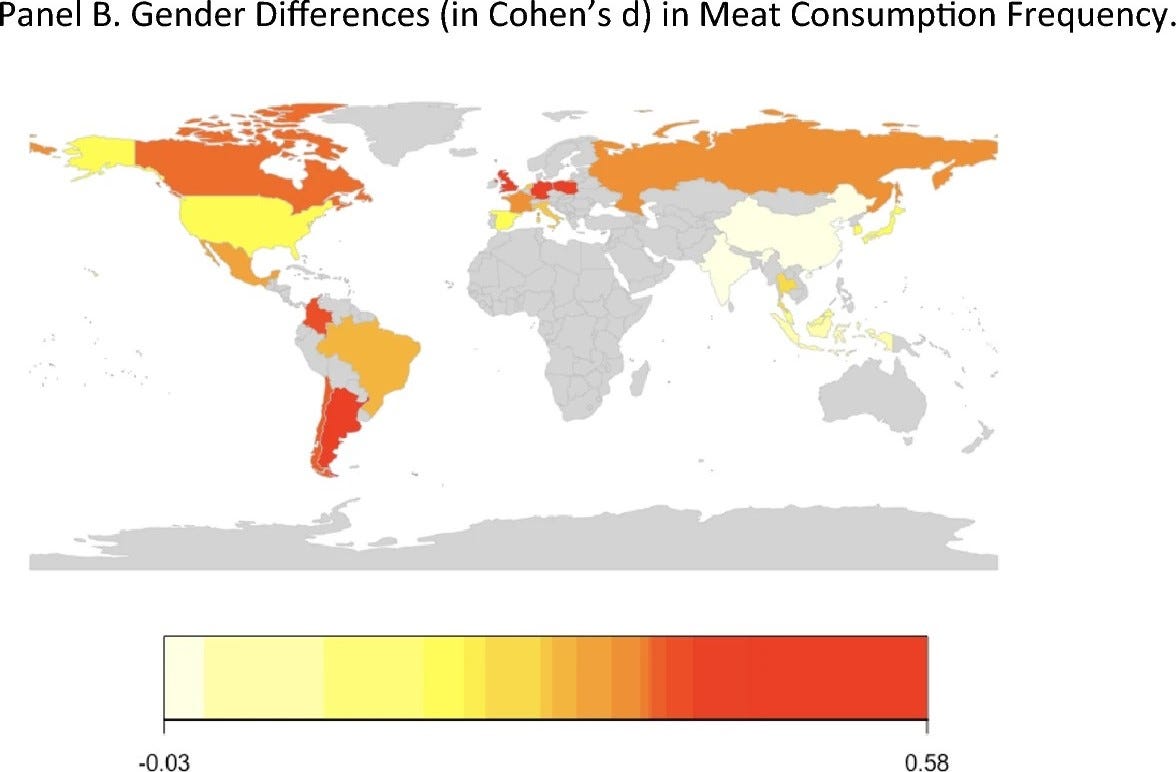
A new paper by Christopher Hopwood and colleagues tackles these very questions. The researchers recruited 20,966 people from 23 nations spread across four continents, and asked them about their typical levels of meat consumption. They then obtained measures of each nation’s level of gender equality and economic development.
The findings went against what we’d expect if the Western meat-eating sex difference were just due to culture or gender norms. First, the sex difference was found in the vast majority of nations. It wasn’t found in all; in China and India, there was no sex difference. However, in every other nation bar none, men ate more meat than women - and in no nation did women eat more than men. This isn’t what we’d expect if the difference were shaped entirely by arbitrary cultural norms.
Second, the sex difference in meat consumption turned out to be larger, rather than smaller, in wealthier, more gender-equal nations, as shown in the graph below. (HDI is the Human Development Index; GGGR is an index of gender equality reported in the Global Gender Gap Report 2021.) This counterintuitive pattern isn’t unique to meat-eating; it’s been found for sex differences in a wide variety of traits, and is known as the gender-equality paradox. But it’s the opposite of what we’d expect if the sex difference in meat consumption were a product of traditional gender norms.
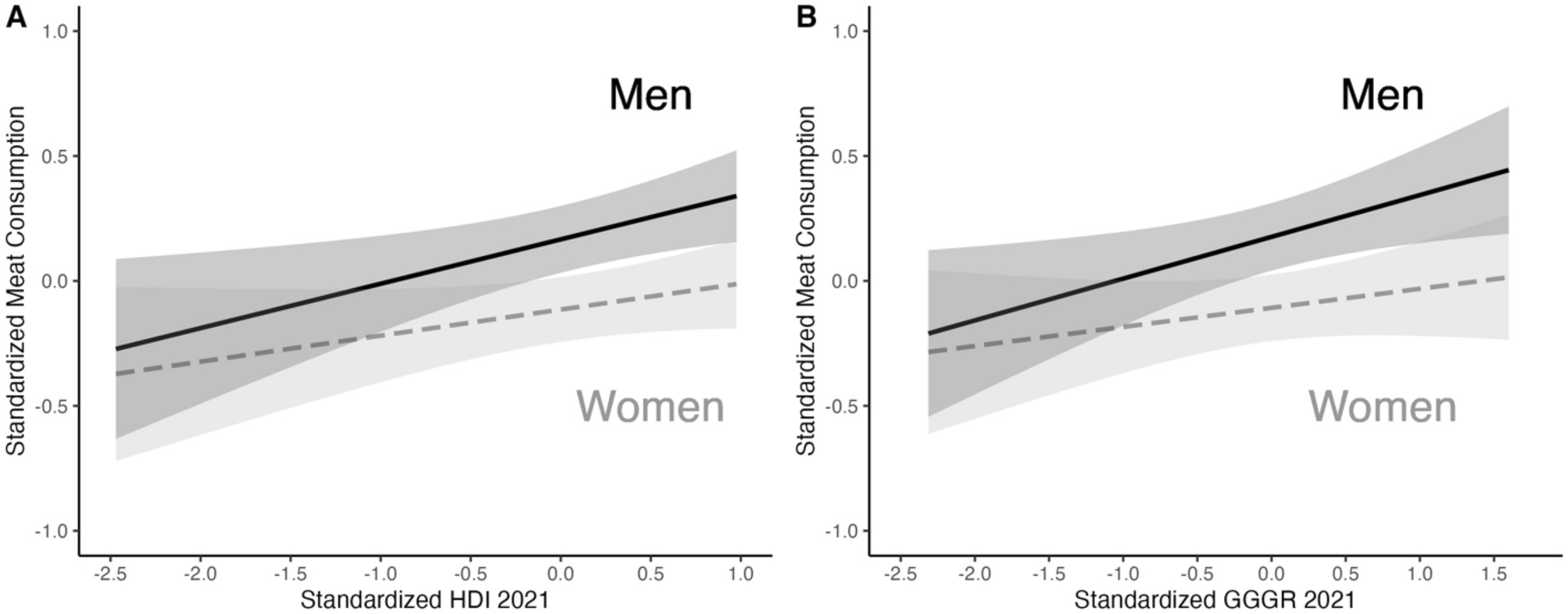
Hopwood and co.’s results aren’t unassailable evidence for an evolutionary contribution to the meat-munching gender gap; aside from anything else, they didn’t find the sex difference in every nation. Still, the results should nudge up our confidence that nature is an important part of the explanation - and they should also nudge down our confidence that the sex difference comes entirely from gender norms. Culture clearly influences the sex difference, but the gender-norm theory apparently does a poor job of telling us how.
If the gap has an evolutionary explanation, why doesn't it go the other way?
Iron deficiency anemia is an important risk factor for maternal mortality. If there's a limited amount of meat available it seems as if it would be optimal for women to eat more of it.
Hypothesis: men traveled far in groups to track and kill meat. Far cheaper to cook and eat some of it before returning with the rest to women. So they always had the lion's share. Upon return if it's divided evenly, men will always get more.
This helped men maintain muscle mass necessary for physicality of bringing down the meat and traveling far to find it.
Based partly on seasons 5-7 of, "Alone".