



A new Nature paper by Ali Akbari, David Reich, and colleagues explores recent evolution - that is, evolution in the last 14,000 years - in West Eurasians.
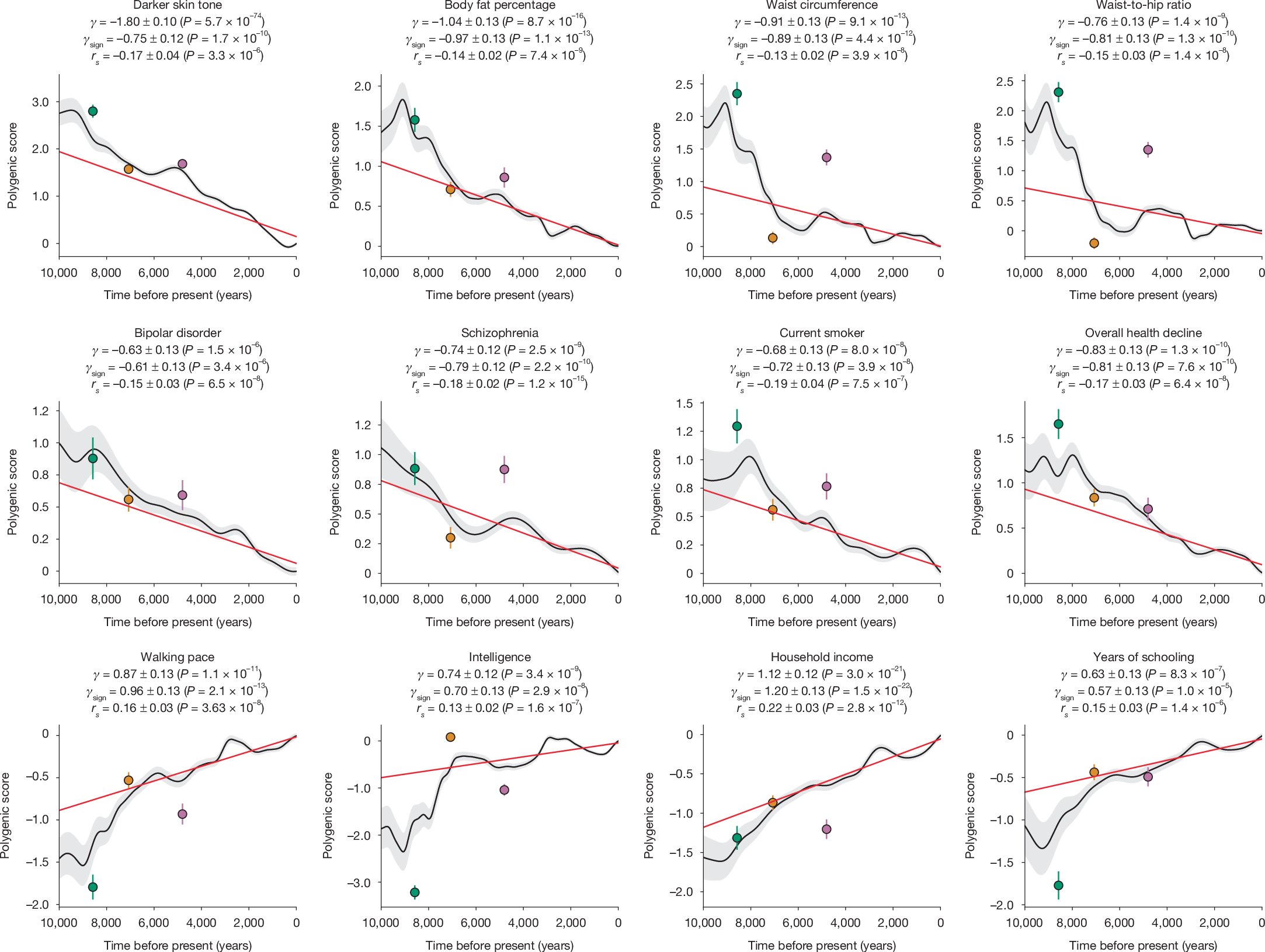
Comparing the genomes of ancient West Eurasians to those of modern ones, they found strong evidence that gene variants associated with intelligence were under positive selection, whereas gene variants associated with body fat, darker skin, and disorders like schizophrenia and bipolar were under negative selection.
The body-fat finding is particularly interesting; it fits with the idea that farming reduced the need to stockpile fat on the body, and thus that farming populations evolved to do less of it.
Here’s the abstract:
Ancient DNA has transformed our understanding of population history, but its potential to reveal as much about human evolutionary biology has not been realized because of limited sample sizes and the difficulty of distinguishing sustained rises in allele frequency increasing fitness—directional selection—from shifts due to migrations, population structure, or non-adaptive purifying or stabilizing selection. Here we present a method for detecting directional selection in ancient DNA time-series data that tests for consistent trends in allele frequency change over time, and apply it to 15,836 West Eurasians (10,016 with new data). Previous work has shown that classic hard sweeps driving advantageous mutations to fixation have been rare over the broad span of human evolution. By contrast, in the past ten millennia, we find that many hundreds of alleles have been affected by strong directional selection. We also document one-standard-deviation changes on the scale of modern variation in combinations of alleles that today predict complex traits. This includes decreases in predicted body fat and schizophrenia, and increases in measures of cognitive performance. These effects were measured in industrialized societies, and it remains unclear how these relate to phenotypes that were adaptive in the past. We estimate selection coefficients at 9.7 million variants, enabling study of how Darwinian forces couple to allelic effects and shape the genetic architecture of complex traits.
You can access the paper here for free.
Follow me on Twitter/X for more psychology, evolution, and science.
How You Can Support the Newsletter
This post was free to read for all. If you like what I’m doing with The Nature-Nurture-Nietzsche Newsletter, and want to support my work, there are several ways you can do it.
Like and Restack: Click the buttons at the top or bottom of the page to boost the post’s visibility on Substack.
Share: Send the post to friends or share it on social media.
Upgrade to Paid: A paid subscription gets you:
Full access to all new posts and the archive
Full access to excerpts from my book A Billion Years of Sex Differences
Full access to exclusive content such as my “12 Things Everyone Should Know” posts, Linkfests, and other regular features
The ability to post comments and engage with the growing N3 Newsletter community
If you could do any of the above, I’d be hugely grateful. The support of readers like you helps keep this newsletter going and growing.
Thanks!
Steve
Related Reading From the Archive
Natural Selection in Modern Humans

A new paper in the journal Behavior Genetics looks at natural selection in three generations of modern Americans. The graph below shows the key results. Specifically, it shows the strength of selection for a range of traits based on the sample’s polygenic scores (PGS; see
12 Things Everyone Should Know About Evolution

This is the latest post in my “12 Things Everyone Should Know” series. You can access the full collection here.
12 Things Everyone Should Know About Evolutionary Psychology

This is the latest post in my “12 Things Everyone Should Know” series. You can access the full collection here.
Razib Khan talked extensively about this paper on his substack today. It's pretty clear there has been a lot of human evolution over the past 10,000 years. It certainly didn't stop. I got the impression certain allele frequencies didn't only monotonically change over this period but some waxed and waned.
https://www.razibkhan.com/p/10000-years-of-selection-in-western
I read that in the pre-industrial era, farming communities often suffered catastrophic famines when a crop failed. You could say farming therefore didn’t eliminate the need to conserve energy as fat, but maybe in the case of a crop famine, there is no way to store enough fat to avoid starvation over the course of a whole growing season, so it becomes less adaptive to store a lot of fat compared to the case of a hunter gatherer whose involuntary fasts last much shorter. Another possibility is that farmers have less of a need to store away food energy because they don’t burn as many daily calories as hunter-gatherers. That is debatable, as modern hunter gatherers spend a lot of time at leisure, according to researchers, and traditional agriculture can be back-breaking work