


This is the eighth excerpt from my book, A Billion Years of Sex Differences. You can access the full collection here, and pick up a copy of the book here.
In this installment, I discuss a phenomenon I call the tail-of-the-distribution effect. This refers to the fact that sex differences are often larger among the minority at the extremes than the majority in the middle: the shortest and tallest, for instance; the most aggressive and the least. The tail-of-the-distribution effect is one of several reasons that sex differences can, paradoxically, have large real-world effects even when they’re relatively small. I’ll explore some of the other reasons in coming weeks.
First things first, though, an update: A Billion Years of Sex Differences was mentioned in The New Zealand Listener! This has been a lifelong dream of mine, as my family always used to get the Listener when I was a kid. To my surprise, being mentioned there meant more to me than being mentioned in The New York Times or Rolling Stone. (Admittedly, the latter mentions were somewhat tarnished by the reason for them - namely that my last book, The Ape That Understood the Universe, was a favorite of Luigi Mangione, the guy who killed the UnitedHealthcare CEO.)

Anyway, time for today’s excerpt!
How Sex Differences Can Be Large Even When They’re Small
Having argued that sex differences in our species are generally modest, let’s now balance things out by looking at four ways in which, paradoxically, even small sex differences can have important societal impacts.
1. Sex Differences Are Often Larger at the Extremes
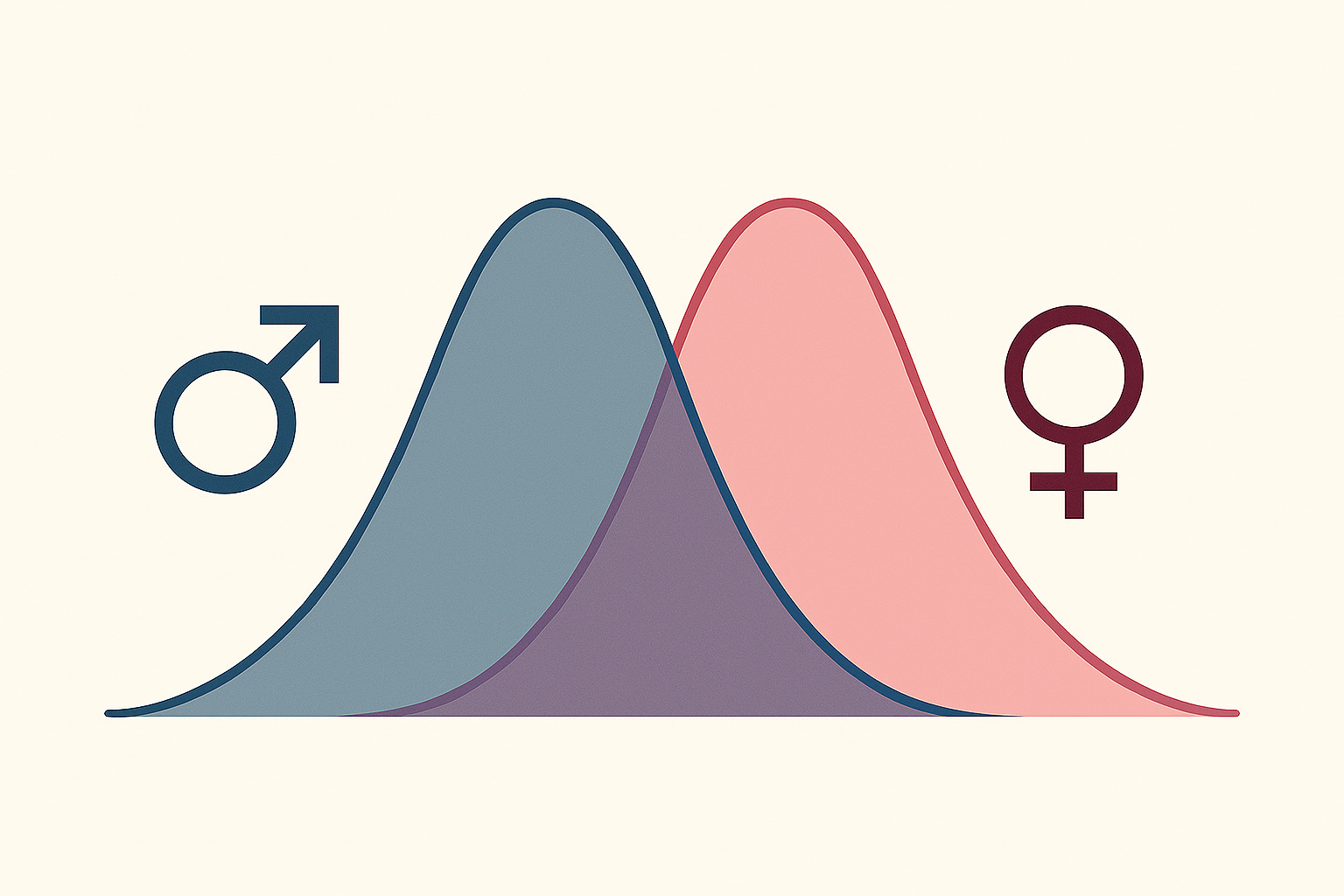
For normally distributed data, even small differences in the average scores of any two groups are associated with large differences among the minority at either extreme. I call this the tail-of-the-distribution effect.
A good example is the sex difference in height. At the mean, as mentioned, this difference isn’t particularly big. If we see a woman who’s the average height for men, we don’t faint from shock. However, if we look at the tallest people in the world – people who are, say, two metres tall or above – we find that virtually all of them are men. Of course, very few men attain those lofty heights. But thousands more men do than women.