


This is the latest excerpt from my book, A Billion Years of Sex Differences. In it, I tackle one of the longest-standing questions in evolutionary biology: Why, in many species, do females and males differ in size?
You can access the full collection of excerpts here, and pick up a copy of the book here.
Sizing Up the Sexes
A common trend in the animal kingdom is that the sexes differ in size. People tend to assume this means males are larger, presumably because that’s what we find in our own species. Most of the time, however, it’s the opposite: Males are the midgets, and females the larger sex. This is the case with many insects and most spiders, as well as most fish, many frogs, and most birds of prey. It’s also the case with blue whales, which has the interesting implication that the largest individual animal on the planet is probably a female.
Why do females usually dwarf the males? According to Darwin, the main reason is that larger females can produce more eggs. Largeness isn’t usually as advantageous to males, so males tend to be smaller. Sometimes, in fact, they’re tiny compared to their female counterparts. For example, male green spoonworms are around 200,000 times smaller than the females, which, as the evolutionary biologist Olivia Judson remarked, is equivalent to a human male being as big as the eraser on the end of a pencil.
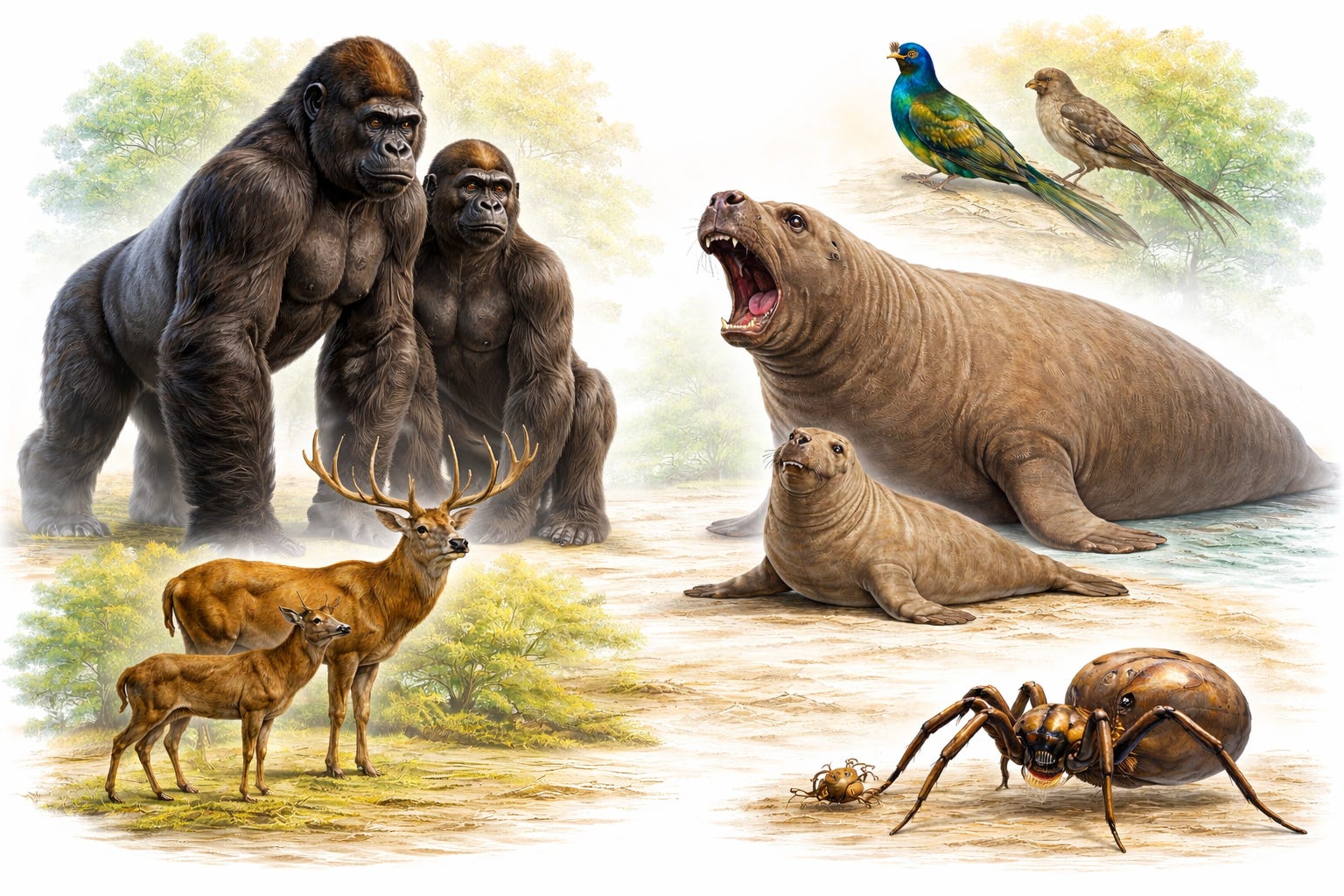
But although females are larger in most species, in a minority, the males are – a pattern that would seem decidedly odd to a scientifically minded green spoonworm. What the spoonworm would eventually figure out is that greater male size, on the rare occasions it’s found, is usually a product of the same selective process that brought us the deer’s antlers and grumpy demeanour: intrasexual selection. In many species, being larger gives males an advantage in fights with same-sex rivals. Winning more fights means siring more offspring, and thus the average male size in these species increases. Sometimes, it even increases to the point where the males become the larger sex.
Selection for fighting ability doesn’t always favour larger males. For species that fight in midair or underwater – including many birds, bats, and marine mammals – it’s sometimes better to be smaller and thus more agile in this three-dimensional fighting space. Still, for species that fight in two dimensions, being bigger often gives you the upper hand. This is true, for instance, for gorillas, red deer, and elephant seals. And it’s also true for us. That’s why we have weight classes in boxing: They’re not to protect the big guys from the little guys; they’re to protect the little guys from the big.