

Most mammals fit a familiar pattern: Males compete for females; females choose from among the males on offer. Humans, at first glance, seem to follow suit. But look a little closer, and a more interesting picture emerges - one in which both sexes compete, both sexes choose, and the usual story about the evolution of human sex differences needs a major overhaul.
In this excerpt from my book A Billion Years of Sex Differences, I outline a theory I developed with Andrew Thomas about how the extraordinary demands of raising human offspring helped transform our species from a fairly typical mammal into something closer to a pair-bonding bird: a species characterized by mutual mate choice, in which both sexes have their equivalents of the peacock’s tail and the deer’s antlers.
You can access the full collection of excerpts here, and pick up a copy of the book here.
The Evolution of Mutual Mate Choice
In many ways, as you’ve no doubt already noticed, our species fits the same mould as most other animals, and particularly other mammals. For a start, the minimum biological contribution required to make a new human being is larger for women than men. Women’s minimum is a nine-month pregnancy and – until recently – several years of breastfeeding. Men’s minimum is notably more modest: in principle, as little as a single sex act. The philosopher and psychologist Cordelia Fine captured the asymmetry like this:
As we all know, the two parents of every human baby are owed grossly unequal debts for the miracle of life. According to my rough calculations, the mother is due more or less a lifetime of unwavering gratitude in return for the donation of a nice plump egg, forty weeks or so full bed and board in utero, many hours of labour, and several months of breast-feeding. But for the father, who by the time of birth may have supplied nothing more than a single sperm, a quick appreciative nod might well seem sufficient.
(Note that Fine isn’t a fan of the evolutionary approach to sex differences, and that the passage above comes from a book critiquing it. But she’s a great writer, and I love the passage!)
As a result of the sex difference in minimum parental investment, men can potentially have many more offspring than women. Of course, the fact that men can potentially do this doesn’t necessarily mean any do. But sociological, anthropological, and genetic evidence indicates that, in virtually every society, men’s reproductive output is more variable than women’s, with more men than women having many offspring and more men than women having none. And just as we’d expect in such a species, humans exhibit most of the sex differences found in our nonhuman kin: Women are often more selective about their sexual partners, men are often more aggressive, and so on – the usual list. At first glance, then, we seem to be typical mammals with typical mammalian sex differences.
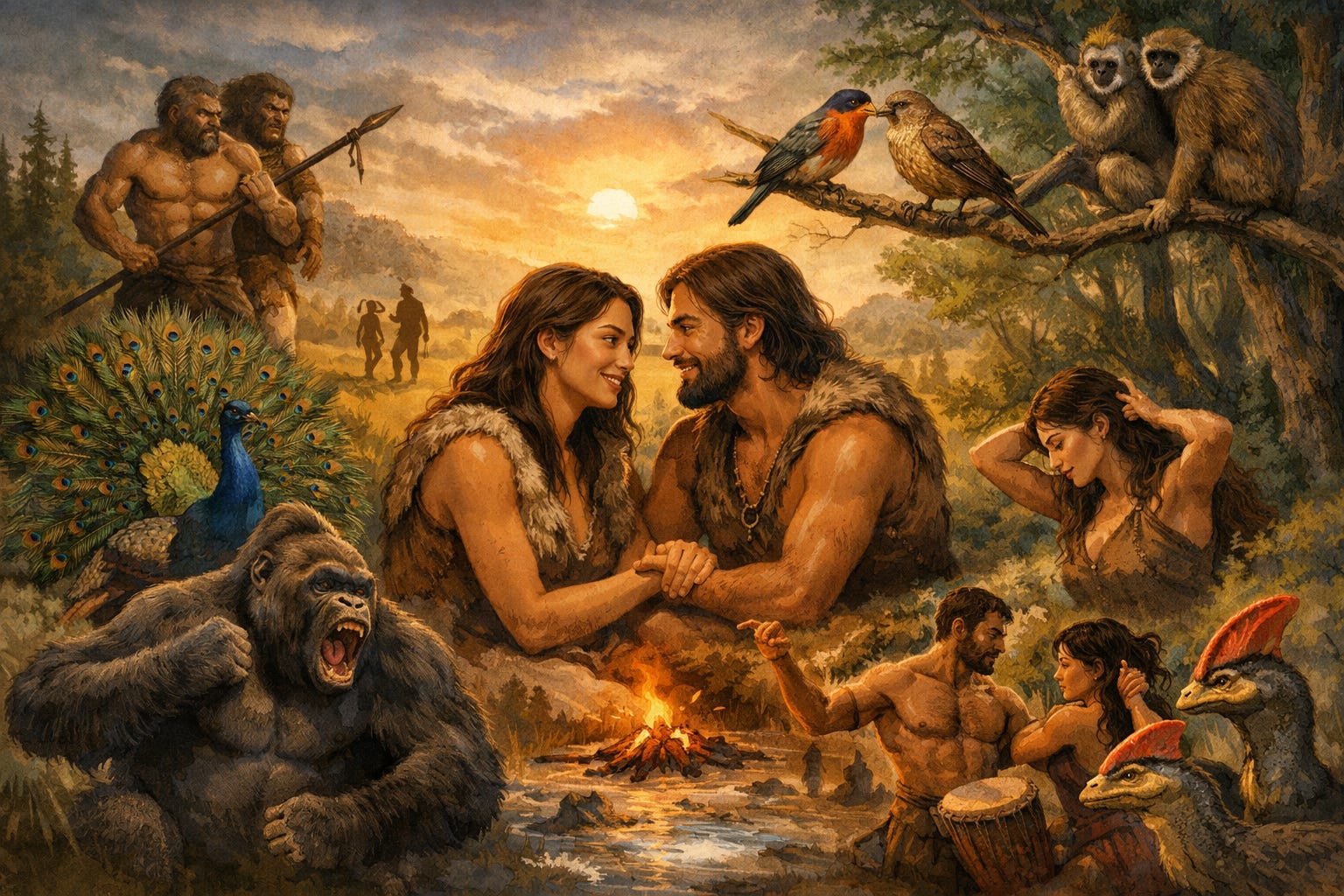
But it’s time for a twist in the plot. Humans, you see, turn out to be anything but typical. As I argued in a 2013 paper in Psychological Inquiry, co-authored with my then-PhD student Andrew Thomas, there are two main ways we can construe humans’ evolved sexual psychology. The first we dubbed the males-compete/females-choose (or MCFC) model. According to this model, humans are a highly dimorphic species, in which males compete for mates, and females choose from among the males on offer. The second model we called the mutual-mate-choice (or MMC) model. According to this model, humans are a relatively monomorphic species: a species in which both sexes are choosy about their long-term mates, and both compete among themselves for the most desirable mates in their league. As you’ve probably guessed, we argued that the latter is a better fit for our species.
Certainly, women are often choosier than men, and certainly, men often compete in more extreme and risky ways. However, these are differences of degree rather than kind, and compared to most other mammals, sex differences in our species are modest. Rather than being highly dimorphic critters like gorillas or red deer, humans are somewhat monomorphic ones, like gibbons or grebes. Here’s our five-step explanation for how we came to be this way.