



A fascinating new paper explores the evolutionary psychology of parental care, and comes to two major conclusions.
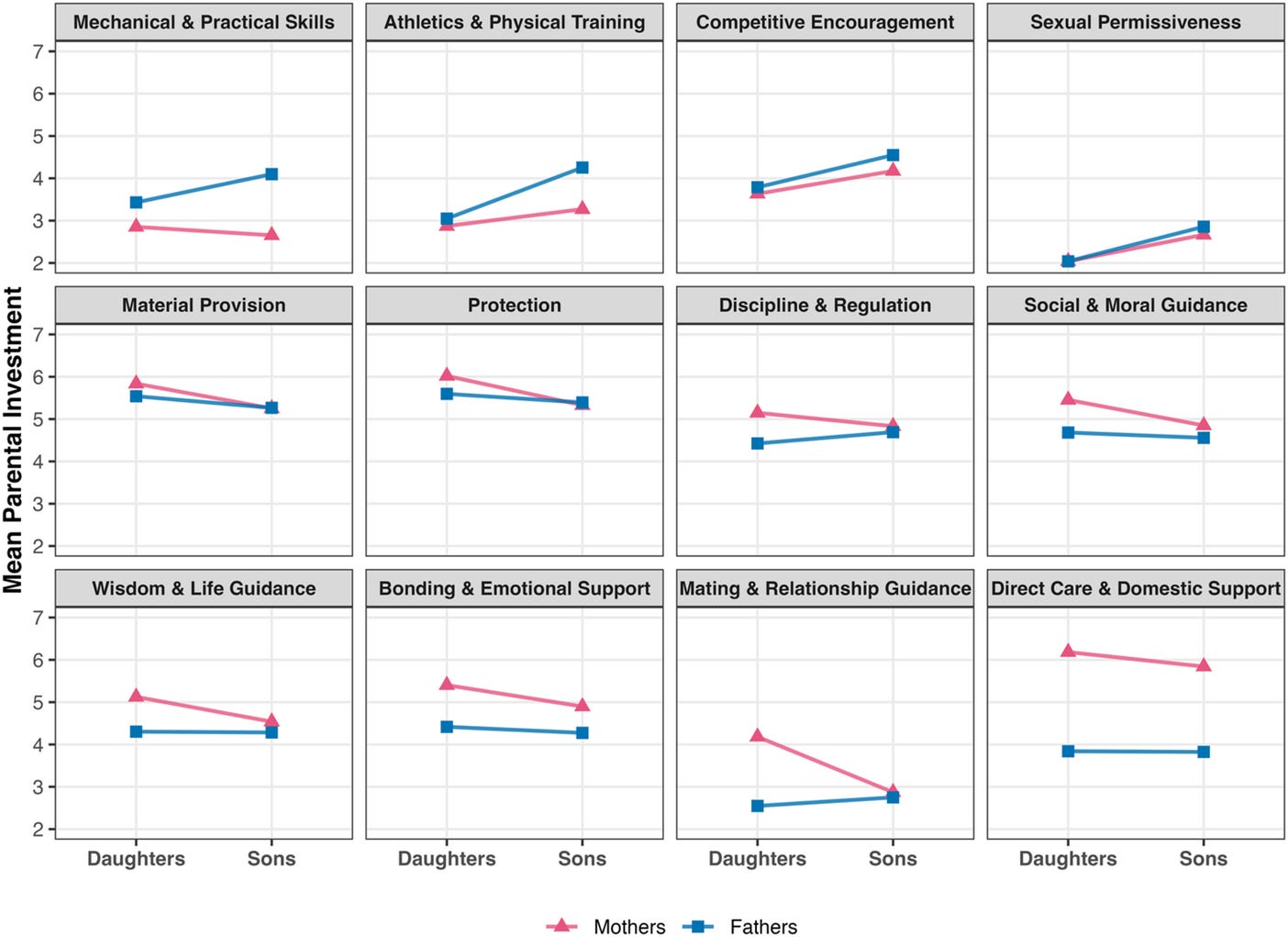
First, parents differ in how they treat their sons vs. their daughters: Daughters receive more relationship guidance, protection, and emotional support, whereas sons receive more athletic training and encouragement to be competitive. Sons also have fewer restrictions on their sexual behavior.
Second, mothers and fathers differ in the types of parental care they provide. Mothers are more involved in direct care, bonding, social/moral guidance, and discipline. Fathers are more involved in athletics and in teaching mechanical and practical skills.
These findings are summarized in the following graph.
According to study authors Francis (Sid) Dougan, William Costello, and David Buss, these results make good evolutionary sense. Throughout our evolutionary history, daughters and sons faced different adaptive problems, and needed different kinds of parental input. At the same time, evolved differences between men and women meant that fathers were often better equipped to provide certain forms of input, while mothers were better equipped to provide others.
Here’s the abstract of the paper:
Most research on human parental investment has focused on overall parental effort or resource allocation, overlooking the fact that human investment spans a broad suite of material, instructional, and social forms of investment. This array of investment enables examination of how evolutionary processes have elaborated parental care into distinct domains. Where daughters and sons historically faced different recurrent adaptive problems, selection should have favoured biases in parental investment that cultivate in each offspring the competencies relevant to its sex-specific challenges (e.g., navigating greater reproductive costs for daughters; navigating contest competition for sons). Likewise, mothers and fathers should differ in parental investment domains where their own evolutionary and life histories afforded greater sex-specific expertise. To test these hypotheses, we used linear mixed-effect models to analyse 105 adults’ (49.5% female) ratings of parental investment received across 73 behaviours organised into 13 domains. Results were largely consistent with predictions. Daughters received more parental investment in mating and relationship guidance, protection, and material support. Sons received greater parental investment in athletic training, permissiveness regarding sexual behaviour, and competitive encouragement. Mothers invested more than fathers in direct care, bonding, social and moral guidance, and discipline. Fathers invested more in athletics, and mechanical and practical skills. Domains linked to adaptive challenges common to both sexes (e.g., direct care) showed no offspring-sex differences in parental investment. The patterns accord with the evolutionary hypothesis that parental investment maps onto sex-differentiated adaptive problems. Discussion explores hypotheses about the interactions between socialisation practices of parents and sex-linked predispositions in offspring.
You can access the paper for free here.
You can read a user-friendly Twitter/X thread about the research by first author Sid Dougan here.
I discuss the evolution of sex differences in parental care in my new book, A Billion Years of Sex Differences, and in my earlier book, The Ape That Understood the Universe.
Follow me on Twitter/X.
Related Reading From the Archive
12 Things Everyone Should Know About Evolutionary Psychology

This is the latest post in my “12 Things Everyone Should Know” series. You can access the full collection here.
A Billion Years of Sex Differences

I recently gave a professorial lecture at my university, focused on some of my theoretical work on the evolution of human sex differences. The following is a lightly edited transcript of the lecture.
The Second Law of Behavior Genetics

This is the second part of my five-part series on the Four Laws of Behavior Genetics. You can access the full collection here.
How You Can Support the Newsletter
This post was free to read for all. If you like what I’m doing with The Nature-Nurture-Nietzsche Newsletter, and want to support my work, there are several ways you can do it.
Like and Restack: Click the buttons at the top or bottom of the page to boost the post’s visibility on Substack.
Share: Send the post to friends or share it on social media.
Recommend: If you’re a Substack creator, recommend The N3 Newsletter to your followers. You could also add a sentence or two about why you subscribe to the newsletter - a mini review - which could end up on the newsletter’s landing page.
Upgrade to Paid: A paid subscription gets you:
Full access to all new posts and the archive
Full access to excerpts from A Billion Years of Sex Differences
Full access to exclusive content such as my “12 Things Everyone Should Know” posts, Linkfests, and other regular features
The ability to post comments and engage with the growing N3 Newsletter community
If you could do any of the above, I’d be hugely grateful. The support of readers like you helps keep this newsletter going.
Thanks!
Steve Stewart-Williams
Now you've got me wanting to read this paper and then compare its findings with my graduate study of Jungian archetypes. Methinks there would be some significant parallels to what Jung and his followers posited and what evolutionary psychologists have observed.