



Our personality traits help predict which story elements we enjoy in movies. People high in openness prefer movies involving exploration, discovery, and intellectual debate; people high in extraversion prefer movies involving romance, friendship, and nurturing children; people high in conscientiousness prefer movies in which characters defend their values or condemn wrongdoing; and people high in agreeableness prefer movies that involve warm, empathetic characters - and that don’t involve rage or revenge. These and other personality-preference links are found in the following graph.
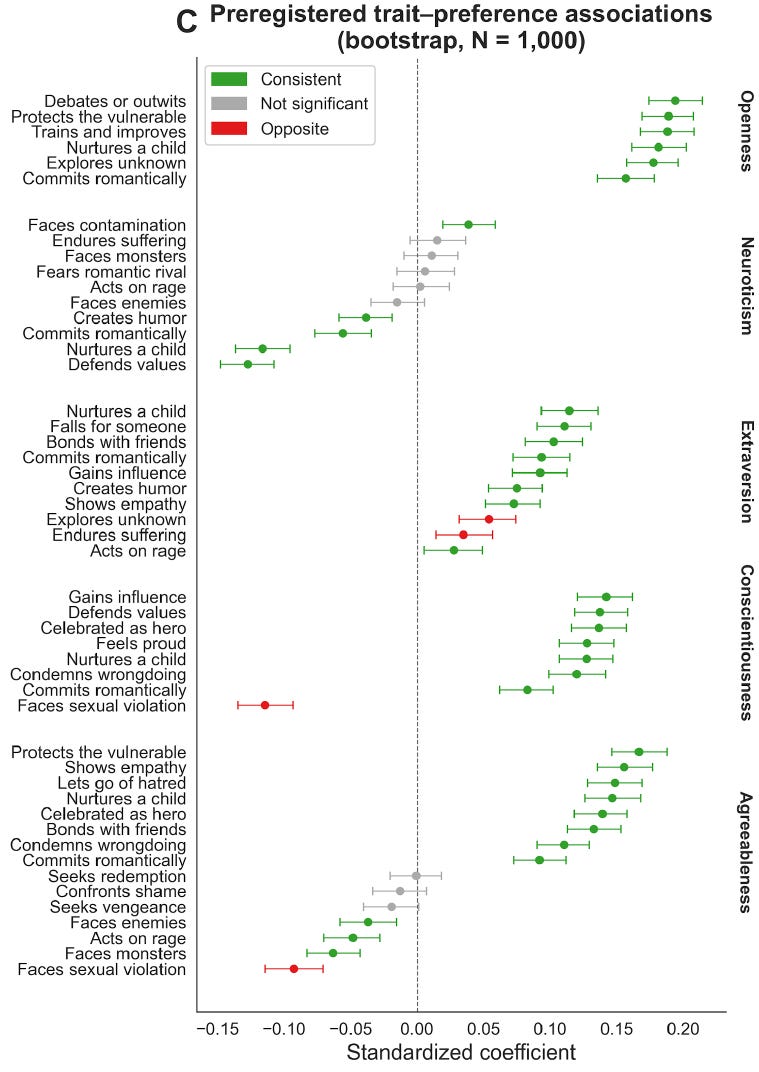
The links are modest, indicating that personality is just one factor among many shaping people’s movie preferences. Still, they’ve been replicated in 22 of 23 countries. That’s a remarkable degree of cross-cultural consistency.
Dubourg and co.’s work suggests that people’s movie preferences are better understood in terms of fine-grained narrative themes than broad genres. Two films in the same genre can attract very different audiences if they foreground different themes, while the same person may enjoy films from different genres if they share the same themes.
The findings come from a fascinating recent preprint by Edgar Dubourg and colleagues. Here’s the abstract.
Why do people prefer certain fictional stories over others? Personality traits capture stable individual differences in motivational sensitivities: Openness reflects exploration, Neuroticism reflects threat-reactivity, and so on. If so, these traits should systematically predict preferences for narrative features that engage the corresponding motivational systems. We test this hypothesis across three preregistered studies. In Study 1, we directly measured individual preferences for motivationally salient narrative features in a cross-cultural survey of 9,201 participants from 23 countries. Personality traits predicted preferences and the overall pattern replicated in 22 of 23 countries. In Study 2, we confirmed these predictions using ecologically valid data from 574 movies, annotated by large language models for the same narrative features and linked to the Big Five profiles of 3.5 million Facebook users. The predicted associations replicated at the population level. In Study 3, we tested a complementary structural prediction: if story preferences reflect an underlying motivational architecture, then the co-occurrence structure of narrative features in stories should mirror the co-preference structure across individuals. Using Mantel tests, we found strong structural correspondence, replicated across all 23 countries. Together, these findings support a model in which story preferences arise from universal motivational systems whose sensitivities vary across individuals.
If you want to dig deeper into the details, you can read the preprint for free here.
Follow me on Twitter/X for more psychology, evolution, and science.
How You Can Support the Newsletter
This post was free to read for all. If you like what I’m doing with The Nature-Nurture-Nietzsche Newsletter, and want to support my work, there are several ways you can do it.
Like and Restack: Click the buttons at the top or bottom of the page to boost the post’s visibility on Substack.
Share: Send the post to friends or share it on social media.
Upgrade to Paid: A paid subscription gets you:
Full access to all new posts and the archive
Full access to excerpts from my book A Billion Years of Sex Differences
Full access to exclusive content such as my “12 Things Everyone Should Know” posts, Linkfests, and other regular features
The ability to post comments and engage with me and the N3 Newsletter community
If you could do any of the above, I’d be hugely grateful. The support of readers like you helps keep this newsletter going.
Thanks!
Steve
Related Reading From the Archive
12 Things Everyone Should Know About Personality

This is the second post in my “12 Things Everyone Should Know” series. You can access the full collection here.
12 Things Everyone Should Know About the Big Five Personality Traits

This is the latest post in my “12 Things Everyone Should Know” series. You can access the full collection here.
Sex Differences in Personality

The graph below shows sex differences in the Big 5 personality traits across the adult lifespan. The first five panels show the differences in each of the Big 5 traits in turn; the final panel shows the trajectory of all five traits across adulthood, averaging across the sexes.