



In Case You Missed It…
12 Things Everyone Should Know About the Psychology of Victimhood
The People Most Confident in Their Political Views Know the Least About Politics
Liberals and conservatives both want to reduce harm and help victims. Where they differ is in who they see as the victims.
The disagreement isn’t that liberals think Black people are the victims whereas conservatives think White people are, or that liberals think poor people are the victims whereas conservatives think rich people are.
Instead, each side conceptualizes victimhood in a fundamentally different way.
Liberals tend to see victimhood as group-based, dividing the social world into vulnerable oppressed groups and invulnerable oppressors. Conservatives, in contrast, tend to see victimhood as individual-based and more evenly distributed across groups.
This pattern is shown in the graph below.
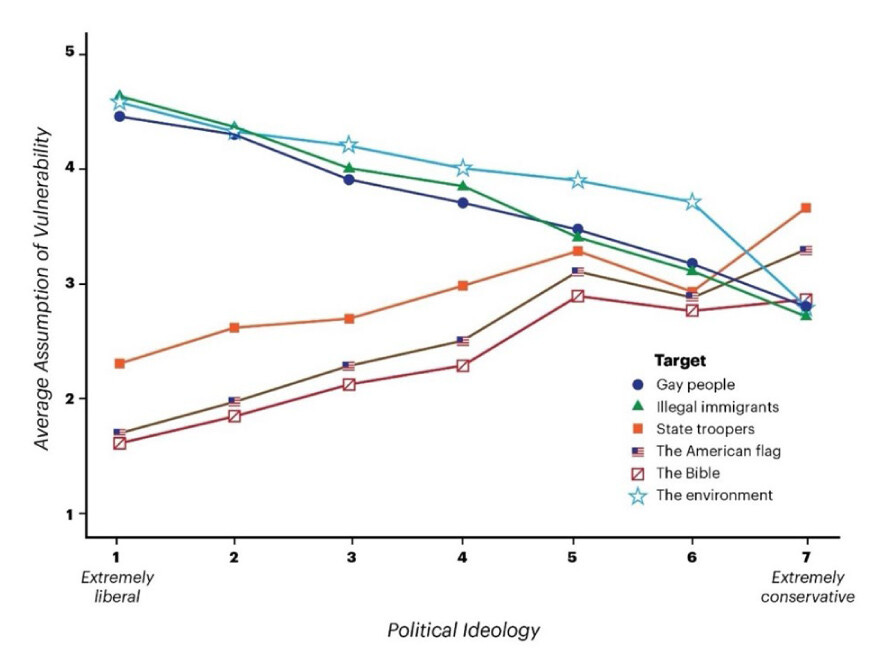
The graph comes from a recent paper by Jake Womick and colleagues. Here’s the abstract:
Moral disagreement across politics revolves around the key question, “Who is a victim?” Twelve studies explain moral conflict with assumptions of vulnerability (AoVs): liberals and conservatives disagree about who is especially vulnerable to victimization, harm, and mistreatment. AoVs predict moral judgments, implicit attitudes, and charitable behavior—and explain the link between ideology and moral judgment (usually better than moral foundations). Four clusters of targets—the Environment, the Othered, the Powerful, and the Divine—explain many political debates, from immigration and policing to religion and racism. In general, liberals see vulnerability as group-based, dividing the moral world into groups of vulnerable victims and invulnerable oppressors. Conservatives downplay group-based differences, seeing vulnerability as more individual and evenly distributed. AoVs can be experimentally manipulated and causally impact moral evaluations. These results support a universal harm-based moral mind (Theory of Dyadic Morality): moral disagreement reflects different understandings of harm, not different foundations.
You can access the paper here or download a free version here.
Follow me on Twitter/X for more psychology, evolution, and science.
How You Can Support the Newsletter
This post was free to read for all. If you like what I’m doing with The Nature-Nurture-Nietzsche Newsletter, and want to support my work, there are several ways you can do it.
Like and Restack: Click the buttons at the top or bottom of the page to boost the post’s visibility on Substack.
Share: Send the post to friends or share it on social media.
Upgrade to Paid: A paid subscription gets you:
Full access to all new posts and the archive
Full access to excerpts from my book A Billion Years of Sex Differences
Full access to exclusive content such as my “12 Things Everyone Should Know” posts, Linkfests, and other regular features
The ability to post comments and engage with the growing N3 Newsletter community
If you could do any of the above, I’d be hugely grateful. The support of readers like you helps keep this newsletter going and growing.
Thanks!
Steve
Related Reading From the Archive
12 Things Everyone Should Know About the Psychology of Victimhood

“Victims have never been in short supply in the world, but the rush to identify oneself as a victim is rather a new feature of modern life.”
12 Things Everyone Should Know About Political Psychology

This is the latest post in my “12 Things Everyone Should Know” series. You can access the full collection here.

Imaginary Enemies

In this post, I’d like to tell you about one of the most fascinating papers I’ve read in the last few years. Led by the psychologist Victoria Parker, it’s about the causes and consequences of political polarization. Here’s my one-sentence summary of the paper:
Fascinating chart! Have not read the paper yet.
Question arises: Does the conservative position look more like conpassion and the liberal position look more like empathy? Or are they not measuring the right grouping so that similar gaps would appear on the conservative side?
Hoffer, Zizek and Chomsky all recognised the problem with empathy and antipathy which seems to be reflected in the gaps on one side and perhaps compassion in convergence on the other....
Oppressor versus oppressed is the paradigm of “woke,” so the dichotomy seems to be basically capturing degree of wokeness. Whether you consider that the same as liberalism may depend on where you are on the spectrum.
Anecdotally, I see plenty of group-based resentment on the right — conservatives complain a lot about reverse racism and sexism and DEI. The graph does not necessarily suggest conservatives see victimhood as individual-based. They could just have less concordance about which groups are victimized. That in itself may be interesting, but it seems some of the most salient identity groups (cis women, trans, blacks, whites, men) weren’t targeted in the survey.