



In Case You Missed It…
The evidence [for implicit prejudice reduction] is thin. Together with the lack of evidence for diversity training, these studies do not justify the enthusiasm with which implicit prejudice reduction trainings have been received in the world over the past decade.
-Elizabeth Paluck et al. (2023, Annual Review of Psychology).
The Implicit Association Test, or IAT, is a popular measure of “implicit bias” - a form of bias that people supposedly aren’t conscious of, but which may lead them to unknowingly discriminate against Black people, women, or other disadvantaged groups.
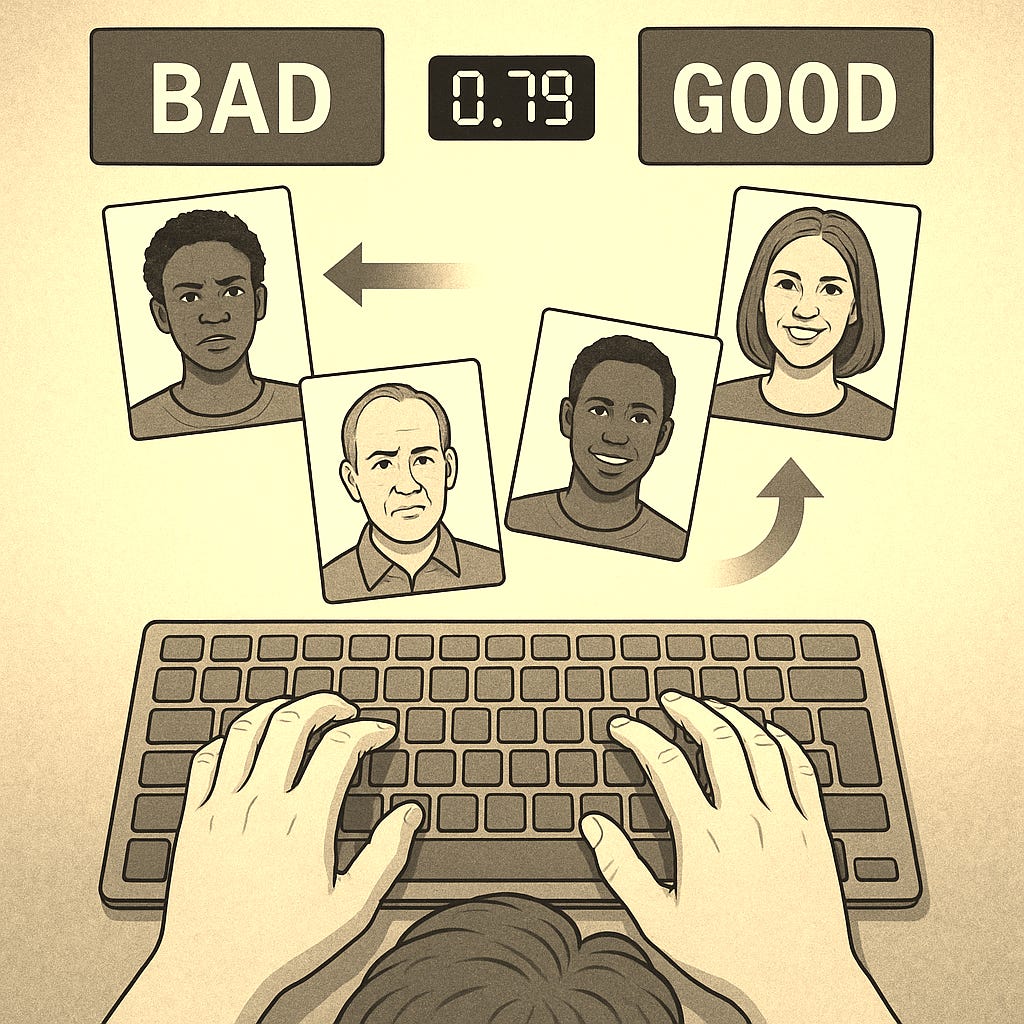
The IAT involves categorizing a series of words or images presented on a computer screen using two buttons. In the classic race IAT, for instance, you might push the left-hand button whenever you see a positive word or a White face, and the right-hand button whenever you see a negative word or a Black face. Later, the pairings are reversed: You push the left-hand button for positive or Black, and the right-hand button for negative or White.
The idea is that, if test takers have positive associations with White people and negative associations with Black people, they’ll be quicker to categorize the stimuli in the first condition (White-positive, Black-negative) than in the second (Black-positive, White-negative). Sure enough, that’s what’s often reported.
Based on data from the IAT, psychologists have argued that, while old-fashioned, overt bias is much less common these days, implicit bias is still rampant. And it’s not just rampant for race. People are also implicitly biased against women, gay people, obese people, and so on. All the traditional biases are alive and well, claim psychologists; they’ve just gone underground.
The concept of implicit bias has long since made the leap from psychology labs and journal articles to the wider culture. The phrase can be found on the lips of HR managers, politicians, and characters in stories and movies. Meanwhile, implicit bias training, which seeks to root out the biases supposedly lurking in our unconscious minds, has become a multi-million dollar industry.
But does implicit bias research really show what people think it shows? Does the IAT really measure implicit bias? And does implicit bias training really work?
In this essay, I’ll give five reasons for skepticism in each of these areas.
1. The IAT Doesn’t Say What People Think It Does
First things first, even if the IAT were perfect in every way, its results aren’t what most people think. People assume that it confirms the standard activist view of the world, but in many ways, it upends it.
This was most vividly illustrated by a recent multi-study paper with more than 5,000 participants, published in the prestigious Journal of Personality and Social Psychology. Most IAT studies look at only one axis of bias at a time: Black vs. White, women vs. men, etc. As a result, they can’t assess the relative importance of these different variables. This paper, in contrast, looked at implicit bias toward targets varying on multiple dimensions.
The main finding was that the dominant form of bias wasn’t bias based on race, class, or age, but rather bias based on sex. And it wasn’t bias in favor of men and against women; it was the opposite: bias in favor of women and against men. Yes, you read that correctly: Pro-female bias was stronger than any other form of bias, including even bias based on race.

A deeper dive into the race findings yielded further surprises. Depending on the task, participants sometimes showed anti-Black bias, sometimes pro-Asian bias, and sometimes anti-White bias. Moreover, different racial groups exhibited different biases: Asian participants favored Asians; Black participants favored Black people and Asians; and White participants showed no racial bias.
None of this is what most people expect when they think of implicit bias. Yet those who take the IAT seriously should take these findings seriously as well.
2. The IAT Is Unreliable
But should we take the IAT seriously in the first place? Maybe not. One important reason for skepticism is that the IAT has poor test-retest reliability - that is, the same person will often get very different results each time they take the test. As the psychologist Paul Bloom quipped, “If you take the test and don’t like the result, just take it again.”
This challenges the idea that the IAT is measuring prejudice. We usually view prejudice as a fairly stable trait. We wouldn’t think “Well, I was racist this morning when I took the IAT, but I wasn’t racist five minutes ago when I took it again. Hope I’m still not racist tomorrow!” Taken at face value, however, the IAT would imply exactly that kind of instability. This suggests that it’s not reliably measuring prejudice.