



If you’ve taken an introductory psychology course, you’ll have heard about general intelligence, also known as g. g is a general-purpose cognitive ability that’s brought to bear on every cognitive task. It’s what IQ tests aim to measure.
What makes us think that there’s any such “thing” as g? Simple: the fact that people who do well on one kind of cognitive test also tend to do well on others. Good at vocabulary? You’re more likely to be good at math as well. Good at math? You’re more likely to have a good memory - and good spatial abilities and good processing speed. The positive correlation among cognitive tests suggests an underlying factor that contributes to performance on all of them. Whatever exactly that factor is, it’s what psychologists call g.
The evidence for g’s importance is overwhelming. People with higher IQs tend to stay in education longer, enter higher-status occupations, earn more, enjoy better health, and even live longer. These aren’t just cherry-picked, small-sample, yet-to-be-replicated flukes. They’re among the strongest and most consistent findings in psychology.

But although people who do well on one cognitive task tend to do well on others, no one does exactly as well on every task. Two people can have exactly the same IQ score but different profiles of strengths and weaknesses. Jojo may have exceptional verbal skills but only somewhat above average math skills. Loretta may process information at lightning speed but fall behind on abstract thinking. Martin may have an intuitive feel for machinery and electronics but lack the gift of gab.
Should we expect these individuals to end up having similar life outcomes simply because their overall IQs are the same?
For many years, the conventional wisdom in psychology was basically “yes.” General intelligence was thought to do almost all the heavy lifting. As one influential paper put it, specific cognitive abilities contribute “not much more than g.”
But recent research by Tobias Edwards and Colin DeYoung, published in the journal Intelligence and Cognitive Abilities, suggests otherwise. Using data from nearly 19,000 Americans across two generations, the researchers showed that your specific abilities shape your occupation, income, and job status, over and above IQ.
Edwards and DeYoung extracted three specific abilities statistically independent of g: technical ability, processing speed, and math-vs-verbal ability - a factor reflecting the extent to which people are better with numbers than words. They then looked at the extent to which IQ and these specific abilities correlated with people’s life outcomes.
The following four graphs summarize their main findings.
Enjoying the post so far and want more of the same only different? Subscribe to The Nature-Nurture-Nietzsche Newsletter today!
Graph 1: IQ Matters More with Age - But Specific Cognitive Abilities Matter Too
The first figure shows how cognitive abilities predict income and occupational status across the adult years. The key message is that IQ becomes increasingly important with age, while specific abilities have a fairly stable impact.
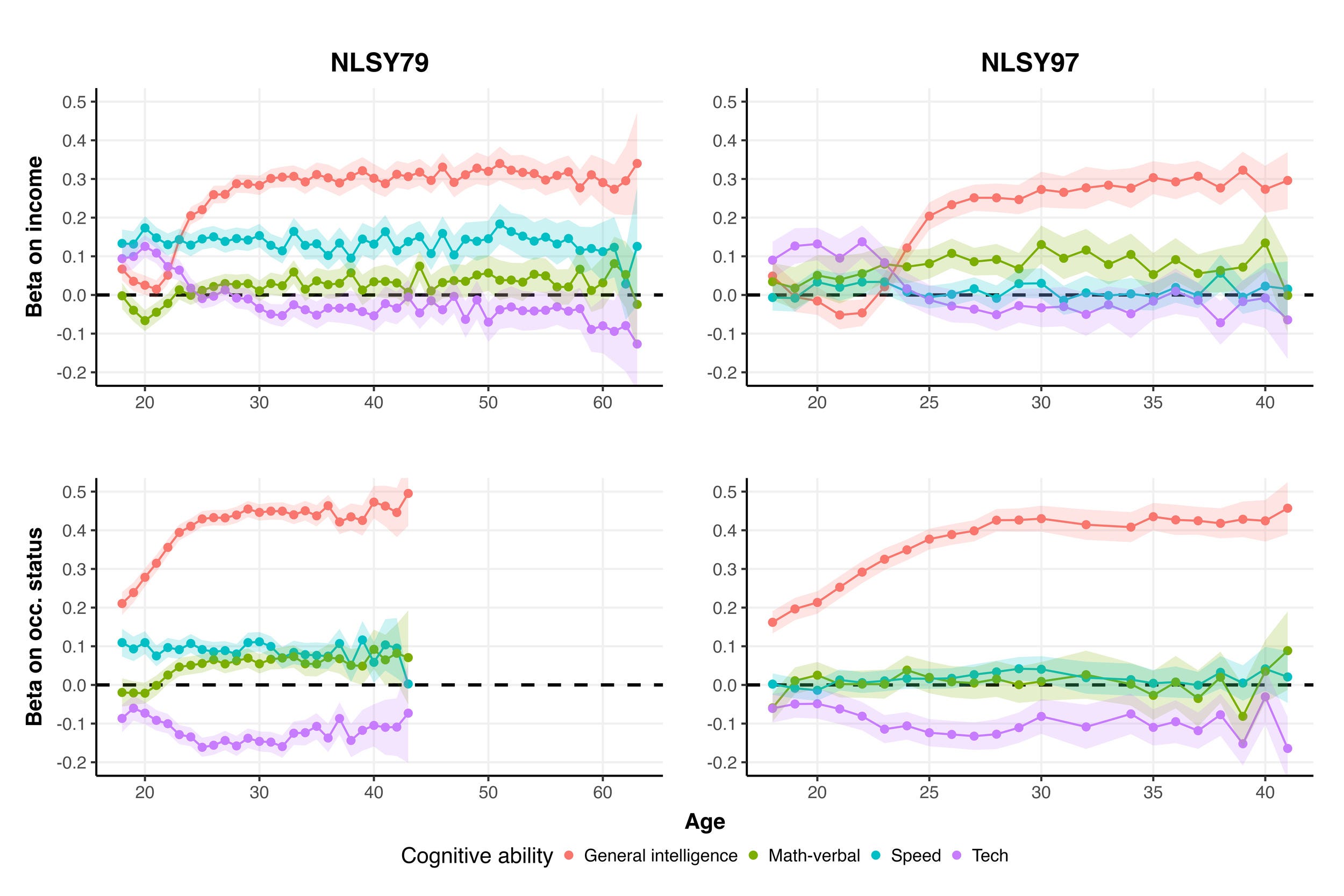
The effect of cognitive abilities on earnings is worth zooming in on. As you can see, in people’s late teens and early twenties, general intelligence barely predicts earnings at all. Indeed, in one of the two datasets, the relationship is briefly negative. This is presumably because, in their first years out of high school, many cognitively gifted individuals are still in education, trying different jobs, or not yet in positions where their cognitive talents can fully express themselves. It takes until the mid-twenties for IQ to really start making waves - but when it does, it soon becomes the strongest cognitive predictor of income.
Meanwhile, tech ability shows almost the opposite pattern. It has a positive effect on income in the late teens and early twenties - the exact time when general intelligence does nothing - but then crosses the zero line and drifts negative as people age. That’s the earnings fingerprint of the kid who left school to become an electrician or mechanic before their classmates had even decided on a major. It pays off in the short term, but then traditional academic pathways overtake it.