



In Case You Missed It…
We’d all like to believe that the criminal justice system is rational: that punishments are meted out fairly, consistently, and in ways that promote the common good. And contrary to the cynics, they often are. In certain respects, however, the system falls short of this ideal. People’s biases and instinctive taste for vengeance sometimes intrude on legal decision-making, such that offenders are punished in ways that have little to do with fairness or social utility. While racial biases in criminal justice are widely recognized, other biases - including those based on sex - receive far less attention. In this essay, I explore how these biases shape punishment, and what this reveals about the gap between justice as it is and justice as it ought to be.
The Goldilocks Approach to Punishment
When it comes to theories of punishment, one stands head and shoulders above the rest: optimal punishment theory. Most famously associated with the economist Gary Becker, optimal punishment theory treats criminal justice as a matter of balancing costs and benefits. The central idea is that punishments should be set at a level that minimizes both the costs of crime and the costs of punishing it.
This deceptively simple premise yields various concrete proposals about how society ought to punish different crimes and different criminals. One is that crimes that are harder to solve should attract harsher penalties, so the average expected cost of offending remains high despite the lower probability of getting caught. A second is that criminals at greater risk of reoffending should be punished more severely, both to deter them effectively and to incapacitate them for longer. And a third is that punishment should not be shaped by factors that are irrelevant to the goal of minimizing the combined costs of crime and punishment.
In short, punishment should be neither too harsh nor too lenient, but “just right” for minimizing social harm.
Does the System Measure Up?
All of this sounds eminently reasonable - but to what extent does reality approach the ideal? Many studies have addressed this question over the years, but one particularly illuminating contribution is a paper by Edward Glaeser and Bruce Sacerdote titled “Sentencing in Homicide Cases and the Role of Vengeance.” The paper tests some of the central predictions of optimal punishment theory by examining sentencing patterns in US homicide cases.
In some ways, the news is good. Glaeser and Sacerdote report, for example, that offenders tend to be punished more severely when the risk of getting caught is low, consistent with the idea that harsher penalties are needed to deter potential offenders in those circumstances. Thus, arson-related homicides receive longer sentences than homicides during robberies, which in turn receive longer sentences than homicides during drunken brawls.
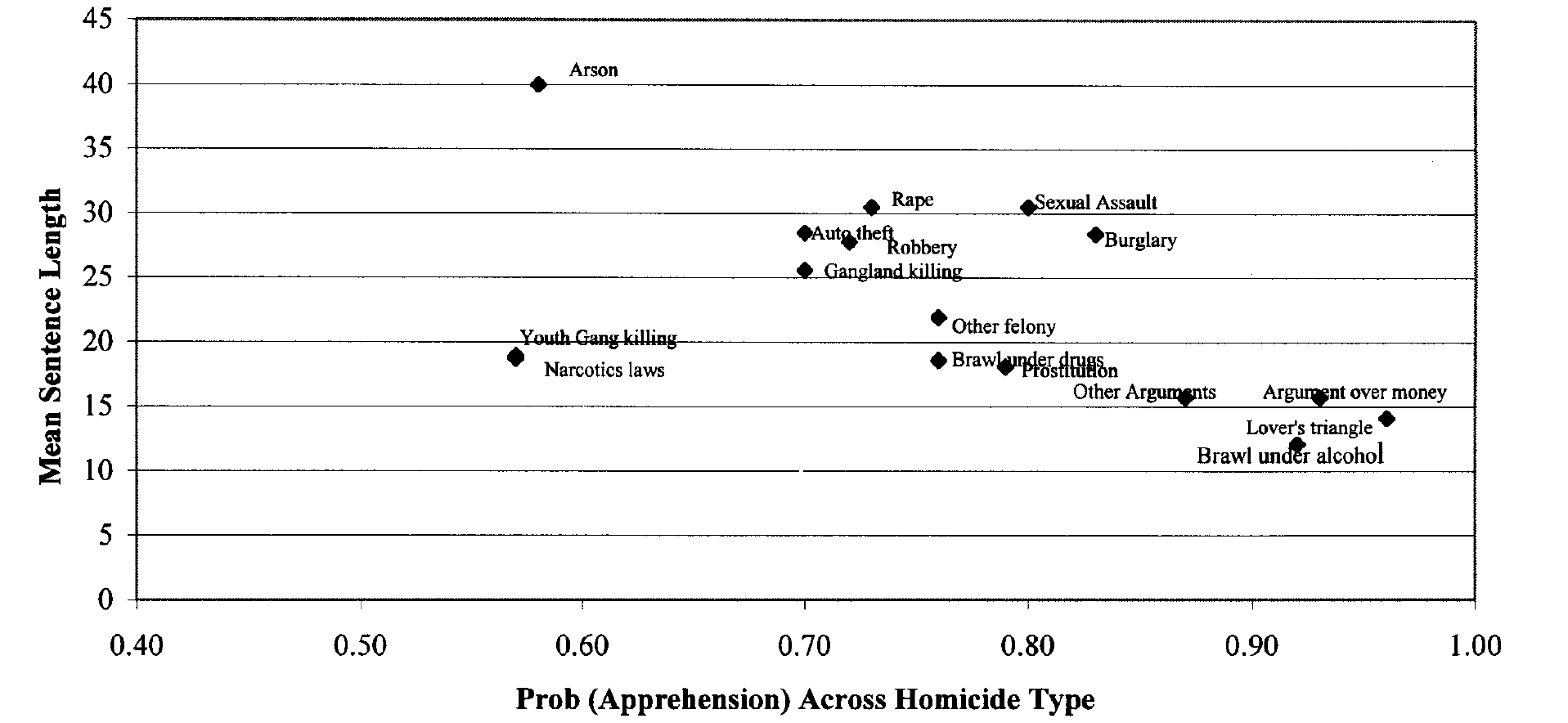
Also consistent with optimal punishment theory, offenders at higher risk of reoffending tend to be punished more severely. People who kill during a robbery, for instance, receive longer sentences than those who kill during a fight or lovers’ quarrel.
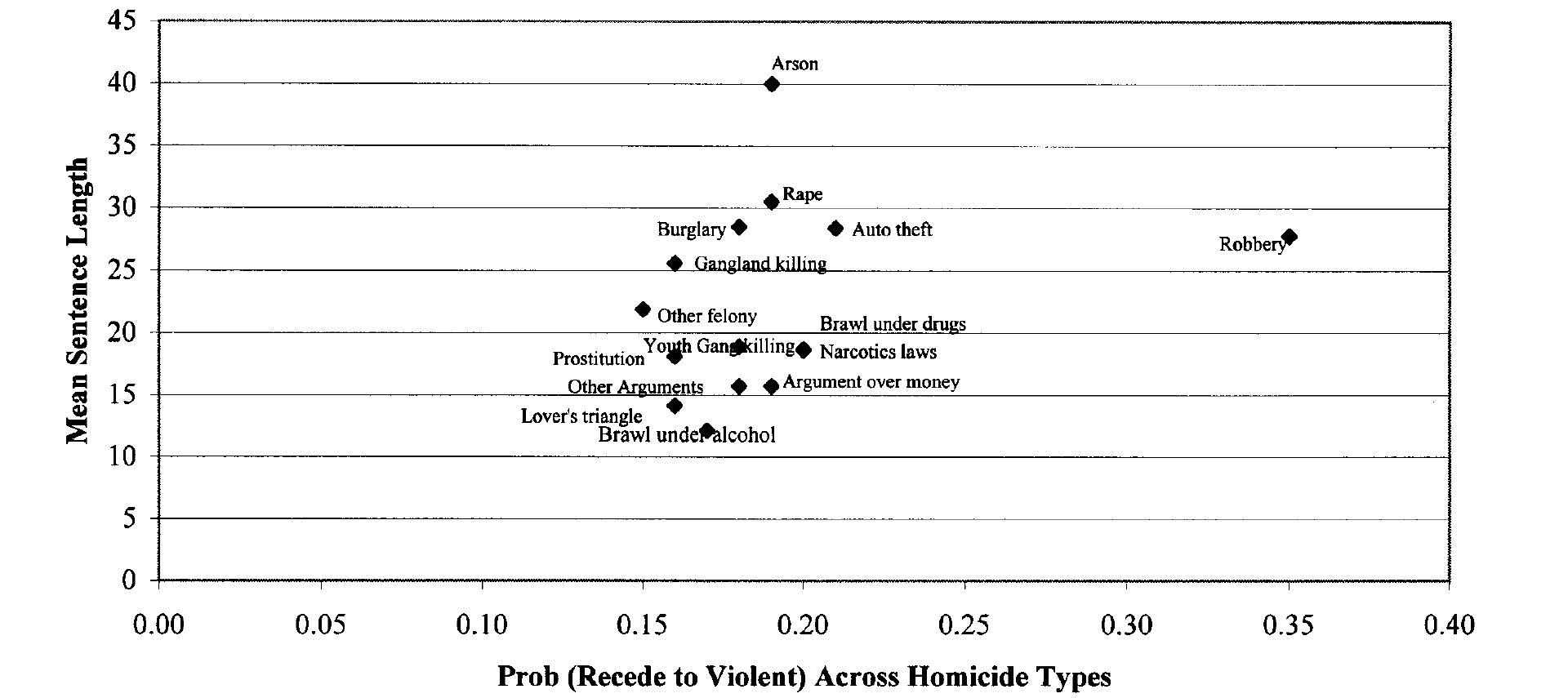
So far, so good. In these respects, the system behaves roughly as optimal punishment theory would predict and recommend.
But then things start going off the rails.
Bias in the Machine
One of the central premises of optimal punishment theory is that factors unrelated to crime risk should play no role in determining punishment. But Glaeser and Sacerdote found compelling evidence that they do.
The researchers looked at two broad categories of influence: demographic characteristics of the offender and demographic characteristics of the victim.
Let’s begin with the offender. A large body of research suggests that various demographic traits influence sentence length even after controlling for potential confounds such as crime severity and criminal history. Perhaps the least surprising example is that Black offenders tend to receive longer sentences than White offenders for the same crime. More surprising to many is that men tend to receive longer sentences than women. Indeed, women from every ethnic group - even the least favored - tend to receive shorter sentences than even the whitest of White men.