


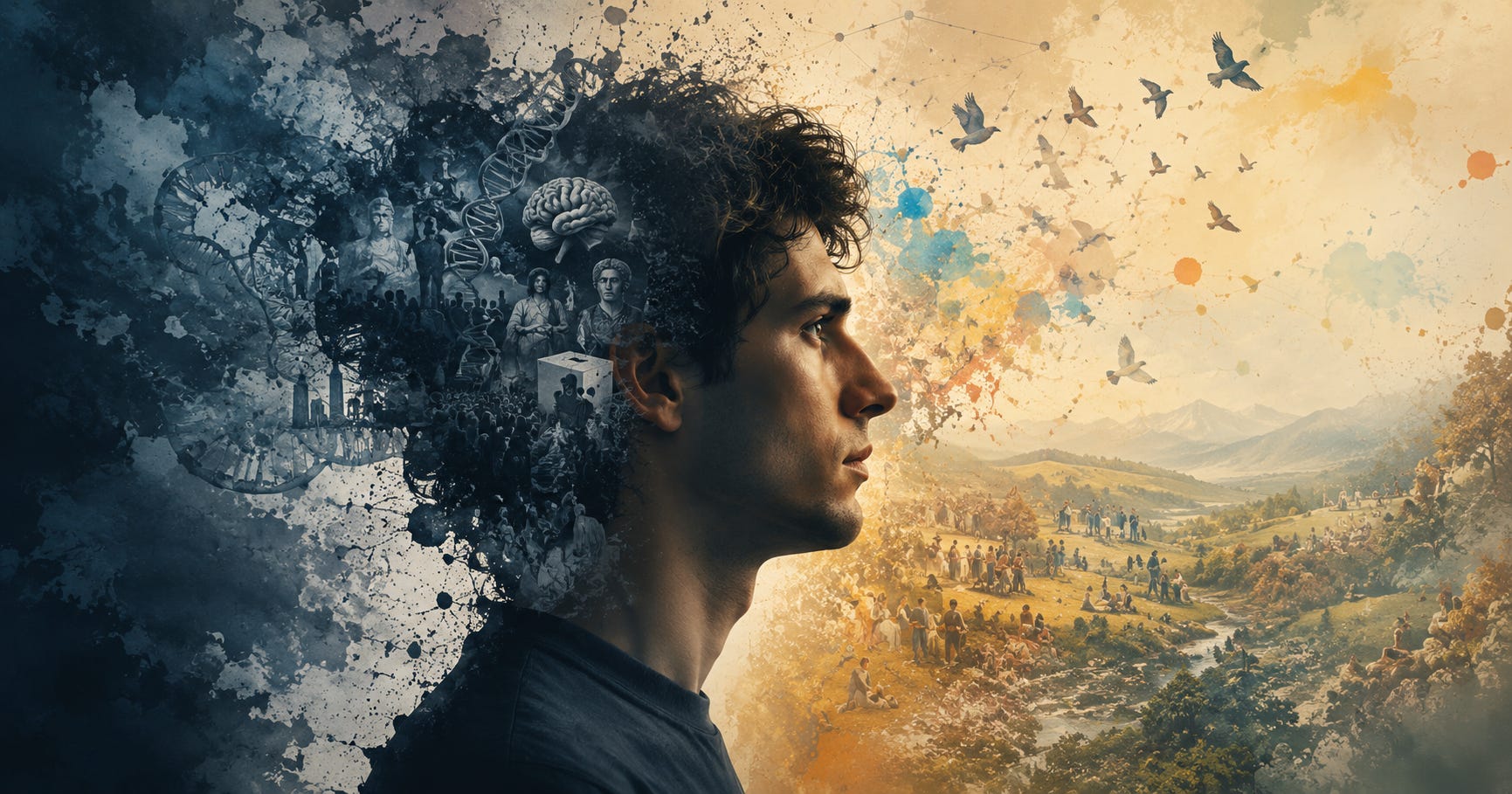
This is a guest post by Turi Munthe. His book, Why We Think What We Think: The Unexpected Origins of Our Deepest Beliefs, was published on May 14 by Penguin’s Hutchinson Heinemann.
Can You Control Your Own Beliefs?
Only if you know how your beliefs control you.
A few years ago, the UK’s Guardian newspaper bravely informed its left-leaning readership that attractive people tended to lean right. The heartthrobs and dreamboats of this world - people with conventionally desirable traits like tall men and women, men with high natural upper-body strength and women with symmetrical faces - vote conservative. Specifically, attractive people are greater believers in meritocracy - the classic conservative view that you should earn what you get, and that you get what you deserve.
There’s nothing intrinsically sexy about conservatism: listening to Ronald Reagan’s speeches will not give you lustrous hair or an aquiline nose. The reason that conventionally attractive people tend, on average, to be bigger believers in meritocracy is because of something teenagers call ‘Pretty Privilege’. Beautiful people inhabit a gentler reality than us common mortals: strangers, teachers, employers and even parents all bend towards them, quietly smoothing their path. It’s no wonder they trust in a meritocracy - for them, it largely works, even if their ‘merit’ is only being pretty.
It’s a disconcerting notion. Who wants to be told their careful reading of Milton Friedman and Friedrich Hayek is just post-hoc rationalisation? That their deepest convictions are arbitrary: the fruit of happenstance rather than intellectual agency?
And yet, as I show in Why We Think What We Think: The Unexpected Origins of Our Deepest Beliefs, so many of our opinions are just that. From our faith in God to our taste in decoration, the ‘reasons’ we hold our convictions are often more accurately attributable to quirks of history, geography, climate, psychology and even genetics than to reading, deliberation and ‘reasoning’.
Wherever the climate is hot and humid - from Singapore to the DRC - people tend to be both more xenophobic and more conformist than the global average. Why? Because hot and humid climates are rich in pathogens like bacteria, fungi and parasites. The locals’ wariness of strangers comes from a heightened fear they might bring infection. And their learned conformity is a form of behavioural immunity to ensure nobody deviates from the practices they know will keep them safe from contagion.
People who score high in ‘neuroticism’ (one of our five key personality traits) are more likely to follow radical ideologies. At the 2015 general election, they were both more likely to vote for the hard-left Greens and more likely to vote for the hard-right UK Independence Party. Why? Because that existential discomfort prompts those high in neuroticism to search for radical alternatives that might fix it.
‘Moralising’ deities like God or Allah (and unlike, say, Zeus or Thor who don’t have much to moralise about given their own behaviour) almost always emerge in regions prone to drought. Why? Because drought is the great climatic killer - worse than floods or typhoons or earthquakes - and the only way to survive it as a society is to pull together. You need strict moral rules to keep the community from destroying itself - they’re less important when everyone is doing OK.
Your deepest sense of self and your relationship to the world is a by-product of the agriculture of your ancestors. There are two broad camps. Individualist cultures (like Europe) prioritise self-expression and personal autonomy over group loyalty, and collectivist ones (like Asia) prioritise shared obligations and social harmony over personal interests. If your ancestors grew up planting wheat, you’re likely the former, and if rice, then the latter. Why? Because rice cultivation takes whole communities to build the paddies, manage the irrigation systems and harvest the rice. A culture of cooperation and harmony was essential to survival. Whereas wheat can be cultivated by a single family, which afforded early Europeans the luxury of putting themselves first.
We know our beliefs are subject to the vagaries of history: 500 years ago, we’d all have believed the sun rotated around the Earth. But history influences our attitudes in much more unconscious ways too. Why are Bretons historically more liberal, less patriarchal and more egalitarian than their neighbouring Frenchmen? Because, as Asterix tells us, the Romans never truly conquered that corner of the country, and the paternalistic culture Rome spread across Europe never took root quite so deeply there.
There are countless ‘accidental’ environmental influences on our opinions - like the weather, or topography, or history - but there are also deeper ‘biological’ ones too, and they have an outsized effect on our politics.
Right-wingers, on average, have measurably more taste buds than left-wingers. It’s because people with greater ‘disgust sensitivity’ (like sensitive tongues) tend to be more conservative in all their tastes, and more judgmental of those who deviate from them.
Put a teenager in a brain scan and you can tell with 70% probability what their politics are. The amygdala, which responds to emotions like fear and threat, tends to be larger and more active in conservative teens; the prefrontal cortex, which processes ambiguous information and works to resolve cognitive conflict, is more active in liberal ones. That enlarged amygdala might be behind right-wing concerns about immigration or crime. And that overactive prefrontal cortex might explain why liberals tend to be more tolerant of difference or why so many pernickety academics lean left.
Your politics owe more to your genes than to your reading. Identical twins who share 100% of their DNA have MUCH more similar politics than fraternal twins who share only 50% of their DNA, even when they were raised apart. By comparing identical and fraternal twins’ beliefs, we know that genetics explains around 50% of the variance in our views on tax policy (or porn), for example. That means that half of the differences between people’s opinions on things like government spending (or banning Pornhub) can be traced back to their genes – inherited traits from their biological parents.
Our opinions are not predetermined: we can control our beliefs. Some cuties do vote Labour, just as some trolls vote conservative. We are, as the famous phrase goes, hardwired not to be hardwired. Humans have the most extraordinary capacity for reason. We do have intellectual agency. We can and frequently do change our minds. But we are predisposed to many of our beliefs. Acknowledging that, and understanding how the quirks of history, geography, climate, psychology and even biology unconsciously influence our worldviews is the first step towards achieving intellectual independence from ourselves.
Turi Munthe is the author of Why We Think What We Think: The Unexpected Origins of Our Deepest Beliefs, which was published 14 May with Penguin’s Hutchinson Heinemann.
How You Can Support the Newsletter
This guest post was free to read for all. If you like what I’m doing with The Nature-Nurture-Nietzsche Newsletter, and want to support my work, there are several ways you can do it.
Like and Restack: Click the buttons at the top or bottom of the page to boost the post’s visibility on Substack.
Share: Send the post to friends or share it on social media.
Upgrade to Paid: A paid subscription gets you:
Full access to all new posts and the archive
Full access to excerpts from my forthcoming book A Billion Years of Sex Differences
Full access to exclusive content such as my “12 Things Everyone Should Know” posts, Linkfests, and other regular features
The ability to post comments and engage with the growing N3 Newsletter community
If you could do any of the above, I’d be hugely grateful. The support of readers like you helps keep this newsletter going and growing.
Thanks!
Steve Stewart-Williams
Related Reading From the Archive

One Bias to Rule Them All

I can explain it only by a weakness of the scholarly mind that I have often observed in myself. I call it theory-induced blindness: once you have accepted a theory and used it as a tool in your thinking, it is extraordinarily difficult to notice its flaws.
Imaginary Enemies

In this post, I’d like to tell you about one of the most fascinating papers I’ve read in the last few years. Led by the psychologist Victoria Parker, it’s about the causes and consequences of political polarization. Here’s my one-sentence summary of the paper:

Thank you Steve!
Looking fwd to reading yours immensely.
This will upset people who have not recognized we live in a deterministic world. For those of us who have, it's old hat. Some of the specifics like "humidity produces more xenophobic people" are quite interesting conjectures - quite plausible, but not earth shaking.
On the other hand, the statement, "Our opinions are not predetermined: we can control our beliefs" is false. We might think so only because we don't fully recognize the causes involved. We are components of a vast universe and there is no "ghost in the machine" running things that is not subject to the causal connections of all things.