



In Case You Missed It…
For years, we’ve been told that universities discriminate against women and racial minorities - and that White men are the chief beneficiaries of this biased system. A growing body of research suggests, however, that the reality is now closer to the reverse.
The latest example comes from a new paper by political scientist Scott Desposato. Desposato tracked more than 400 political science PhD students who entered the job market in 2023. His question was whether they’d secured a tenure-track assistant professorship by the following autumn.
Contrary to the conventional wisdom, female and underrepresented-minority candidates were considerably more likely to have done so than non-minority men. Was this because the former had better credentials? Apparently not; the disparity persisted even after statistically controlling for PhD-program rank, publication record, degree status, and academic subfield.
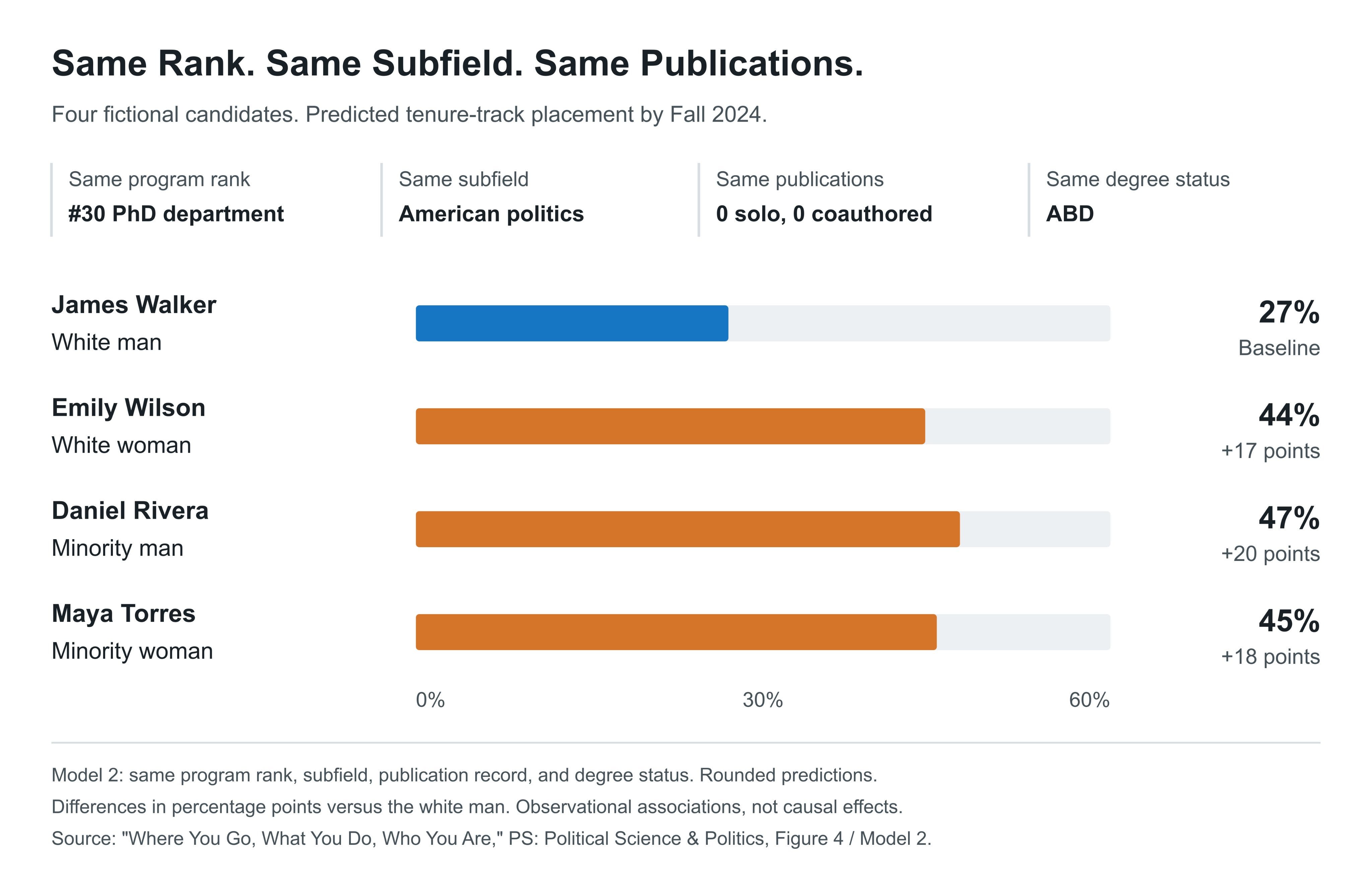
Based on Desposato’s findings, John Holbein on Twitter/X calculated the chances of four hypothetical individuals landing a position: a White man, a White woman, a minority man, and a minority woman. The candidates were identical in every respect, other than their sex and race. As shown in the graph below, the White man was considerably less likely than the rest to get the job.
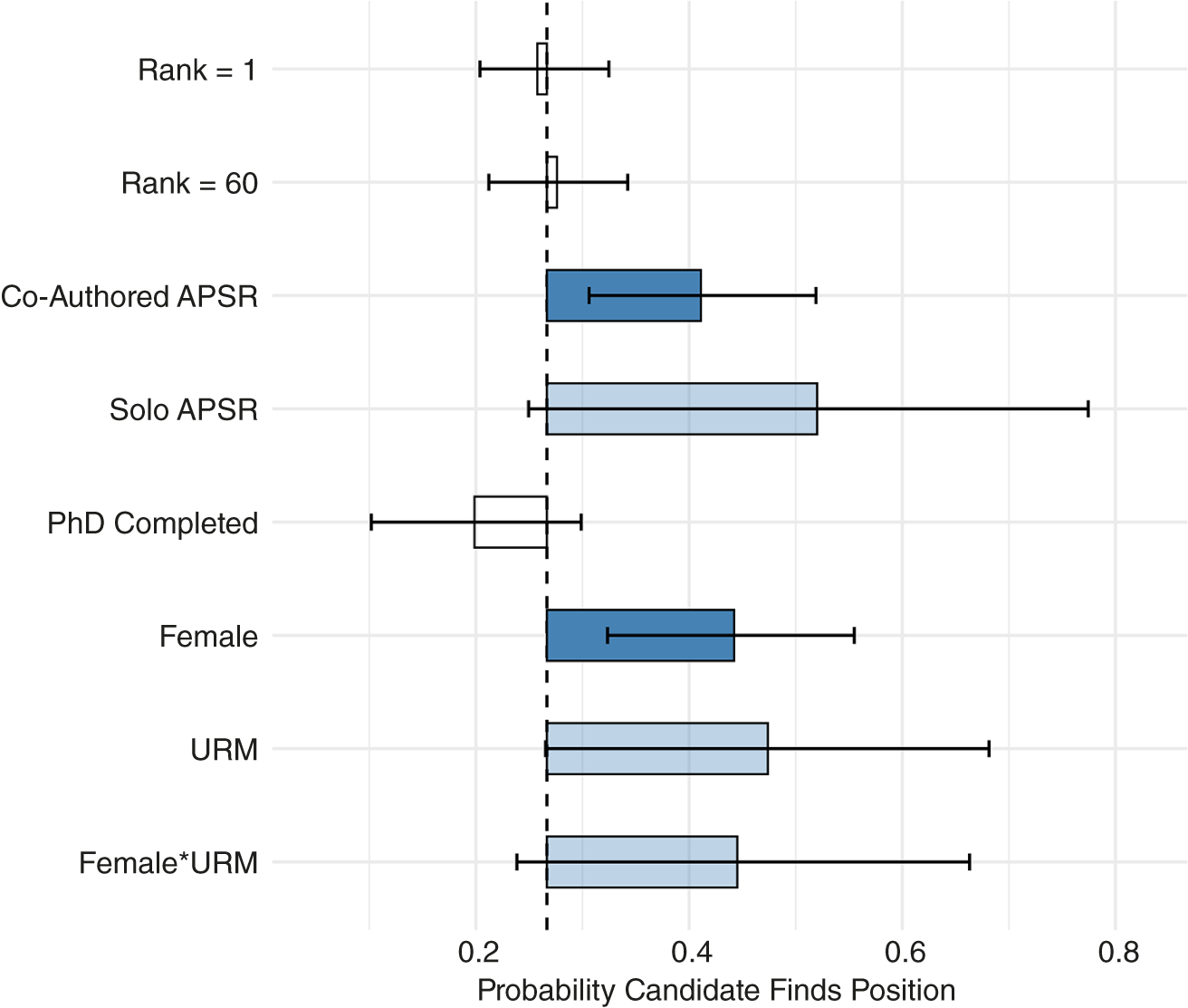
How important was identity in determining who got hired? The answer seems to be “very.” Co-authoring a paper in the American Political Science Review - the discipline’s flagship journal - substantially increased a candidate’s chances of securing a position, just as you’d expect. But it didn’t increase their chances nearly as much as simply being female or an underrepresented minority. Only a solo-authored APSR paper was worth more on the job market than these demographic variables.
Desposato’s research doesn’t prove beyond a shadow of a doubt that the differences were due to discrimination. In principle, they could reflect unmeasured differences among candidates, differences in the positions they applied for or were willing to accept, or other confounding variables.
But it seems unlikely. Other research points in the same direction (see, e.g., here and here), and in any case, it’s an open secret that academia has been putting a thumb on the scale for women and underrepresented minorities for many years. The most plausible interpretation of Desposato’s data is that the relevant hiring committees were discriminating against White men.
Ironically, this was happening under the cover of the assumption that academia routinely discriminates in favor of White men. I was raised to think that discrimination is wrong, and I once assumed that most of my peers agreed. Apparently, though, many think it’s perfectly acceptable - as long as it’s against the right groups.
You can access Desposato’s paper here for free.
Follow me on Twitter/X for more psychology, evolution, and science.
Coming Soon to The Nature-Nurture-Nietzsche Newsletter…
Sex Differences in Cognitive Abilities
The Nature-Nurture-Nietzsche Linkfest for September 2026
Quick-Fire Responses to 18 Common Woke Arguments
How You Can Support the Newsletter
This post was free to read for all. If you like what I’m doing with The Nature-Nurture-Nietzsche Newsletter, and want to support my work, there are several ways you can do it.
Like and Restack: Click the buttons at the top or bottom of the page to boost the post’s visibility on Substack.
Share: Send the post to friends or share it on social media.
Upgrade to Paid: A paid subscription gets you:
Full access to all new posts and the archive
Full access to excerpts from my book A Billion Years of Sex Differences
Full access to exclusive content such as my “12 Things Everyone Should Know” posts, Linkfests, and other regular features
The ability to post comments and engage with the growing N3 Newsletter community
If you could do any of the above, I’d be hugely grateful. The support of readers like you helps keep this newsletter going and growing.
Thanks!
Steve
Related Reading From the Archive


The Truth About Sexism in Science

It’s an idea so widely accepted that we rarely think to question it: Women face rampant discrimination in STEM fields, while men coast along on a cushion of unearned privilege. You’ll hear this claim echoed everywhere, from the most prestigious scientific journals to the pages of