



In Case You Missed It…
Introductory psychology textbooks still haven’t caught up with the science. Despite years of criticism, they continue to promote debunked research, to present psychology as more settled than it is, and to be overly credulous of ideas that buttress progressive political pieties.
Among other things, many intro psych textbooks gloss over flaws in famous studies such as the Stanford Prison Experiment; misrepresent areas like evolutionary psychology; present highly contested but left-friendly ideas like stereotype threat as settled science; promote psychological myths such as that violent video games cause real-world violence; and ignore exaggerations and distortions in famous case studies like that of Phineas Gage and Kitty Genovese.
The relative frequencies of these and other errors are shown in the table below.
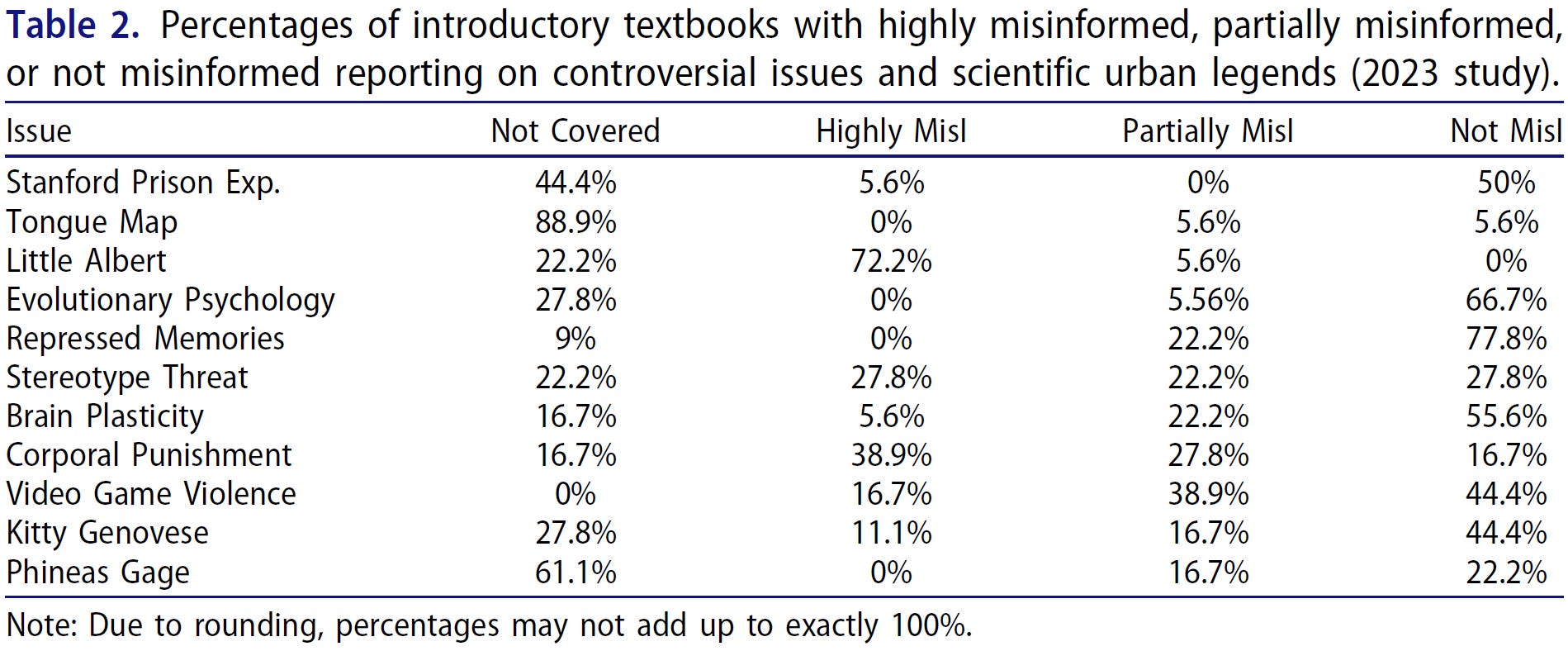
The table comes from a recent paper by Jeffrey Brown and Christopher Ferguson. Here’s the abstract:
Recent scholarship has identified that factual errors have been common in introductory psychology textbooks. These errors tend to be in the direction of making psychological research appear more consistent than it is, as well as promoting viewpoints consistent with politically progressive ideologies. Some famous experiments in psychology have also seen serious questions raised about their validity. Given that these conversations have gone on for about a decade, it is worth considering whether identification of these issues resulted in improved coverage in introductory textbooks. Textbooks were sampled at two time points. Sixteen textbooks were sampled in 2018, and 18 in 2023. Although some improvements are seen from earlier studies, results indicated that errors in textbooks have remained common even after this issue had been clearly identified in the published literature. Misreporting of basic scientific information remains common in introductory textbooks, despite improvements in some areas. Textbook authors should be alert to potential misinformation, particularly related to controversial topics. Introductory psychology teachers may need to be aware that not all information presented in textbooks is true.
You can access the Brown and Ferguson paper here, or request a free copy from the authors here.
Follow me on Twitter/X for more psychology, evolution, and science.
Related Reading From the Archive
5 Replication Failures, Questioning DEI, and Sex Differences in Brain and Behavior

Welcome to my latest Linkfest: a collection of links to papers and articles that caught my eye over the last few weeks. On the menu today, we have some hot-off-the-press findings from psychology, five recent replication failures, Bryan Caplan on DEI, and an assorted collection of sex differences. Enjoy!


How You Can Support the Newsletter
This post was free to read for all. If you like what I’m doing with The Nature-Nurture-Nietzsche Newsletter, and want to support my work, there are several ways you can do it.
Like and Restack: Click the buttons at the top or bottom of the page to boost the post’s visibility on Substack.
Share: Send the post to friends or share it on social media.
Upgrade to Paid: A paid subscription gets you:
Full access to all new posts and the archive
Full access to exclusive excerpts from my new book, A Billion Years of Sex Differences
Full access to exclusive content such as my “12 Things Everyone Should Know” posts, Linkfests, and other regular features
The ability to post comments and engage with the N3 Newsletter community
If you could do any of the above, I’d be hugely grateful. The support of readers like you helps keep this newsletter going.
Thanks!
Steve Stewart-Williams
Would be nice to see what textbooks say about intelligence research too. In spite of being a robust research area, many students don’t learn about it or learn about misleading ideas like multiple intelligences.