



For as long as I can remember, the standard story in the social sciences has been that women and minorities are routinely discriminated against in STEM fields: Their research is judged more harshly, and they’re less likely to be hired or promoted. Evidence is mounting, however, that this story is increasingly out of date. A new preprint reports that, when evaluating identical CVs, STEM professors in the United States rate the research records of women and Black people as superior to those of men and White people, and are more likely to recommend them for promotion or tenure.
The key results of the research are shown in the following table.
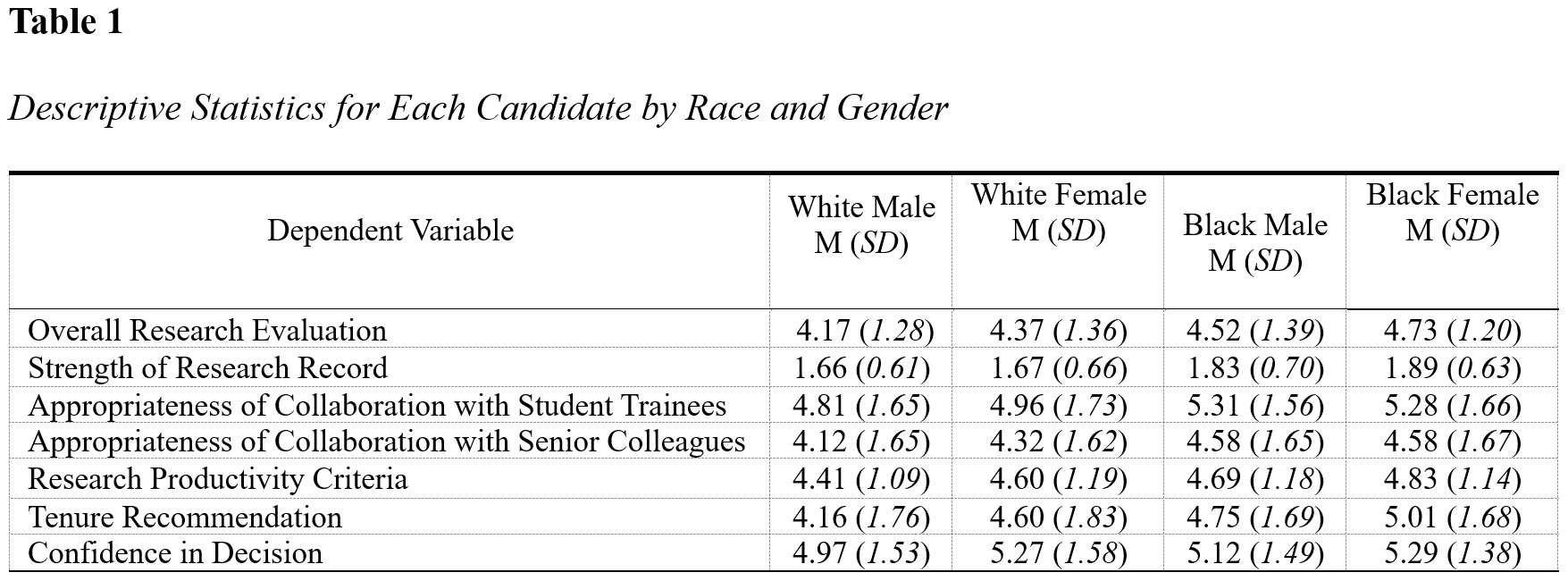
This pattern is plausibly the result of efforts to correct for historical anti-female and anti-Black bias. Rather than eliminating that bias, however, we seem to have inadvertently reversed it, at least in some domains.
The research was conducted by Deborah Wu and Nilanjana Dasgupta. Here’s the abstract of their paper:
Gender and race disparities persist among tenure-track faculty in the United States, especially in STEM, where women hold 26% of academic positions and Black and Hispanic faculty together comprise only 7%. We conducted a randomized controlled experiment with 796 tenured biology and chemistry professors employed at 183 U.S. doctoral-granting institutions to investigate their evaluation of pre-tenure faculty’s research readiness for tenure and promotion in research-intensive universities. Faculty received an identical CV with only the candidate’s name varying to signal their gender and race, using a 2 Race (Black vs. White) by 2 Gender (male, female) between-subjects factorial design. Results revealed that STEM faculty evaluated female and Black candidates’ research record significantly more favorably and recommended them for tenure and promotion at higher rates, compared to male and White candidates with identical CVs. Findings remained largely consistent even after controlling for faculty participants’ own gender, race, and rank. We speculate that social norms about diversity, equity, and inclusion prominent in 2020-21 when these data were collected during the COVID-19 pandemic and shortly after George Floyd’s murder may have heightened faculty’s awareness of gender and race bias, increased motivation to be fair in decision-making, and led to compensatory judgments to increase diversity in STEM careers.
Note that, in the Discussion section of the paper, Wu and Dasgupta offer the following caution:
Our studies were conducted during a time in which promoting faculty diversity was widely accepted and encouraged. The current climate in higher education has drastically shifted away from discussing diversity in employment since the federal executive orders of 2025 under the Trump administration, which may alter how academic leaders approach these decisions today. The observed favoring of Black and female candidates over others may not generalize to our current-day context and to other environments in which diversity norms are less prescriptive.
My guess is that the bias would still be found; the government rules have changed, but STEM professors’ attitudes and values probably haven’t. Still, this is an empirical question, and it will be interesting to see how future research pans out.
You can access Wu and Dasgupta’s paper here for free.
I discuss bias in favor of women in STEM in Chapter 10 of my book, A Billion Years of Sex Differences.
HT Lee Jussim for pointing me to this paper.
Update: 21 August 2026
The Jason Arday scandal is a tragic real-world example of what can happen when institutions put identity before individual merit. Arday was woefully unqualified for a professorship at Cambridge, and serious problems with his academic record and life story were hiding in plain sight. But Cambridge hired him anyway, amid an institutional push for greater racial diversity, then initially defended him when questions began to emerge. Eventually, inevitably, the truth came out. Arday resigned amid a blaze of publicity and, days later, took his own life.
Ultimately, Arday was responsible for his own dishonesty, and for his own final, terrible decision. But Cambridge surely bears some responsibility for putting him in a position he should never have been in. In its eagerness to improve its diversity numbers, the university suspended the skepticism and scrutiny that might have protected both itself and him. Lowering standards in the name of compassion or inclusion isn’t compassionate if it places people in roles they’re unable to sustain and leaves them to bear the consequences when reality catches up.
Follow me on Twitter/X for more psychology, evolution, and science.
Related Reading From the Archive
The Truth About Sexism in Science

It’s an idea so widely accepted that we rarely think to question it: Women face rampant discrimination in science, while men coast along on a cushion of unearned privilege. You’ll hear this claim echoed everywhere, from the most prestigious scientific journals to the pages of
Upgrade to a Paid Subscription
I love writing The Nature-Nurture-Nietzsche Newsletter - but it’s a lot of work! If you can afford it, please consider upgrading to a paid subscription. A paid subscription will get you:
Full access to all new posts and the archive
Full access to excerpts from my book A Billion Years of Sex Differences
Full access to my “12 Things Everyone Should Know” posts, Linkfests, and other regular features
The ability to post comments and interact with the N3 Newsletter community
On top of that, you’ll be helping support my efforts to explore important ideas and promote open, non-politicized scientific inquiry. Thank you!
Steve
Deci and Williams have shown similar findings: https://journalofcontroversialideas.org/article/6/1/313/htm
It is not likely just due to the timing of the data collection for this study. Much work in other areas shows the same consistent biases against men and whites, counter to the popular academic narratives. I'm working on a heterodox reader for psych of gender courses to help highlight some of these issues. If anyone is interested in potentially collaborating, please let me know. : )
Thanks for all the great posts Steve, and your new book is excellent!