


In Case You Missed It…
Welcome to the February 2026 edition of the N3 Newsletter Linkfest: a collection of links to papers and articles that grabbed my attention over the last month. On the menu today…
A new theory about why we fear spiders.
Female tortoises that walk off cliffs to escape coercive males.
How different researchers come to opposite conclusions about immigration from exactly the same data.
An AI that reads your mind from a handful of photos.
Evidence that we’ve been underestimating the heritability of longevity - by a lot.
On top of that, we’ll ask: How often does the average person fall in love in their lifetime? How do music preferences change with age? And what explains increasing political polarization: the Left moving left, the Right moving right, or both?
You can access the complete collection of Linkfests here.
The Breaking-Bad Effect
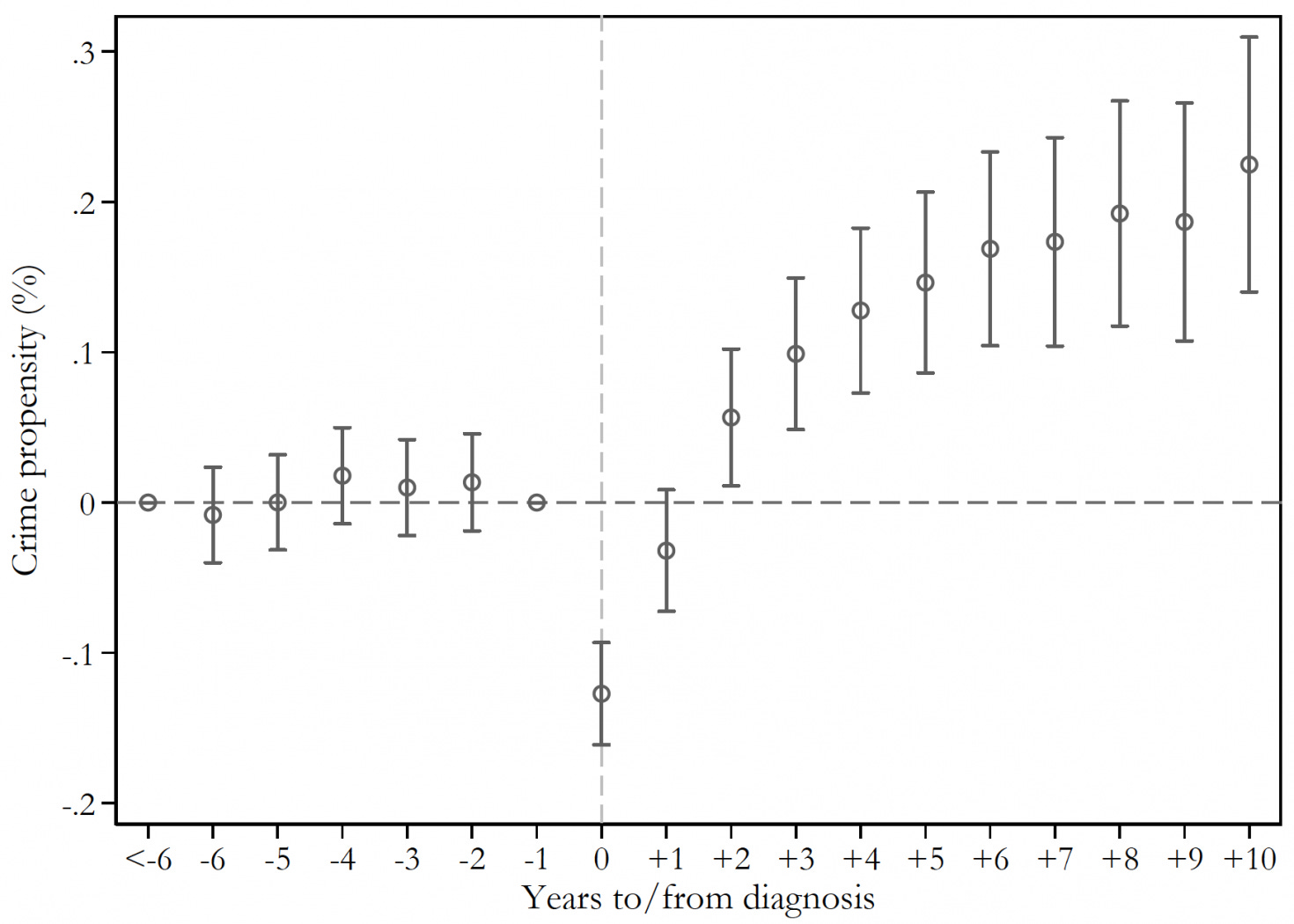
Cancer diagnoses are associated with a significant increase in criminal behavior. This seems to be the product of two main factors: financial stress and a reduced perceived cost of getting caught as a result of one’s impending demise. [Link.]
Twice in a Lifetime
How often do people experience passionate love? Surprisingly rarely. A survey of more than 10,000 US adults revealed that most experience it only once or twice in their lifetimes. Roughly 28% had fallen in love once, 30% twice, 17% three times, and 11% four or more times. Meanwhile, 14% had never been in love. The average was slightly higher for men than for women. [Link.]
Did Humans Evolve to Fear Spiders?
A classic claim in evolutionary psychology is that humans evolved to find snakes and spiders scary. A new paper argues instead that we evolved to find snakes and scorpions scary, and that our fear of spiders is simply a byproduct of mechanisms designed to make us wary of scorpions. This, the authors argue, makes good evolutionary sense: Scorpions were much more dangerous to our ancestors than spiders. [Link.]

Female Tortoises Walk Off Cliffs to Escape Male Harassment
When male tortoises outnumber females in a region, groups of males often sexually harass females. This increases the chances of females falling off cliffs - sometimes because overenthusiastic males accidentally push them, and sometimes because females deliberately opt for a risky, sometimes-fatal exit strategy. [Link.]

Pretend Play in Apes
A new paper in Science reports that a language-trained bonobo named Kanzi (now deceased) was capable of pretend play, making him the first nonhuman animal to demonstrate this capacity. In a clever series of experiments, researchers mimed pouring juice into one of two mugs. Kanzi kept track of the imaginary liquid, reliably pointing to it even after the mugs were moved around. The bonobo also kept track of an imaginary grape when a researcher pretended to transfer it from an empty container into a jar. [Link.]
When Politics Distorts Science
Given exactly the same dataset, different research teams came to opposite conclusions about the effects of immigration. Those in favor tended to find positive effects; those opposed tended to find negative ones - again, from exactly the same data. I have to say I find results like these extremely worrying. How can we ever trust research on politically charged topics? [Link.]