



This is the ninth excerpt from my book, A Billion Years of Sex Differences. You can access the full collection here, and pick up a copy of the book here.
In this installment, I introduce the greater male variability hypothesis: the controversial idea that, for many traits, males vary more than females. One implication of this is that sex differences can be modest or even absent at the mean, yet large at the tails of the distribution.
The excerpt is fairly brief, so I thought I’d make it a freebie. Hope you enjoy it!
How Sex Differences Can Be Large Even When They’re Small
2. Men and Women Sometimes Differ in How Variable They Are
There’s another reason that sex differences can sometimes be larger at the extremes than the mean. For some traits, one sex is more variable than the other – that is, the peak of the distribution is slightly lower for that sex, while the tails stretch out slightly further on either side. Most often, males are more variable, an observation that goes by the name the greater-male-variability hypothesis. What this implies is that even if the average scores for a trait are identical for both sexes, somewhat more men than women will be found at both extremes, while somewhat fewer men will be found in the centre (although to be clear, most will still be found in the centre; it’s a subtle effect).
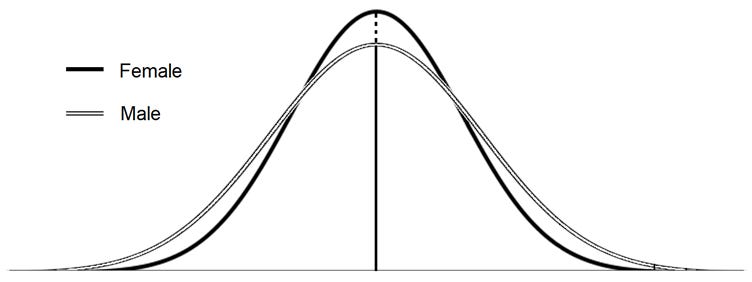
Greater male variability has been documented for a wide range of traits, including height, running speed, various brain parameters, daily energy expenditure, grades, aggression, risk-taking, some mate preferences, some personality traits, some occupational preferences, specific cognitive abilities such as verbal, maths, and spatial ability, and even general cognitive ability or intelligence.
The greater-male-variability hypothesis is controversial, and the subject of vigorous debate. Enemies of the hypothesis point out that variability sex differences are often trivially small, and that some studies don’t even find them. They also point out that, for some traits, women are more variable than men. (Curiously, greater female variability often centres on traits related to sexuality, including orgasm frequency, sex drive, and sexual enjoyment.) Still, the hypothesis has enough research behind it to justify taking it seriously. And to the extent that either sex exhibits greater variability, this may be an additional contributor to larger sex differences at the extremes than in the general population.
Upgrade to a paid subscription to read all excerpts from A Billion Years of Sex Differences. A paid subscription also gets you:
Full access to all new posts and the archive
Full access to exclusive content such as my “12 Things Everyone Should Know” posts, Linkfests, and other regular features
The ability to post comments and engage with the N3 Newsletter community
On top of that, you’ll be supporting my efforts to bring you intellectually honest science writing on a range of important topics - including topics that some writers and academics shy away from, such as evolutionary psychology, sex differences, gender issues, nature-nurture issues, and threats to freedom of speech.
You can pick up a copy of A Billion Years of Sex Differences here.
Follow me on Twitter/X for more psychology, evolution, and science.
Previous Excerpt
Sex Differences Are Often Larger at the Extremes

This is the eighth excerpt from my forthcoming book, A Billion Years of Sex Differences. You can access the full collection here, and preorder the book here.

Yes, that was what I was wondering about. Thank you.
In most amphibians, the females are larger than the males. Does their size also show greater variability?