



In Case You Missed It…
When it comes to politics, confidence and competence don’t always go hand in hand. In fact, often they go in opposite directions: The people with the least political knowledge are the most confident that they’ve got everything figured out - as shown in the figure below. (FOK = feeling of knowing; CJ = confidence judgments.)
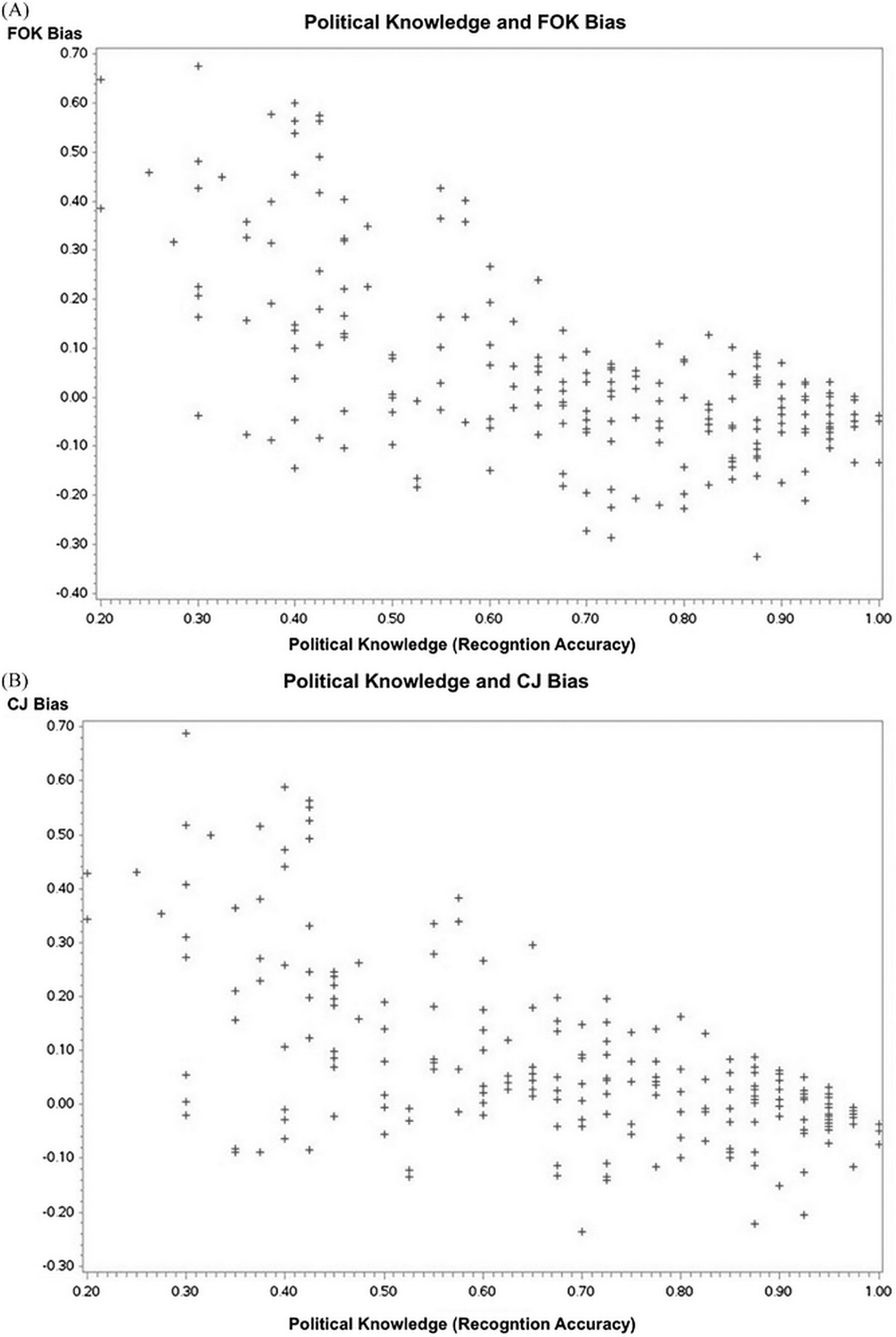
The figure comes from a paper by Erika Fulton and colleagues. Here’s the abstract:
Accurate metacognition is essential to informed political decisions and preventing the spread of misinformation, but research on metacognitive monitoring of political facts, outside of misinformation studies, has not met metacognitive research measurement standards. We addressed this limitation and assessed potential factors (political knowledge, political orientation, and cognitive style) related to this type of metacognitive monitoring accuracy. A sample of 216 Amazon Mechanical Turk participants completed measures of political orientation, political knowledge, and cognitive style, along with a test of political metacognitive monitoring accuracy, between February 2021 and March 2022. Participants were generally overconfident in their political knowledge, especially those with less political knowledge and who were more conservative, with conservatives also showing worse relative metacognitive accuracy. Cognitive style partially explained differences due to political orientation. Our participants were U.S. residents and disproportionately White, male, and lower-to-middle income, so studies of other samples and political contexts are needed for generalizability. Results also build on cue theory, showing that political knowledge and political orientation can act as metacognitive judgment cues. The study highlights the need to improve political metacognitive monitoring accuracy and reveals three targets for intervention: political knowledge, political orientation, and cognitive style.
You can access the paper here or request a free copy here.
Follow me on Twitter/X for more psychology, evolution, and science.
How You Can Support the Newsletter
This post was free to read for all. If you like what I’m doing with The Nature-Nurture-Nietzsche Newsletter, and want to support my work, there are several ways you can do it.
Like and Restack: Click the buttons at the top or bottom of the page to boost the post’s visibility on Substack.
Share: Send the post to friends or share it on social media.
Upgrade to Paid: A paid subscription gets you:
Full access to all new posts and the archive
Full access to exclusive content such as my “12 Things Everyone Should Know” posts, Linkfests, and other regular features
Full access to excerpts from my book A Billion Years of Sex Differences
The ability to post comments and engage with the growing N3 Newsletter community
If you could do any of the above, I’d be hugely grateful. The support of readers like you helps keep this newsletter going and growing.
Thanks!
Steve
Related Reading From the Archive
12 Things Everyone Should Know About Political Psychology

This is the latest post in my “12 Things Everyone Should Know” series. You can access the full collection here.

Imaginary Enemies

In this post, I’d like to tell you about one of the most fascinating papers I’ve read in the last few years. Led by the psychologist Victoria Parker, it’s about the causes and consequences of political polarization. Here’s my one-sentence summary of the paper:
Seems very similar to (or perhaps an example of) the Dunning-Kruger effect. While I don't doubt that this will bear out in future studies, this study is pretty limited in what we can draw from it imho.