


I’m very happy to report that I’ve just had an op-ed published in The Independent, titled “A Century of Evidence Tells Us Men and Women Are Different - Let’s Stop Pretending They’re the Same.” The piece summarizes some of the key arguments in my new book, A Billion Years of Sex Differences.
The road to publication was bumpier than I’d expected, ironically for reasons related to the very phenomenon the article highlights. Although the science of sex differences has advanced enormously over recent decades, discussing the topic remains contentious. Even modest, commonsensical claims can provoke strong reactions.
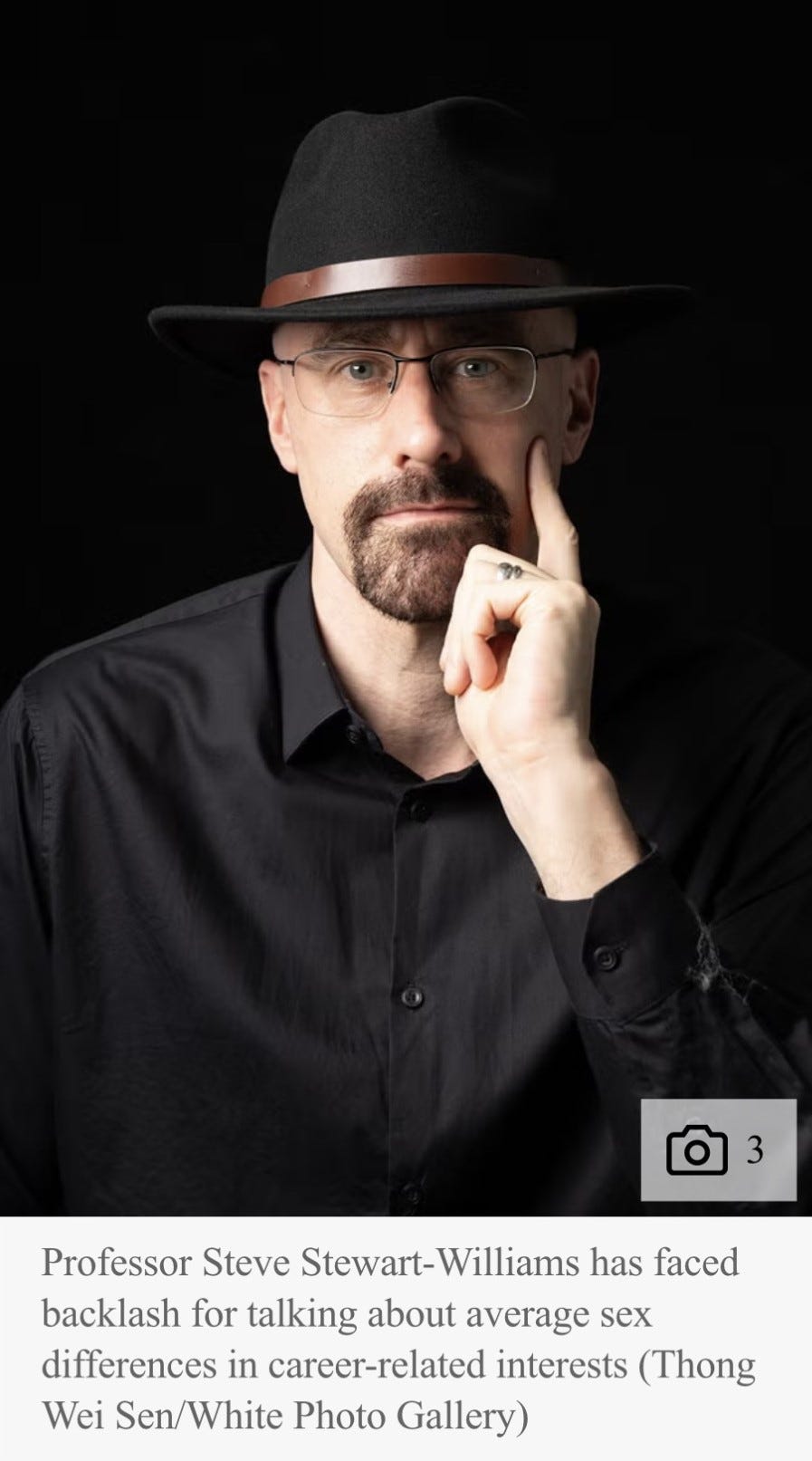
As I explain in the piece - and in the book - I got my first taste of this several years ago when I published an academic paper with Lewis Halsey about gender gaps in STEM professions. We argued that, although bias and barriers are part of the explanation, average sex differences in career-related interests and other relevant traits also contribute. I soon found myself at the center of an online controversy and was reported to my university’s equality, diversity, and inclusion office. Later I learned that the journal editor who handled the paper received calls from fellow academics to retract it - not due to errors or fraud, but as a way to censor the paper’s ideas.
To the credit of the university and the journal, nothing came of the complaints. But the episode drove home an uncomfortable truth: Talking honestly about sex differences is still a minefield.
The op-ed explores why that is, and why I think the controversy is misguided. Recognizing that men and women differ, on average, in certain traits is not incompatible with treating everyone equally and with respect. Indeed, if we care about improving people’s well-being, we have no choice but to follow the evidence wherever it leads.
Here’s a brief excerpt from the piece.
Why, then, does the topic generate so much heat? …
[One] reason is that many assume that generalisations about the sexes provide intellectual ammunition for sexism…
[But] we can’t just assume that differences imply deficiencies. As psychologist Diane Halpern observed, everyone agrees that men’s and women’s genitals are different, but no one would argue that either sex’s genitals are superior. The same applies to many psychological sex differences.
Indeed, it’s ironic that, in an age where we rightly celebrate differences and diversity, we often get outraged when anyone points any out. Not exactly tolerance of diversity!
Rather than supporting old-fashioned sexist views, the science of sex differences actively undermines them. It shows, for example, that there are no average sex differences in IQ (much to the surprise and disappointment of both sexes). And if either sex comes off worse, it’s men: men have higher rates of violence and criminality, for instance, and are more likely to abandon their children. Unless we think these are desirable traits, the science paints men in a less favourable light.
The larger point is that a commitment to equality doesn’t entail the denial of sex differences. We can treat men and women fairly and respectfully even if they’re not identical on every trait.
You can read the whole article here. And you can order A Billion Years of Sex Differences here.
Follow me on Twitter/X for more psychology, evolution, and science.
Further Reading
I cover the question of sex differences in career choice in depth in A Billion Years. In addition, I’ve written several academic papers with Lewis Halsey on the topic.
The main one - the one that ruffled a lot of feathers - is this 2021 paper in the European Journal of Personality:
Stewart-Williams, S., & Halsey, L. G. (2021). Men, women and STEM: Why the differences and what should be done? European Journal of Personality, 35, 3-39. https://doi.org/10.1177/0890207020962326 [Free version]
This was published alongside two commentaries - one favorable; one critical.
Ceci, S. J., Kahn, S., & Williams, W. M. (2021). Stewart-Williams and Halsey argue persuasively that gender bias is just one of many causes of women’s underrepresentation in science. European Journal of Personality, 35, 40-44. https://doi.org/10.1177/0890207020976778
El-Hout, M., Garr-Schultz, A., & Cheryan, S. (2021). Beyond biology: The importance of cultural factors in explaining gender disparities in STEM preferences. European Journal of Personality, 35, 45-50. https://doi.org/10.1177/0890207020980934
Here’s our response to the critical commentary:
Stewart-Williams, S., & Halsey, L. G. (2022). Not biology or culture alone: Response to El-Hout et al. (2021). European Journal of Personality, 36, 991–996. https://doi.org/10.1177/08902070211022477 [Free version]
From the Archive

Upgrade to a Paid Subscription
To help support my work, please consider upgrading to a paid subscription. A paid subscription will get you: (1) full access to all new posts and the archive, (2) full access to my “12 Things Everyone Should Know” posts, Linkfests, and other regular features, and (3) the ability to post comments and interact with the N3 Newsletter community.
Thanks!
Steve
This is one of the signs that Darwin’s revolution remains far from finished.
Related to this topic is the discussion surrounding the feminization of academia. It seems like the conservative opposition to female majority student bodies rests on the idea that empathy is inversely correlated with reasoning skills. How true is this?