



In Case You Missed It…
The Adolescent Personality Dip
Research on personality change across the lifespan has flourished in recent decades. Much of what we’ve learned is good news. For example, as people move through adulthood, they tend to become less neurotic, more conscientious, and more agreeable, at least until they retire.
When it comes to personality change in adolescence, however, the news isn’t quite so good. Across cultures, the teen years are marked by a temporary dip in many of the traits we consider most desirable. Teenagers commonly become less conscientious, less agreeable, and more neurotic. As personality researcher Colin DeYoung likes to say - and as parents of teenagers everywhere would probably agree - the teen years are the nadir of personality.
But although the general outline of teenage personality development is clear, many questions remain. When exactly does the teenage personality dip begin? Do both sexes experience the same personality makeover, or does it differ for boys and girls? And what fine-grained personality changes underlie changes at the broad trait level?

A recent longitudinal study from Norway addressed these fascinating questions. Silje Steinsbekk, Lars Wichstrøm, and Tilmann von Soest followed a representative sample of 805 teens, measuring their personalities at ages 10, 12, 14, and 16. Unlike most prior studies, they looked not only at the Big Five personality traits - conscientiousness, agreeableness, neuroticism, extraversion, and openness - but also at a selection of lower-order personality facets. The major results are summarized in the following two graphs.
Age and Sex Differences in the Big Five Personality Traits
The first graph shows how the Big Five personality traits differ by age and sex. The panels on the left show the observed mean scores for each sex from ages 10 to 16; the ones on the right show the estimated personality trajectories over that time.
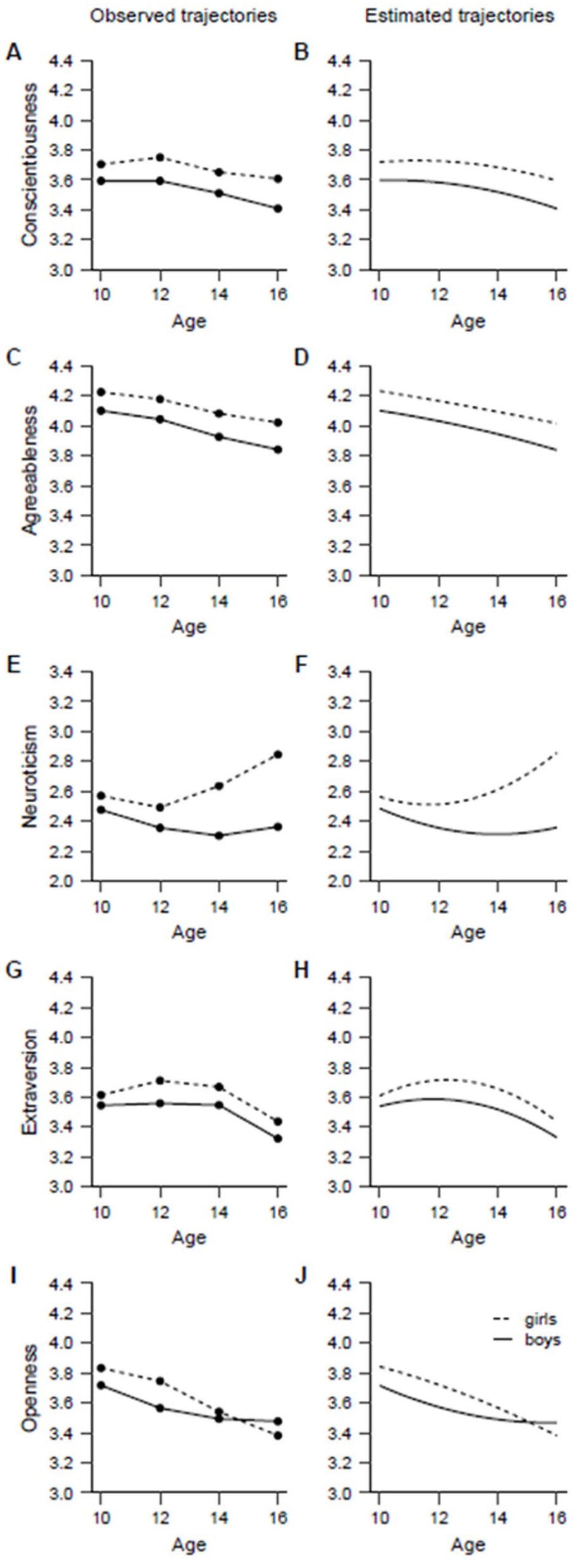
As you can see, conscientiousness declines in both sexes, starting at around age 12. This broadly matches earlier findings, although some studies suggest that the decline begins slightly earlier. Importantly, while the trajectory of change is similar for both sexes, boys score lower than girls at every age.