



In Case You Missed It…
Everyone knows the stereotype: Women are more empathetic than men. They find it easier to put themselves in others’ shoes, and they’re more concerned about others’ suffering. Most of us realize, of course, that within each sex, individuals differ a lot in how empathetic they are, and that some men are more empathetic than some women. On average, though, women show higher levels of empathy.
That’s the stereotype, anyway. But is it actually true?
For many decades, psychologists have answered this question with a tentative yes. On average, women score higher than men on standard measures of empathy. This is the case both for cognitive empathy (that is, the ability to take other people’s perspective) and for emotional empathy (the tendency to care about other people’s well-being).
But how large are the differences? Do they show up across cultures, or only in certain contexts? And where do the differences come from: socialization, biology, or some combination of the two?
A new large-scale study by Alicia Romero, Angel Blanch, and William Chopik helps answer these fascinating questions. Drawing on data from more than 100,000 participants from 24 countries, it offers one of the most comprehensive cross-cultural examinations of sex differences in empathy to date.
Let’s look at the study’s three main findings, captured in its three main graphs.
1. Across Cultures, Women Are More Empathetic Than Men
The first finding is also the most straightforward: Across cultures, women score higher than men on empathy. This is true for both cognitive empathy (perspective taking) and emotional empathy (empathic concern).
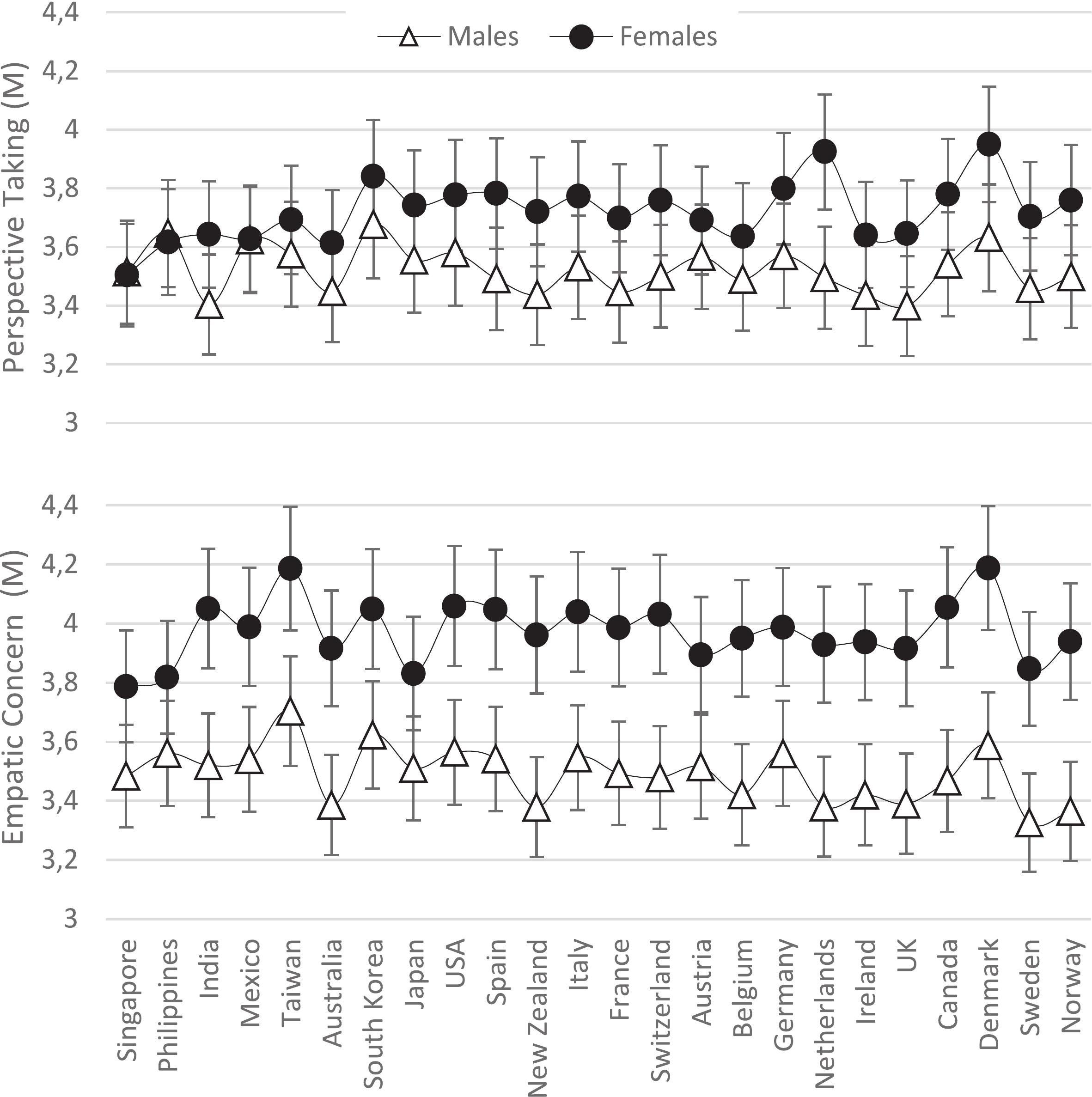
The cross-cultural robustness of the sex differences provides a strong reason to think that there’s a non-trivial innate contribution. If there wasn’t - if it were all just down to culture - we’d expect more variation in the direction of the effect across countries. In some countries, we’d find the standard differences; in others, we’d find no differences; and in others still, we’d find the reverse.
At the same time, the fact that the size of the differences varies across countries tells us that sociocultural factors matter as well. As usual, nature and nurture are both active participants in shaping the relevant differences.
2. Sex Differences Are Larger for Emotional Than Cognitive Empathy
Although women score higher than men on both aspects of empathy, the size of the differences varies. For emotional empathy, the average sex difference is fairly substantial (d = 0.65). For cognitive empathy, it’s noticeably smaller (d = 0.28). (See here for a guide to interpreting Cohen’s d effect sizes.)
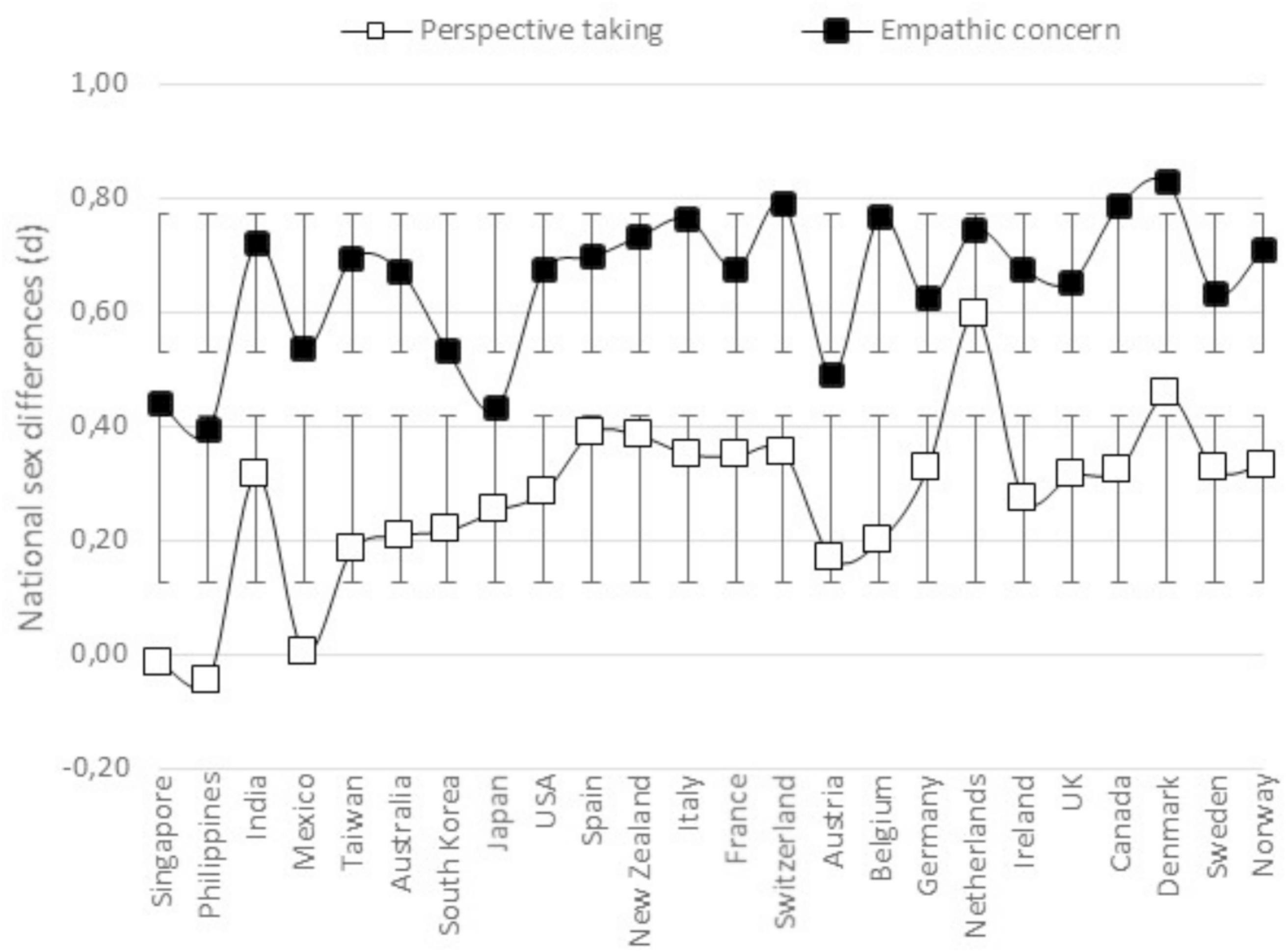
Interestingly, the researchers found more cross-national variability in the size of the sex difference in cognitive empathy than emotional empathy. One possible explanation is that the sex difference in emotional empathy is more biologically canalized, whereas the difference in cognitive empathy is more flexible and sensitive to environmental inputs.
Why that might be is anyone’s guess. My guess is that it’s because emotional empathy is more closely linked to the selection pressures that gave rise to greater female empathy in the first place. The original selection pressure was the need for maternal care. In most mammals, mothers provide more childcare than fathers - indeed, in most, mothers provide all the childcare and fathers none. A concern about others’ well-being may help facilitate maternal care. Thus, the sex difference in emotional empathy plausibly traces back to our earliest mammalian ancestors. In our species, the scope of emotional empathy has been extended beyond offspring to other kin, mates, and friends. Nonetheless, it remains more central to women’s social style than men’s.
Cognitive empathy, in contrast, is less closely related to childcare, and thus selection might not have fixed the sex difference here so strongly. A natural corollary is that it varies more from culture to culture.
To be clear, these are my speculations, not the authors’ - and they are speculations, not final verdicts or a fully fleshed-out theory.
3. Sex Differences in Empathy Are Smaller Nearer the Equator than at Higher Latitudes
The most intriguing finding of the study concerns geography. Sex differences in empathy tend to be smaller in countries closer to the Equator, and larger at higher latitudes. This effect is particularly pronounced for cognitive empathy, where latitude accounts for nearly half the variation (R2 = .48). For emotional empathy, on the other hand, it accounts for only around a quarter (R2 = .28), consistent with the idea that this difference is more biologically canalized.
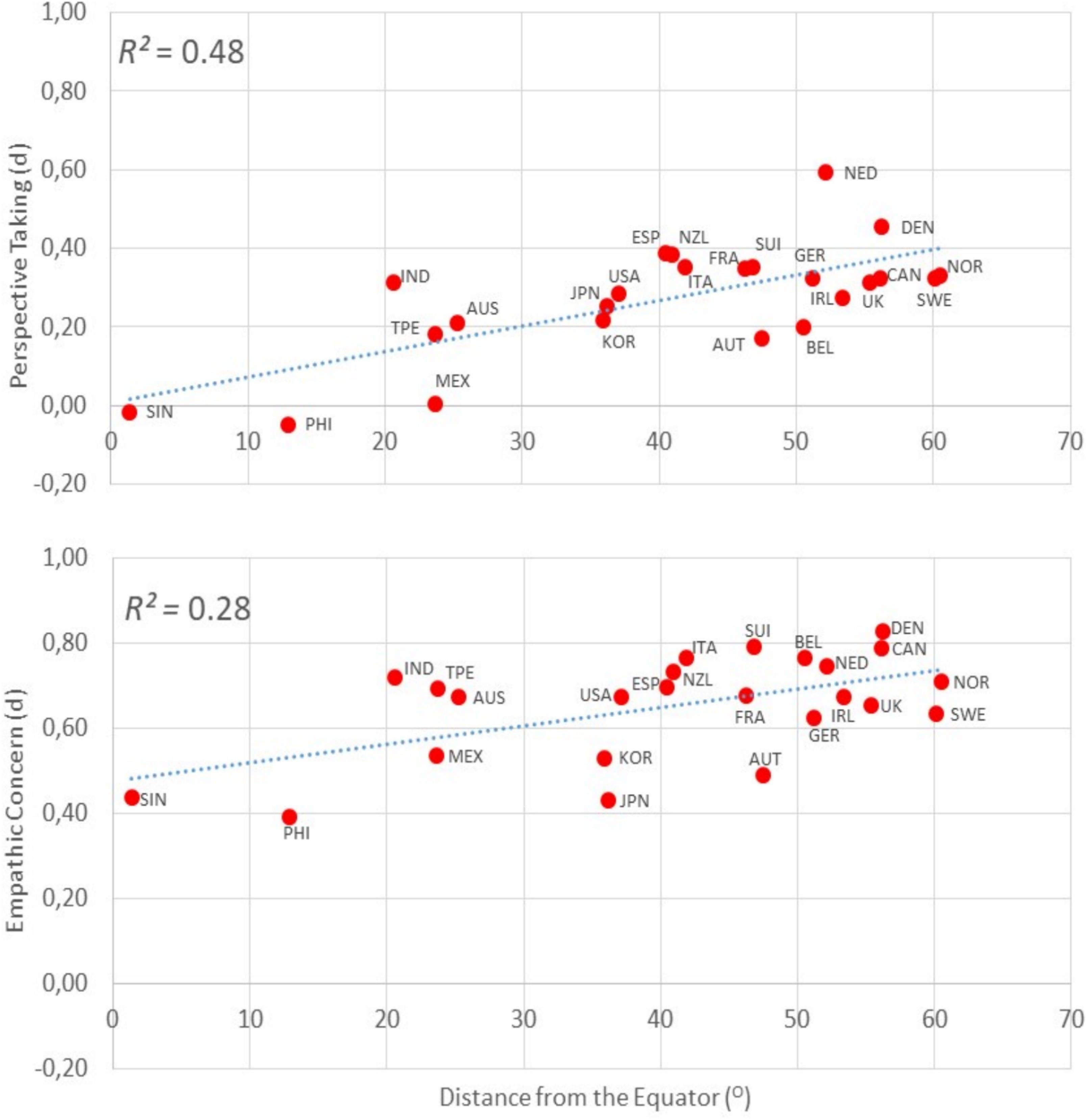
The authors suggest a possible explanation for the pattern - roughly, that colder, more variable climates create a cultural selection pressure for greater cooperation, which amplifies certain empathy-related traits. I have to say that I don’t find this idea convincing. Aside from anything else, it seems to me that it would only explain cross-national differences in overall levels of empathy, rather than in the size of the empathy sex difference.
I’m more persuaded by another possibility, namely that the finding is an example of what’s come to be known - not entirely accurately - as the gender-equality paradox. This is the observation that many sex differences are larger, rather than smaller, in more gender-equal nations. Nations farther from the Equator tend to meet that description, so the geographical distribution of empathy sex differences could fit the gender-equality-paradox rubric.
Now, the authors did look at the relationship between gender equality and the magnitude of the sex differences, and found that while gender equality explained some of the variance, distance from the Equator explained more. At first glance, this seems to refute my hypothesis.
Like I say, though, the gender-equality paradox is somewhat misnamed. I’ve long argued that it’s not gender equality per se that creates the effect, but rather any societal-level variable that increases people’s freedom to choose their own path through life. This includes not only gender equality but also wealth, individualism, and education. When people have more freedom, individual differences have more room to express themselves - and average differences between the sexes often grow larger. Nations farther from the Equator tend to score higher on all the variables associated with greater freedom of choice, which I suggest is why distance from the Equator correlates with the size of the sex differences.
One reason to favor my explanation over the authors’ is that theirs explains the pattern only for traits related to cooperation. Mine, in contrast, explains it for all traits that expand in conditions of greater freedom - which include many traits unrelated to cooperation.
Summary
The cross-cultural ubiquity of sex differences in empathy, along with their amplification in freer societies, suggests that they’re not just products of culture or rigid sex roles. Instead, the differences are an integral part of human nature. Women are naturally more empathetic than men.
From an evolutionary standpoint, this isn’t particularly surprising. Across mammalian species, females usually bear greater responsibility for the young. As such, selection may have favored greater female sensitivity to others’ emotional states. In humans, both sexes exhibit significant empathy. But women exhibit more of it - and this difference may have its roots in our deep evolutionary past.
You can access the Romero paper here
For more on sex differences, you can read excerpts from my book A Billion Years of Sex Differences here, and pick up a copy here
Follow me on Twitter/X for more psychology, evolution, and science
A Pitch
This article was free to read for all. If you enjoyed it and would like access to all Nature-Nurture-Nietzsche-Newsletter content, please consider becoming a paid subscriber. A paid subscription gives you:
Full access to all new posts and the complete archive
Full access to excerpts from my book A Billion Years of Sex Differences
Full access to exclusive content such as my “12 Things Everyone Should Know” posts, Linkfests, and other regular features
The ability to post comments and engage with the growing N3 Newsletter community
You’ll also be supporting my broader project of spreading important ideas and knowledge, and making a space for free thought and politics-free science.
Thanks!
Steve Stewart-Williams
From the Archive
Sex Differences in Personality Across Cultures

Are sex differences in personality a cultural artifact or a human universal? A new 27-nation study offers fresh answers to this enduring question. With more than 143,000 participants from nationally representative samples, Beatrice Rammstedt and her team examined male-female differences in the
Sex and Age Differences in Self-Esteem

In this post, I’d like to discuss a fascinating 2016 paper by Wiebke Bleidorn and colleagues. The paper is about sex and age differences in self-esteem: one of the best-studied concepts in psychology.
Decoding the Gender-Equality Paradox

One of the most surprising discoveries of the last few decades is known as the gender-equality paradox. This refers to the fact that, for a large number of traits, sex differences are larger, rather than smaller, in more gender-equal nations. The finding is surprising because it seems entirely plausible that, in cultures where men and women are treated differently and play different roles in society, sex differences will tend to be magnified. Even if there’s an innate contribution to many sex differences, this seems like a reasonable expectation. But the reasonable expectation turns out to be wrong. In fact, it’s not just wrong; it has things back-to-front, at least for some traits.
I'd be interested in a graph of "gracile features" vs "cognitive empathy". If the theory that we have "domesticated ourselves" by removing those most prone to reactive aggression from our gene pools is correct, then you would expect that those who repeatedly fell into reactive aggression because the only reason they could see for somebody's behaviour is "he disrespected me" (due to a lack of empathic cognition) would be among the first to get the chop.
The analyses in the Romero paper strike me as quite primitive. They seem to have carried out only simple regressions (Table 1), with each predictor separately. Given that all these factors are confounded with each other across countries, the data obviously seem to call for multiple regressions. Even if distance to the equator is the largest correlate in simple regressions, this might reverse once all confounders are taken into account!
Fortunately the data are included in the paper, so the multiple regression can be run by the next person who finds the time.