



In Case You Missed It…
A new paper in Nature Medicine brings together pain data from more than six million people in 118 countries. Among other things, it finds that, across the world, women are more likely than men to experience every type of pain examined.
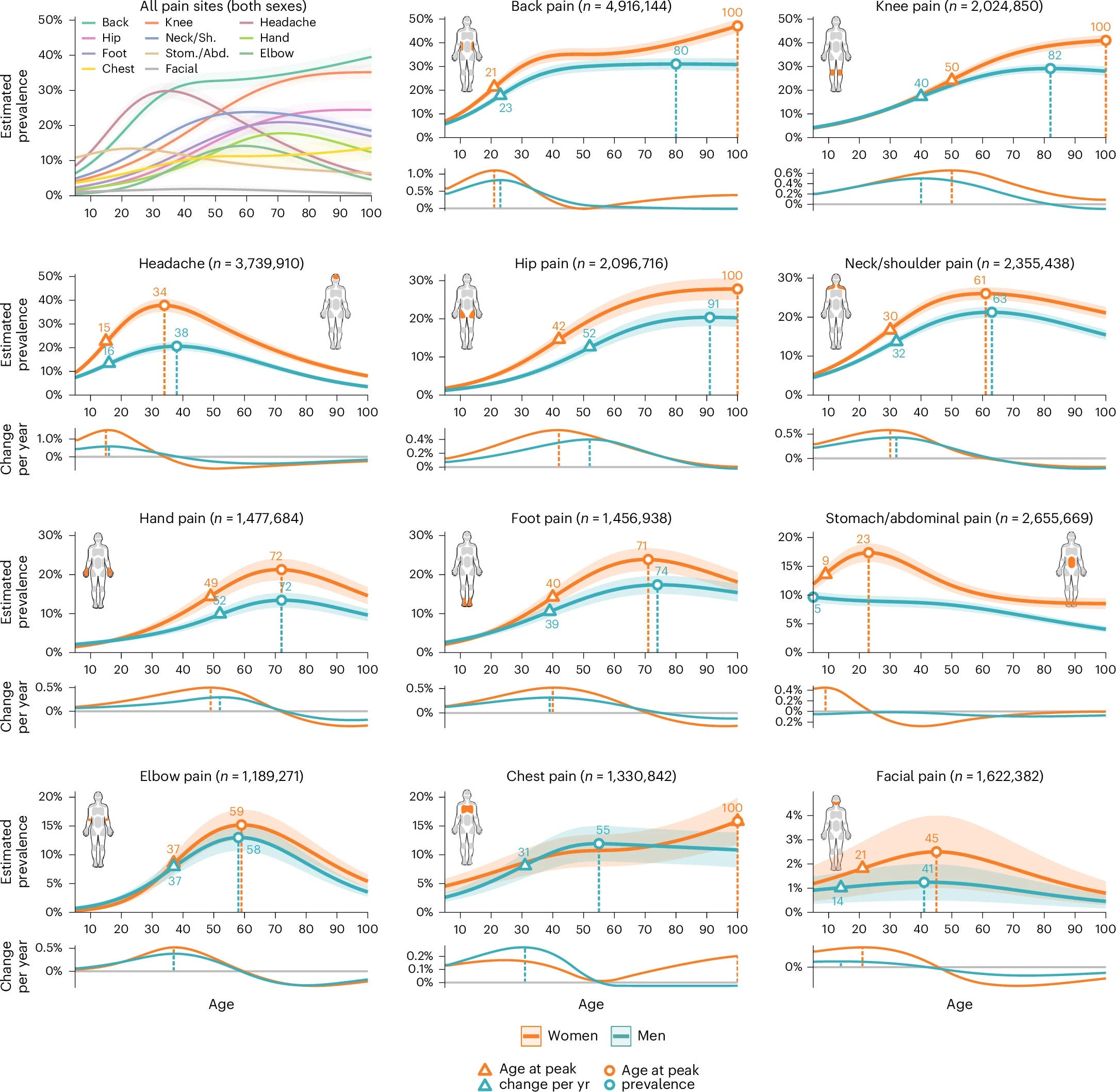
Below are two graphs from the paper. The first shows the prevalence of pain at 11 bodily sites for each sex across the lifespan. As you can see, women are more likely than men to report pain at every site. Note that the truncated y-axes make the gaps look larger than they would on scales spanning from 0 to 100%.
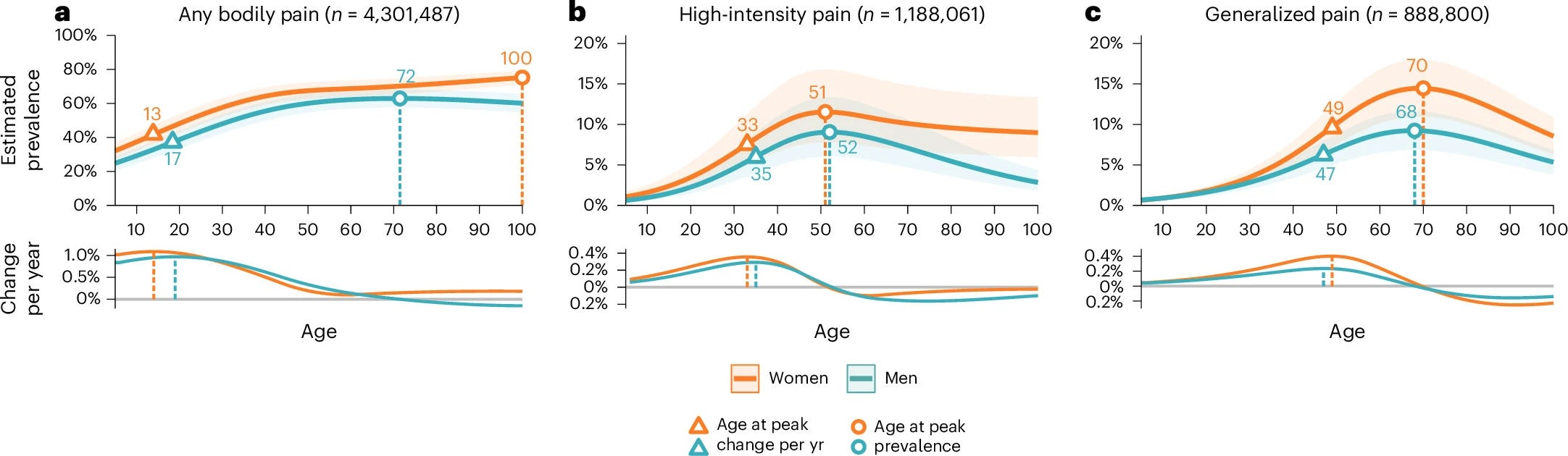
The second graph shows the prevalence of any bodily pain, high-intensity pain, and generalized pain across the lifespan for each sex. Again, women are more likely than men to report pain in all three categories.
Some thoughts:
The sex differences are smaller than I would have predicted. As I discuss in my book A Billion Years of Sex Differences, women are more susceptible than men to pain, for good evolutionary reasons. As such, I would have expected larger gaps in pain prevalence, especially for more extreme forms of pain. (Sex differences tend to be larger at the extremes.)
Age is a stronger predictor of pain than sex. For many forms of pain, the differences across ages are considerably larger than the differences between men and women.
Pain doesn’t always become more common with age. Although the prevalence of any bodily pain rises steadily, high-intensity pain peaks around age 50, while generalized pain peaks around 70. Several site-specific forms of pain also peak in early adulthood, midlife, or early old age, then decline from that point on.
What should be the policy response to the finding that women and older people suffer more pain? In my view, we should adopt an individual-focused rather than a group-focused approach: We should aim to tackle pain in every individual who experiences it, rather than primarily targeting those demographics in which its prevalence is somewhat higher. Because women and older people experience more pain, this approach would mean people in these groups ultimately get more help - but with less risk of overlooking people in groups where pain is less common.
The paper is open access, so you can read it for free here.
For more on sex differences in health and mental health, check out my book A Billion Years of Sex Differences. [Read the first chapter here for free.]
Follow me on Twitter/X for more psychology, evolution, and science.
Coming Soon to The Nature-Nurture-Nietzsche Newsletter…
Sex Differences in Toy Preferences
The Book Cordelia Fine Reviewed Isn’t the Book I Wrote (my response to Fine’s review of A Billion Years of Sex Differences)
The Dinosaurs That Evolved Primate-Level Intelligence - and Never Went Extinct
Upgrade to a Paid Subscription
To help support my work, please consider upgrading to a paid subscription. A paid subscription will get you: (1) full access to all new posts and the archive, (2) full access to my “12 Things Everyone Should Know” posts, Linkfests, and other regular features, and (3) the ability to post comments and interact with the N3 Newsletter community.
Thanks!
Steve
Related Reading From the Archive
12 Things Everyone Should Know About Sex Differences

“Weak people run from new ideas, or so it seems, and then are driven into bizarre mind states, such as believing that words have the power to dominate reality, that social constructs such as gender are much stronger than the 300 million years of genetic evolution that went into producing the two sexes.”
Sex Differences in Disease Burden

This post is free to read for all. To support the Nature-Nurture-Nietzsche Newsletter, please consider a paid subscription. This will get you: (1) full access to all new posts and the complete archive, (2) full access to my “12 Things Everyone Should Know
Sex Differences in Mental-Health Problems in Childhood and Adolescence

I wasn’t planning to post again till the weekend, but I just came across this fascinating graph in a new paper in JAMA Psychiatry. It shows sex differences in the prevalence of a range of mental-health difficulties in people aged 5 to 24 years.