



Discovering that someone is willing to protect you from physical harm makes them vastly more attractive. Conversely, discovering that someone is unwilling to protect you turns them into a hideous troll. Interestingly, this is true for both women and men.
Those are the headline findings from recent research by Michael Barlev, Sakura Arai, the late John Tooby, and Leda Cosmides. Across seven experiments involving more than 4,500 participants in total, people read vignettes describing scenarios in which a date or a friend either protected or failed to protect them. They were then asked to rate the person’s attractiveness as a romantic partner or friend.
The main results are captured in the following three graphs.
The first shows how men and women rate other-sex individuals as romantic partners based on two factors: their willingness to protect them from a violent attack and their physical strength. The main takeaway is that willingness to protect boosts attractiveness over and above strength.
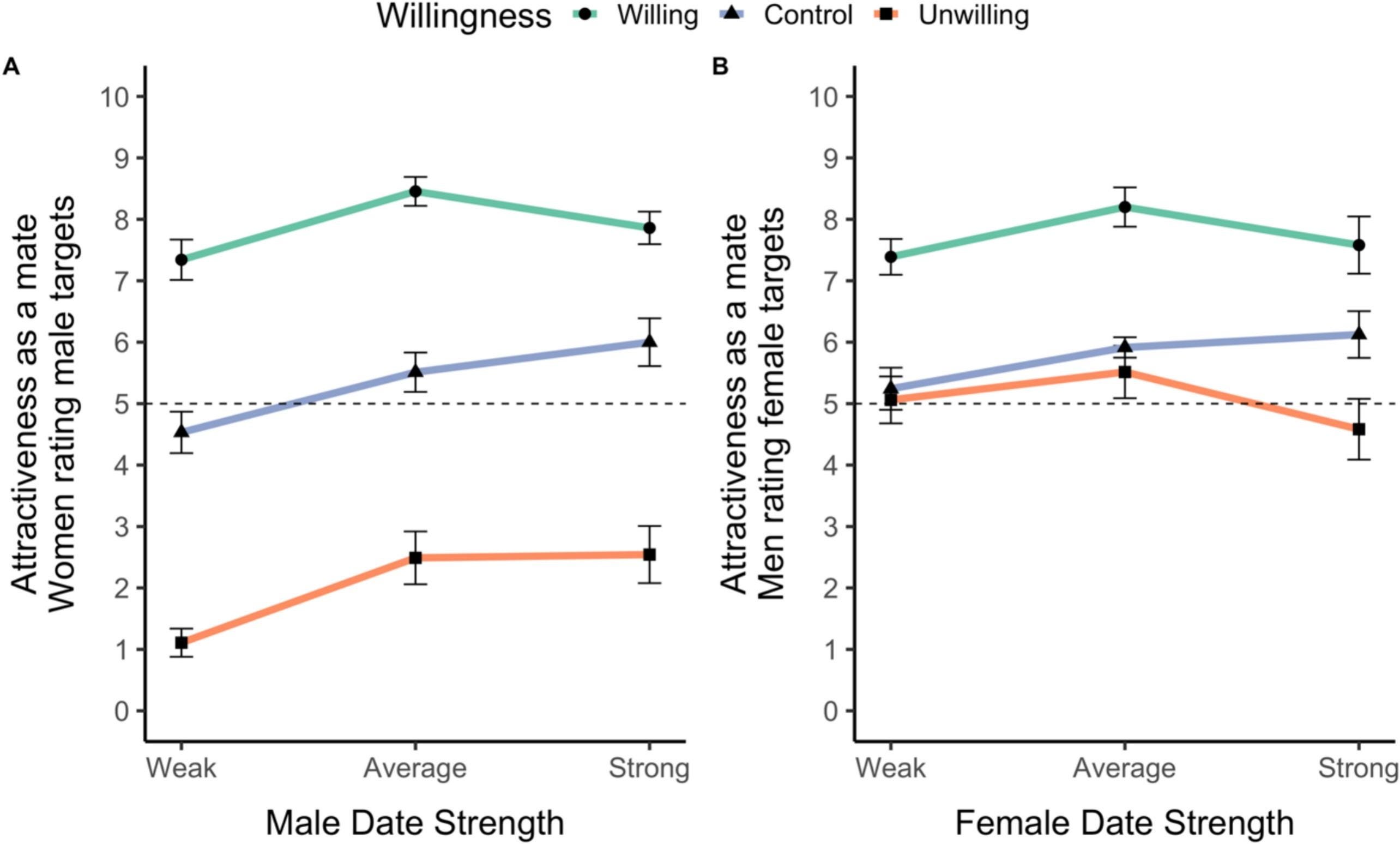
This is an important result, because it rules out a simple alternative explanation for the protectiveness finding - namely, that it’s not protectiveness per se that people find attractive but rather physical strength, and that they just assume that anyone willing to protect them must be strong. Strength is attractive, especially in men. But so is protectiveness. In fact, protectiveness turns out to be more attractive than strength! Notice as well that unwillingness to protect is much more off-putting to women rating men than to men rating women.
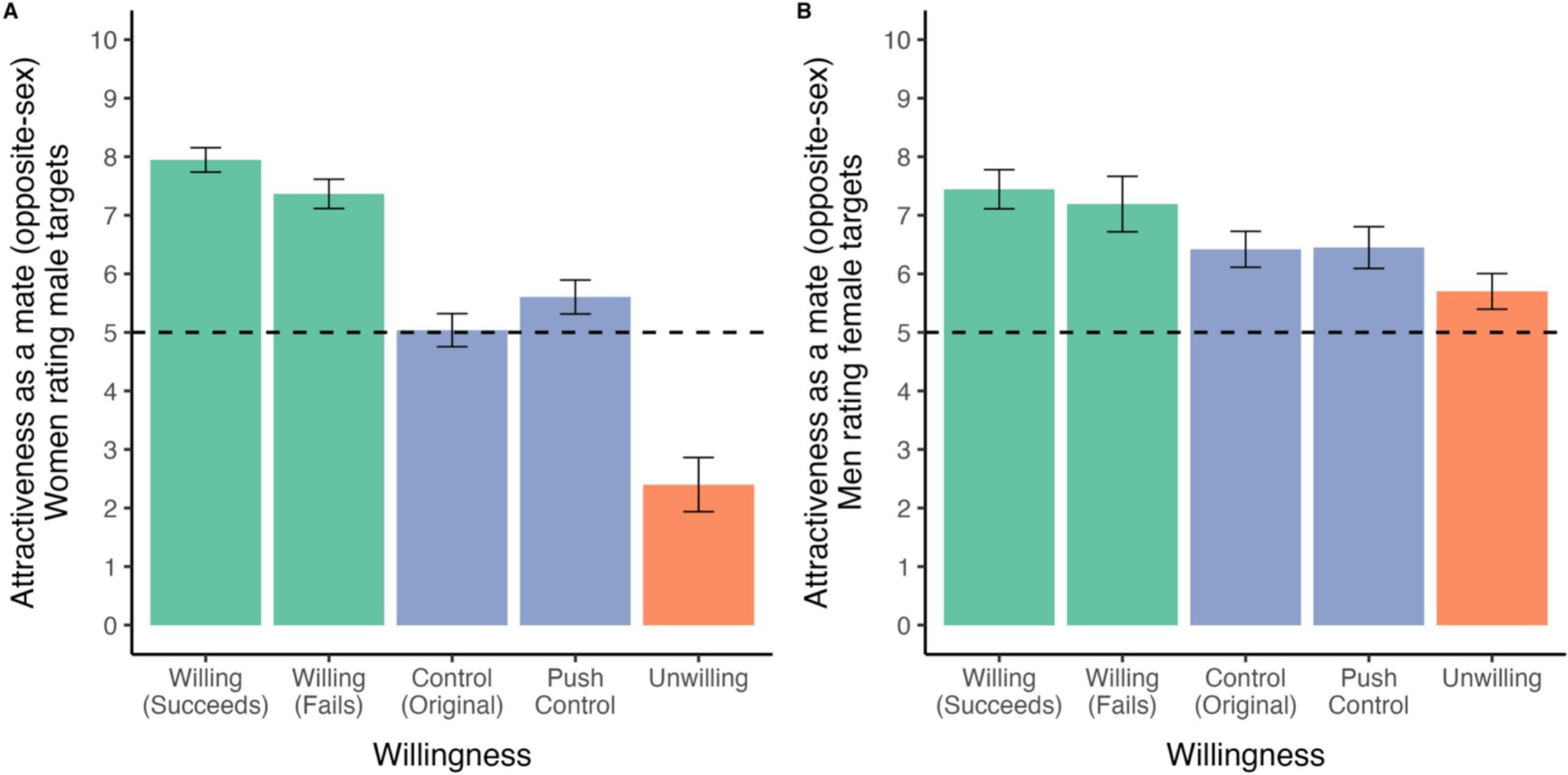
The second graph shows something even more intriguing: that a potential romantic partner’s willingness to protect you increases their attractiveness even when they fail to do so. Participants read a vignette in which they were on a date when a drunk approached and tried to hit them. The date either successfully intervened, tried but failed, or didn’t try at all. As the graph below shows, trying and failing was almost as attractive as successfully intervening. Simply showing willingness to step in signals protectiveness, which we apparently find deeply appealing.
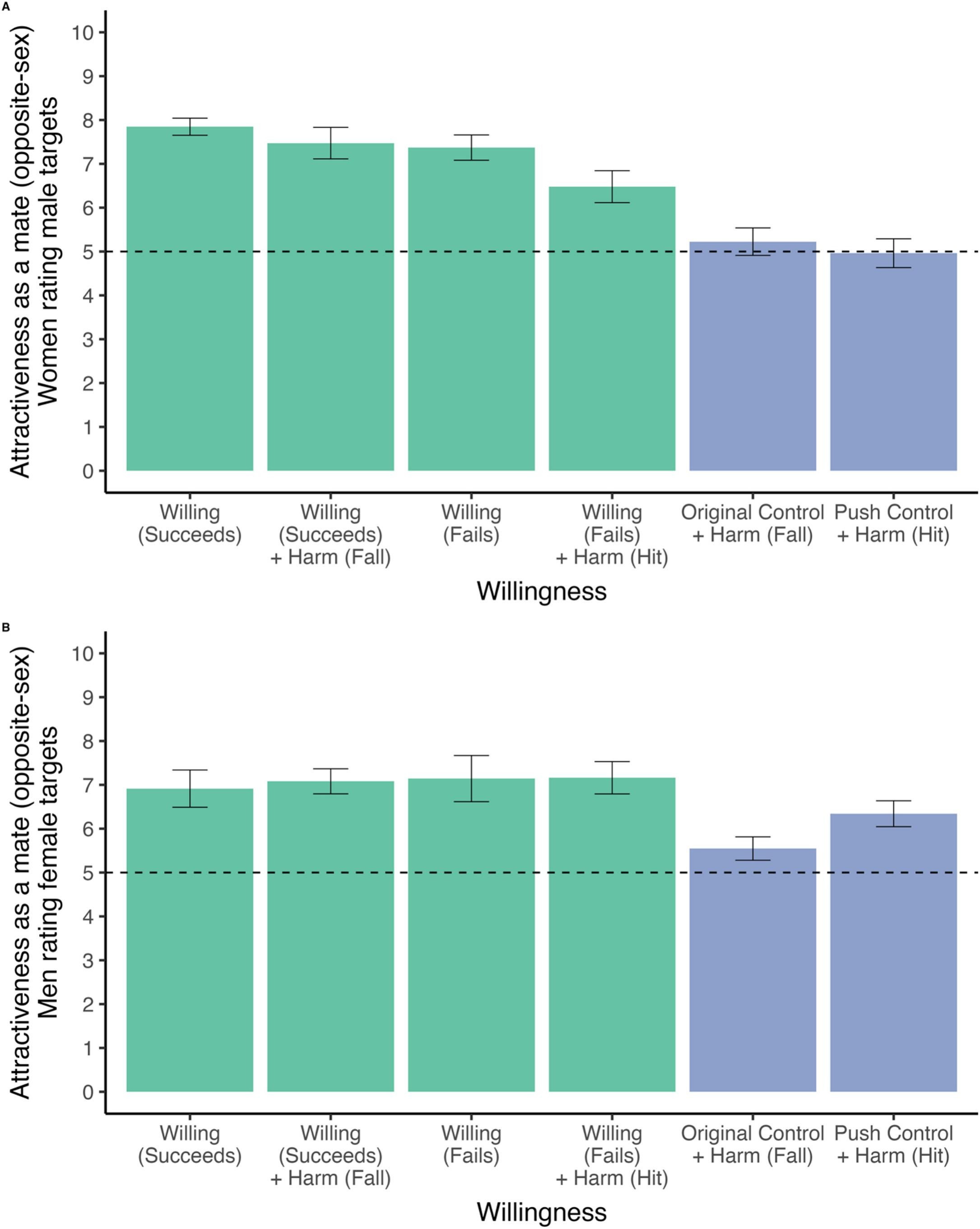
The third and final graph adds a new wrinkle: Not only does willingness to protect boost a date’s attractiveness even when the attempt fails, but it even boosts attractiveness when the date accidentally harms you in the attempt. Once again, what seems to matter is the underlying intention rather than the outcome in this particular case.
As mentioned, the three graphs come from a recent paper by Barlev et al. Here’s the abstract.
Ancestrally, physical violence from conspecifics was a recurrent adaptive problem. Did selection favor preferences for partners who are both strong (highly able) and willing to protect us from violence? Strength and willingness are interrelated, so dissociating their effects is necessary. Here we assessed both inferences and preferences. In 7 experiments (N = 4,508 U.S. adults recruited via MTurk), we systematically varied the willingness of a date or friend to physically protect you from an attack, compared to scenarios where you do not have this information. We also varied that person’s strength. Discovering that a person is willing to protect greatly increased their attractiveness as a romantic partner or friend, regardless of their strength. This held for both women and men raters, and when evaluating both opposite- and same-sex dates and friends. In fact, partners who were willing to protect were attractive even if they tried to do so but failed, and even if you were harmed because of their failure. Discovering that a partner is unwilling to protect decreased their attractiveness, and was a deal-breaker for women evaluating a male date. Unwillingness decreased attractiveness more when the rater was a woman, when the target was a man, and when the target was being evaluated as a date versus friend. Women placed some importance on a male date’s strength, but this was mostly due to inferences about his willingness to protect them. Surprisingly, we found only weak evidence that differences in strength, independent of willingness, increased the attractiveness of a partner.
You can access the Barlev paper here or request a free version here.
For more on human mating psychology and sex differences, check out two most recent books:
A Billion Years of Sex Differences. [Read the first chapter here for free.]
The Ape That Understood the Universe. [Read the first chapter here for free.]
Follow me on Twitter/X.
Coming Soon to The Nature-Nurture-Nietzsche Newsletter…
12 Things Everyone Should Know About Wokeness
Who Engages in More Science Denial, Left or Right?
20 Cognitive Biases That Are Messing Up Your Thinking
How You Can Support the Newsletter
This post was free to read for all. If you like what I’m doing with The Nature-Nurture-Nietzsche Newsletter, and want to support my work, there are several ways you can do it.
Like and Restack: Click the buttons at the top or bottom of the page to boost the post’s visibility on Substack.
Share: Send the post to friends or share it on social media.
Upgrade to Paid: A paid subscription gets you:
Full access to all new posts and the archive
Full access to exclusive content such as my “12 Things Everyone Should Know” posts, Linkfests, and other regular features
Full access to excerpts from my book A Billion Years of Sex Differences
The ability to post comments and engage with the N3 Newsletter community
If you could do any of the above, I’d be hugely grateful. The support of readers like you is what helps keep this newsletter going.
Thanks!
Steve
Related Reading From the Archive
12 Things Everyone Should Know About Evolutionary Psychology

This is the latest post in my “12 Things Everyone Should Know” series. You can access the full collection here.
The Evolution of Violence

[I]f modern Western societies had homicide rates as high as some foraging peoples, a male graduate student would be more likely to be killed than to get a tenure-track position.

This is fascinating. I wonder if it also applies to psychological protection. E.g., defending a partner’s reputation, demonstrating loyalty and fidelity. And by extension, if a partner is more attractive for those types of protective behavior, is later harm by that partner (betrayal, failure to defend, verbal abuse, etc.) then even more destructive to their attractiveness quotient?
the findings are stunning, in terms of how they disentangled strength and willingness to protect.
i’ve yet to read the paper…what i dont understand is why would males find that attractive of females?