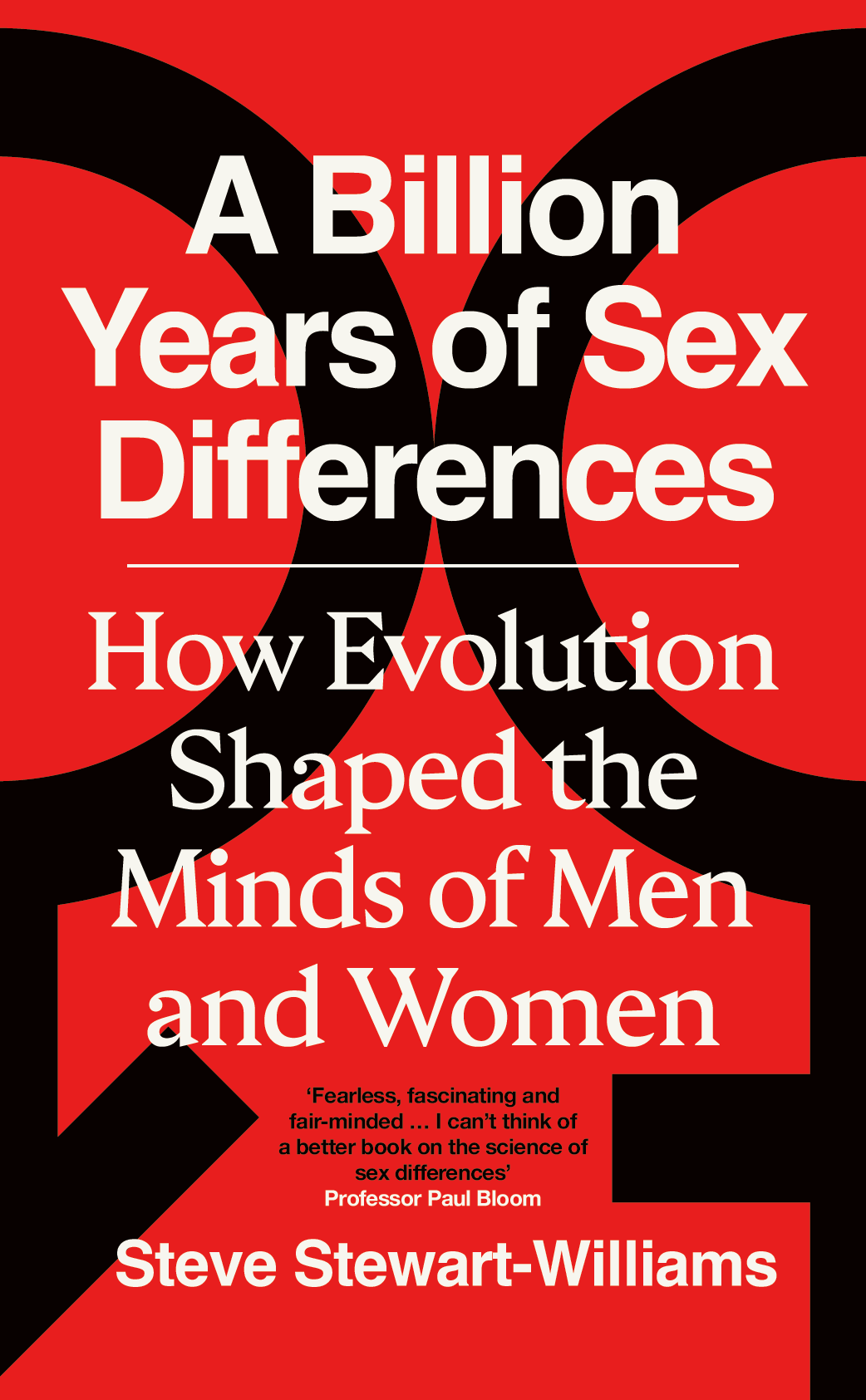


The first negative review of my book A Billion Years of Sex Differences was recently published in The Conversation. It’s by Cordelia Fine, one of the big names in sex-differences minimization, so a negative review was basically a foregone conclusion.
I was initially happy to see the review, despite it being negative. The only options for any author are taking some flak or being ignored, and I’d much prefer the former. And although Fine and I disagree on a lot, I’ve always seen her as a thoughtful and incisive critic, so I was looking forward to a good challenge to my ideas.
Unfortunately, though, I ended up being quite disappointed by the review, which I thought was careless and misleading. Here are my main complaints.
Fine misrepresents my views. She presents various points as rebuttals to my position when they’re points I fully agree with and make myself in the book. Anyone who reads the review but not the book itself will come away with a highly distorted picture of what I argue.
Fine takes her usual tack of arguing for something close to a blank-slate view of psychological sex differences, while simultaneously denying that she’s arguing for something close to a blank-slate view of psychological sex differences.
Fine zooms in on weaknesses in the evidence for an innate contribution, while ignoring stronger evidence and the overall thrust of the evidence. Meanwhile, she applies nothing like the same scrutiny to evidence for a sociocultural contribution. This asymmetrical treatment of the data virtually guarantees an inaccurate view of human sex differences.
In this response to Fine’s review, I tackle these and other issues.
What I Argue in A Billion Years of Sex Differences
The starting point of A Billion Years of Sex Differences is the well-established fact that men and women differ, on average, in many important ways. We differ in sexual inclinations, the things we value in a romantic partner, aggression, parenting, personality, career interests, toy preferences, cognitive abilities, and more. These differences - which I call the standard-issue sex differences - are generally quite modest, but they’re important nonetheless. I explore three main questions about them in the book.
The first is: Where do the differences come from? My view is that they’re not just products of culture; they’re shaped by natural selection as well. In fact, sex differences sometimes appear despite culture, not because of it - and culture sometimes makes sex differences smaller than they’d otherwise be, not larger.
The second question is: Why did the innate contribution to the differences evolve? The short answer is that it’s because men can in principle have more offspring than women: A man who had three sexual partners in a year, for example, could potentially have three offspring, whereas a woman who had three partners would probably have no more offspring than she would if she only had one. This asymmetry doesn’t just produce evolved sex differences in sexual inclinations - men’s greater interest in casual sex and sexual variety, for instance - but also differences in seemingly unrelated traits such as status-striving, aggression, and risk-taking.
The third question is: How should we deal with the differences? I suggest that there are three main approaches, which I call gender-role traditionalism, gender-role progressivism, and gender-role individualism. Roughly speaking, these are: prop up traditional sex differences, fight traditional sex differences, and let people be themselves. I favor the third approach.
I argue in the book that we’re not necessarily stuck with what nature has given us, but that we may sometimes be better off if we learn to live with the differences between men and women rather than trying to eliminate them.
This isn’t to say, however, that we should just sit back and do nothing. In my view, we should do everything we reasonably can to eliminate bias and barriers, introduce everyone to every option, and empower people to pursue the options they find most alluring. Having done that, though, we should respect men’s and women’s decisions about their own lives and how they want to live them.
Fine’s “Alternative” Explanation for Psychological Sex Differences
It’s fair to say, I think, that Fine is not sympathetic to this position. In her estimation, I overstate the importance of nature, relegating nurture to a mere bit player. She, in contrast, argues for a much stronger focus on the role of nurture. This centers on social role theory, garnished with cultural evolution.
Social role theory traces back to the work of psychologist Alice Eagly in the 1980s. The key idea is that, for the most part, psychological sex differences are not directly innate. Instead, they’re primarily offshoots of the gender roles of the local culture, with those roles being shaped largely by innate physical sex differences.
For example, because men are bigger and stronger than women, they tend to be channeled into roles such as hunter, protector, and warrior. Meanwhile, because women get pregnant and nurse the young, they’re channeled into the childcare role and roles compatible with caring for children. Participation in these roles then molds men’s and women’s personalities, preferences, and abilities, creating the psychological sex differences we see in most societies.
I’ve always liked the logic of social role theory. For various reasons, though, I think it falls short as a complete explanation for human sex differences. I give these reasons in the course of discussing female-male differences in mate preferences, aggression, and parenting (pp. 154-155, 174, and 195-196; for further discussion, see this paper I wrote with Andrew Thomas, pp. 258-263).
Fine, however, seems to treat my entire discussion of the nature-nurture issue - in particular, the discussion in Chapter 3 - as an extended argument against social role theory. That’s a mistake; social role theory is just one sociocultural explanation among many, and it’s her primary focus, not mine. Perhaps as a result of that mistake - coupled with the fact that she muddles my position on the nature-nurture issue - Fine radically mischaracterizes my arguments against social role theory.
In her view, I have two. The first is that nurture has little impact. The second is that there’s good evidence for a strong innate contribution to many sex differences. This gets things about as wrong as it’s possible to get them: I don’t argue that nurture has little impact, and I don’t argue that evidence for an innate contribution is evidence against social role theory - or any other sociocultural explanation. Let’s consider each point in turn.
Nurture Matters a Lot - and I Say So
One of the central claims in Fine’s review is that, in my opinion, nurture has only weak effects on human psychological sex differences. This, she suggests, places me “at the extreme ‘nature’ end of the scientific spectrum.”
I strongly dispute this assessment. With the exception of sexual orientation (p. 57), I don’t argue that nurture has only weak effects. On the contrary, I explicitly state that it often has large effects. To be fair, I do suggest that, for many sex differences, nurture is less important than nature (p. 57). But “less important” doesn’t mean “not important,” and nowhere do I say that the effects of culture are trivial.
With that in mind, let’s consider the places where Fine claims that I do.
Claim: “[E]vidence for nurture’s influence is weak, [Stewart-Williams] argues. A key part of his case is the so-called gender-equality paradox.”
Verdict: False.
The gender-equality paradox is the counterintuitive finding that sex differences are often larger, rather than smaller, in wealthier, more individualistic, more gender-equal nations. Contra Fine, I don’t argue that the gender-equality paradox shows that the effect of nurture is weak. Indeed, the paradox is itself an effect of nurture!
What I do argue is that the gender-equality paradox - along with various other challenges to sociocultural explanations - shows that our current crop of sociocultural theories doesn’t do a good job of explaining nurture’s contribution (pp. 63-67). I’m quite explicit about this, stating that “although culture matters enormously when it comes to sex differences… we have far less idea how it does than we usually think” (p. 67).
To be clear, I do argue that the gender-equality paradox clashes with social role theory (pp. 65, 174). But that’s not because it implies that nurture has little impact. It’s because social role theory predicts the opposite pattern: that sex differences will be smaller in more gender-equal, less patriarchal nations. More on the gender-equality paradox soon.
Claim: “[S]tudies showcase considerable cross-cultural variation in sex differences… This seems to undermine one of his core claims: that nurture’s influence on sex differences is weak.”
Verdict: False.
Cross-cultural variation does indeed undermine the claim that nurture’s influence is weak. Again, though, that’s not a claim I make. Not only is cross-cultural variation perfectly compatible with my position, I mention it several times in the book to make exactly the point Fine is making: that human sex differences are shaped to an important extent by nurture. For example, in the early pages of Chapter 1, I note that:
learning, socialization, and culture clearly play a role in shaping the standard-issue sex differences. If they didn’t – if the differences were entirely due to nature – they’d presumably be invariant across cultures and times, which they’re not.
So, the issue isn’t whether nurture is involved in shaping the differences; it’s whether nurture is the whole story. (p. 13)
Claim: “Stewart-Williams thinks gender roles and hierarchy are, at root, a consequence of psychological sex differences.”
Verdict: Incomplete.
It is true that I think society’s gender roles often take shape around pre-existing psychological sex differences. But I also think that the causal arrow points the other way. In Chapter 10, for instance, I argue that “Genuine but modest sex differences give rise to exaggerated stereotypes of men and women. These then become enshrined in the norms and the laws of society: norms and laws which force everyone into the mould of the average” (p. 243). Nor do I think that gender roles merely magnify evolved sex differences; at various places in the book, I make clear that they often push against them (e.g., pp. 69-71, 119-120, 168-169, 196-197, 220).
In contrast, like many social role theorists, Fine only really acknowledges one side of the equation: gender roles shaping psychological sex differences. If either of us takes an extreme view, therefore, I’m pretty sure it’s not me.
Claim: “[H]is mantra - to ‘let people be themselves!’ (so long as they don’t cause harm) - reflects the extreme perspective that socialisation plays a minimal role in people’s self-understanding.”
Verdict: False.
Granted, I do think that, for some traits, the contribution of nature is large enough that completely eliminating the differences would only be possible with coercive interventions that do more harm than good. But that’s not because social factors have a trivial role; it’s because innate factors don’t have a trivial role. They’re often influential enough that we need to take them seriously. That’s perhaps the main thing that Fine and I disagree about.
I should also point out that, when I say we should let people be themselves, I fully acknowledge that the selves in question are shaped in part by socialization (p. 272). In fact, it’s precisely because socialization is important that I think we should introduce everyone to every option and give people the tools to pursue the options they prefer.
As far as I’m concerned, though, the fact that we’re shaped in part by socialization doesn’t license would-be social engineers to try to eliminate sex differences - any more than it would license them to try to make the differences bigger. As long as all the doors are open to everyone, and no one’s prevented from pursuing the path they choose, we should let people make up their own minds (p. 272).
Hiding the (Almost) Blank Slate
Ironically, in mischaracterizing my views in these ways, Fine attributes to me an extreme, one-sided position that actually characterizes her own views, albeit in reverse. Indeed, I suspect that my views seem extreme to her for the same reason that a moderately lit room seems bright when you first leave a movie theater: because her starting point is so extreme.
At first glance, this might seem unfair. Fine states several times that she accepts that both nature and nurture contribute to the development of human psychology and sex differences. She notes, for instance, that “we all agree our minds are not blank slates, genetically endowed with nothing more than general-purpose learning abilities”; that “None of this is to deny the sex-differentiated biological influences on male and female minds that surely exist”; and that “Stewart-Williams is right that our evolutionary history, including sex-linked biology, must play some role in any satisfying explanation of sex differences in our minds.”
Such claims give the impression that Fine takes a balanced nature-nurture-interactionist view of sex differences, and might suggest that our only real disagreement is about the relative contributions of nature and nurture. The problem is, though, that other than the sentences where she claims not to hold a blank-slate view, she gives every appearance of holding exactly such a view, or something close to it. For example:
Fine describes social role theory as an alternative to an evolutionary psychological explanation, implying that it’s one or the other: nature or nurture. And if those are the only options, it’s clear what side she’s on.
Fine discusses at length how innate physical sex differences could indirectly shape psychological differences through their effect on gender roles, but mentions direct innate influences almost entirely in the context of critiquing the evidence for them.
Fine proposes that we’ve evolved to pick up gender norms from culture because “genes can’t predict which behaviours will be advantageous in diverse and changing gender systems,” and that “For any trait, sensitivity to gender norms… may make genetic inheritance of that information unnecessary.” Both statements are rationales for blank-slatism or near-blank-slatism with respect to psychological sex differences. (Both are also extremely implausible, as we’ll see soon.)
Fine states that “Evolution has not ‘shaped’ the minds of men and women in the biologically deep-rooted way Stewart-Williams suggests,” which seems to imply that she thinks that any innate influences are relatively trivial.
Even statements that seem to unequivocally concede a role for nature turn out to be ambiguous. For example, like other social role theorists, Fine agrees that we’re not blank slates, which might seem to imply that she accepts a direct innate contribution to some sex differences. But that’s not what she’s saying; she’s saying that humans don’t just have innate general-purpose learning abilities, but have some domain-specific abilities as well - including, for instance, the “supercharged capacities for social learning” that make us such a culturally flexible species. The question at issue, though, isn’t whether we’re blank slates in every possible sense; it’s whether we’re blank slates with respect to psychological sex differences.
Another example: Fine says that “sex-linked biology must play some role in any satisfying explanation of sex differences,” which again seems to concede a role for nature. But the claim that “biology plays a role” is ambiguous: It could mean that there’s an innate contribution to the differences, or that the differences have a basis in the brain or endocrine system. Although we often conflate these ideas, they’re not the same - after all, brains and hormone levels aren’t shaped only by nature; they’re shaped by nurture as well, and any given brain or hormonal sex difference could in principle be entirely due to nurture. The question isn’t whether psychological sex differences are instantiated in the brain and body - where else could they be instantiated? The question is how those differences got there. Is there a direct innate contribution? Fine doesn’t give a clear answer.
The upshot is that Fine’s position seems much closer to a blank-slate account than her occasional disclaimers suggest.
I could be wrong! Maybe Fine really does accept a direct, non-trivial innate contribution to many psychological sex differences. If so, though, she should say as much, rather than skirting ambiguously around the issue. Until that time, we’re well within our rights to think that she’s promoting something close to a blank-slate view of psychological sex differences. We can’t ignore the blank-slate implications of statements like those above just because she also denies that she’s saying we’re blank slates.
The Gender-Equality Paradox
In her defense of social role theory, Fine takes aim at my discussion of the gender-equality paradox. As mentioned, this is the finding that sex differences are often larger, rather than smaller, in wealthier, more gender-equal nations. That’s a problem for social role theory because it’s the opposite of what the theory predicts.
What might explain the paradox? My (tentative) explanation is that it’s not a product of gender equality per se, but rather of any variable that allows people to act on their preferences and nurture their talents, including not only gender equality but also wealth, individualism, and education. In such conditions, nascent differences between individuals - and average differences between the sexes - have more opportunity to flower and grow. According to Fine, “this downgrades nurture to little more than a background resource: an extreme position on how complex human traits develop.” Of course, even if that were true, it wouldn’t imply my explanation is false. But in any case, it’s not true. My proposal is that certain environmental factors facilitate the flourishing of early-emerging individual differences. It’s not that all environmental factors do nothing other than facilitate the flourishing of early-emerging individual differences.
Is my explanation accurate, though? Fine points to a recent paper by Mathias Berggren and Robin Bergh that challenges it - and indeed that challenges the existence of the gender-equality paradox in the first place. The researchers found that, when controlling for countries’ membership in seven broad cultural groups, the relationship between gender equality and various sex differences vanished or, in some cases, flipped. The same was true of other variables associated with developmental potential, including individualism and national wealth. Within cultural regions, such variables were not reliably associated with larger sex differences. This suggests that it’s not these variables that create the effect, but rather something confounded with them at the level of cultural groups.
I take Berggren and Bergh’s challenge seriously; after they published their paper last year, I somewhat downgraded my confidence in both my explanation for the gender-equality paradox and the reality of the phenomenon. I haven’t reached any firm conclusions yet, though, as the debate is still ongoing (see, e.g., here for a recent contrary finding).
When it comes to the implications for social role theory, however, it makes little difference. Even if Berggren and Bergh are 100% right, their data still fail to provide strong support for the approach. That’s because, for most traits, the researchers found no relationship between gender equality and the magnitude of the relevant sex differences, whereas social role theory predicts that they’ll be smaller in more gender-equal nations.
In contrast, an evolutionary psychological perspective doesn’t predict that they’ll necessarily be larger. That was an unexpected discovery of cross-cultural researchers, rather than an expectation based on evolutionary principles. My own prediction, before seeing the data on the paradox, was that, even accepting an innate contribution to many sex differences, greater gender inequality and stricter gender roles would pry the sexes further apart - an example of my nature-nurture-interactionist default. I was just as surprised by the data as the social role theorists were.
Epistemic Double Standards
According to Fine, my second major argument against social role theory is “strong evidence for nature’s powerful role in creating sex difference[s].” This is another example of Fine’s carelessness in presenting my views. I don’t argue that evidence for an innate contribution disproves social role theory or any other sociocultural explanation; I argue that it disproves a Nurture-Only or blank-slate approach to the differences. Unless we assume that social role theory is by definition a Nurture-Only approach, evidence for an innate contribution is not inconsistent with social role theory - after all, there could be an innate contribution plus a contribution from social roles. Only a blank-slater or genetic determinist would assume otherwise.
Curiously, Fine does appear to assume otherwise, and thus tries to play down the evidence for an innate contribution. In doing so, she employs a tactic she also uses in her books: She homes in on any weaknesses in the evidence for such a contribution, while ignoring stronger evidence and the overall direction of the literature. This isn’t a novel observation on my part; many have pointed it out over the years. For example, in a 2010 review of Fine’s book Delusions of Gender, sex-differences expert Diane Halpern noted that:
Despite the large amount of junk science on the topic that is reported in the popular media and in some academic outlets, there are also consistent findings of sex differences that hold up across studies, across species, and across cultures. Most of these are ignored by Fine.
At the same time, Fine gives evidence for sociocultural contributions a much easier ride. It’s hard to think of a better way to arrive at an inaccurate view of any topic.
Prenatal Hormonal Exposure
Fine’s discussion of the evidence for a prenatal hormonal contribution to many sex differences nicely illustrates her epistemic double standard. The evidence in question includes the fact that girls and women with congenital adrenal hyperplasia or CAH - a condition in which people are exposed to high levels of androgens in the womb - are in various ways somewhat masculinized. Fine observes that “studies have failed to reliably show greater aggression in girls with congenital adrenal hyperplasia, compared to girls without the condition.” This is true and surprising. Other research, however - including research on nonhuman mammals and same-sex-attracted men and women - more consistently supports a prenatal hormonal contribution to the aggression sex difference (p. 172). Meanwhile, various independent lines of evidence - including developmental, cross-cultural, and cross-species evidence - converge with the prenatal hormonal studies in suggesting an innate contribution (pp. 168-177). Fine doesn’t mention any of this; she just highlights the anomalous finding. But every literature has anomalous findings, so this approach could be used to cast doubt on any empirical claim at all.
Fine does note that girls and women with CAH show somewhat male-typical toy and career preferences. She does her best, however, to avoid the obvious inference that the usual sex differences are partly due to prenatal androgen exposure. To that end, she suggests an alternative explanation for the pattern. This revolves around a study in which children were given a selection of toys arbitrarily labeled either boys’ toys or girls’ toys. Some of the children had CAH; others didn’t. Among those who didn’t, most boys played with the so-called boys’ toys and most girls with the so-called girls’ toys, despite the fact that the gender labeling was random. Interestingly, CAH girls were unaffected by the labeling, which Fine acknowledges could be a result of prenatal androgens. The key finding for her argument, though, is that, among the non-CAH children, arbitrary gender labeling strongly influenced their play behavior.
It’s an interesting study, which I cite in the book. But like any study, it’s not beyond criticism. Among other things, the experiment was brief, the setting was artificial, the sample was small, and the finding has yet to be replicated. However, whereas Fine pounces on problems in the evidence for innateness, she doesn’t mention problems with this evidence. Her evidentiary standards differ depending on the findings.
More importantly, Fine seems to assume that if cultural factors can shape toy preferences, then maybe we don’t need to posit an innate contribution. This can be seen in her description of the study as suggesting “another explanation” of the sex differences. Once again, this tacitly assumes an either-nature-or-nurture framing - and once again, if those are the options, it’s clear what side she’s on.
My own view is: Of course cultural factors shape toy preferences! The only thing I’d add is that these preferences aren’t shaped only by cultural factors. The gender-labeling study certainly doesn’t show that they are, any more than the CAH studies show that the differences are shaped only by prenatal hormones. My default assumption is that prenatal hormones and cultural factors both play a role. Fine’s seems to be that it’s basically the latter. Again, who holds the more extreme view?
Other Animals and Cultural Evolution
A further line of evidence for an innate contribution - one I personally find more persuasive than the prenatal hormonal research - is the fact that many sex differences we see in humans are seen in other animals as well. When we find the differences in other species, we immediately credit them to natural selection. When we then find the same differences in our own species, the most reasonable assumption is that they have the same ultimate origin for us. It’s logically possible that we have the same sex differences for entirely different reasons. But if so, it’s a strange coincidence.
Fine’s response to this argument once again reveals her implicit near-blank-slatism regarding sex differences. Different species, she observes, evolve different balances of genetic vs. non-genetic inheritance, and humans lean especially strongly on culture. This applies as much to gender roles as to anything else. According to Fine, humans need to be flexible in this domain because “genes can’t predict which behaviours will be advantageous in diverse and changing gender systems.” The implication, presumably, is that selection removed the innate push toward the sex differences we see in other species - or at least made the differences biologically weakly rooted.
I completely agree that humans lean more heavily on culture than any other species, and that evolutionary psychologists have sometimes underplayed this. That was a major theme of my second book The Ape That Understood the Universe. But that’s not incompatible with the idea that we also have strong innate nudges toward certain sex differences. In fact, I’d argue that, as we evolved our cultural capacity, the need for such nudges became greater to ensure that cultural evolution would tend to be channeled in biologically adaptive directions. As I put it in A Billion Years of Sex Differences, “without any innate guidance, culture could easily go off the rails” (p. 196).
So, which is it? Did the evolution of our cultural capacity lead to the near removal of any direct innate contribution to psychological sex differences, or did it increase the importance of such contributions? The answer may come down to whether the differences remained adaptive. As we’ve seen, Fine suggests that genes can’t predict what will be advantageous in our species. But is this really plausible? Is it really the case that genes can’t predict whether a greater interest in sexual variety, greater aggression, or greater risk-taking will be more adaptive for men or women? Is it really the case that genes can’t predict whether greater choosiness about sexual partners will be more adaptive for women or men?
Surely not. The selection pressure favoring these differences - namely the fact that men can potentially have more offspring - didn’t just evaporate with the advent of culture. It continued to characterize human societies everywhere. Outsourcing the job of building sex differences to culture alone would risk maladaptive learning. Why, then, would selection remove the innate contribution?
Without a satisfactory answer to this question, the fact that we’re a hyper-cultural species shouldn’t count against the idea that the basic sex differences we find in human beings everywhere have a non-trivial innate basis. The fact that the same differences are also found in many other species only strengthens this conclusion.
The Sex Differences Debate Deserves Better Than This
In her books, Fine discusses some of the potential harms of uncritical acceptance of nativist explanations for sex differences: If people get an exaggerated picture of the extent to which the differences are innate, they’ll be less likely to attribute societal gender gaps to discrimination, less likely to think they can be changed, and less likely to strive for gender equality.
I agree that these are legitimate concerns, and say as much in A Billion Years of Sex Differences (pp. 26-27). The question is, though: What’s the best way to deal with this potential problem? Fine’s approach seems to be to downplay innate contributions and play up the role of the environment: to give people the impression that we’re close enough to being blank slates that we don’t need to reckon with evolved sex differences. Unfortunately, this leads her to distort the science.
Given the dangers of exaggerating sex differences, you might wonder whether it’s safest to err in this direction. But as I argue in the book, it’s not, because there are also dangers of minimizing or denying the differences. Probably the clearest example is that it can lead us to overlook medical and psychiatric disorders that present differently in one sex than the other. But there are plenty more examples where that came from (pp. 27-28, 252-265).
With dangers of erring in either direction, the only responsible policy, in my view, is to talk straightforwardly about innate contributions to female-male differences, while also taking care to correct common, potentially harmful misconceptions - to emphasize, for instance, that the differences are generally small; that the environment also matters a lot; that “natural” doesn’t mean “good”; that we’re not necessarily stuck with the way things are; and that we can and should aim to root out discrimination regardless of the relative contribution of nature and nurture to any given sex difference. I made a considerable effort to do this in A Billion Years of Sex Differences. Sadly, Fine has misled her readers about this, giving the impression that I instead argued for something close to a Nature-Only position.
As mentioned, I was disappointed with this review. For the most part, Fine argues not with me but with a stereotype of an evolutionary psychologist - and as a result, she attacks a book I didn’t write. I’m under no illusions that the book is perfect. I’m sure a good critical review could be written of it. Such a review, however, would have to come from someone with a less extreme, more balanced view on the topic.
You can read Fine’s review here.
You can pick up a copy of A Billion Years of Sex Differences here.
Follow me on Twitter/X for more psychology, evolution, and science.
Upgrade to a Paid Subscription
If you’d like to support my work, please consider upgrading to a paid subscription. A paid subscription will get you:
Full access to all new posts and the archive
Full access to my “12 Things Everyone Should Know” posts, Linkfests, and other regular features
Full access to excerpts from A Billion Years of Sex Differences
The ability to post comments and interact with the N3 Newsletter community
On top of that, it will help support my efforts to carve out a space for free thought and non-politicized psychological science.
Thanks!
Steve Stewart-Williams