



In Case You Missed It…
I recently sat down with Nikil Mukerji and Timur Sevincer of the German skeptic group GWUP to discuss evolutionary psychology, nature and nurture, and my new book, A Billion Years of Sex Differences. The interview appeared in Skeptiker magazine last week, but Nikil and Timur kindly agreed to let me reproduce it here.
Before we get to that, though, a quick request. This article is free to read for everyone. If you enjoy it and would like access to all Nature-Nurture-Nietzsche content, please consider becoming a paid subscriber.
A paid subscription gives you:
Full access to all new posts and the archive
Full access to exclusive content such as my “12 Things Everyone Should Know” posts, Linkfests, and other regular features
Full access to excerpts from A Billion Years of Sex Differences
The ability to post comments and interact with me and the N3 Newsletter community
Paid subscriptions also help support my efforts to explore important and controversial topics, and give me the financial freedom to follow the evidence wherever it leads without fear of cancellation.
Thank you - and now, on with the interview.
In this conversation with Timur Sevincer and Nikil Mukerji, Steve Stewart-Williams discusses what evolutionary psychology actually claims, how the field can deepen our understanding of human nature, where the field has gone wrong, why the charge of pseudoscience misses the target, and how skeptics should respond when real science becomes politically unwelcome.
Common Misunderstandings About Evolutionary Psychology
Timur Sevincer: As skeptics, we care about pseudoscience, but also about exaggerated, distorted, or plainly false scientific claims. Which claims about sex differences or evolutionary psychology are most often misrepresented?
Steve Stewart-Williams: The list is long!1 A common view is that evolutionary psychology is a way to justify existing social roles, especially traditional sex roles. Another is that it’s a way to excuse misbehaviour, especially male misbehaviour. I think both claims are false.
Explaining a behaviour is not the same as morally justifying it. To think otherwise is to commit the naturalistic fallacy – the mistaken assumption that what’s natural is therefore morally right. We have to decide for ourselves what’s right and wrong. We shouldn’t let natural selection dictate our ethics. Evolution can explain behaviour without excusing it.
Another common claim is that evolutionary hypotheses are unfalsifiable. I don’t think that’s true either. Evolutionary hypotheses are falsifiable,2 and many have been falsified. More of my own hypotheses than I’d care to admit have been falsified. I’ve come up with a hypothesis and done the research, then reality has said: No, you’re wrong about that.
A further misunderstanding is that evolutionary psychologists think men and women are virtually different species: women are monogamous, men are promiscuous; women are choosy, men will sleep with anything that moves; men care only about a woman’s looks, women only about a man’s resources. None of this is what evolutionary psychologists claim. Most human sex differences are statistical differences with large overlap. Both sexes can form committed relationships and both can be interested in casual sex. Both sexes are choosy about long-term partners and both care about looks.
Finally, many people assume that if a trait has an evolutionary component, it must therefore be fixed or biologically predetermined. But that’s not the claim. Genes may push development in certain directions, but they’re not the only influences. Learning, culture, incentives, and institutions also matter.
Timur Sevincer: I teach open-minded, curious, and intelligent students. However, some of these misunderstandings seem to be very common before they engage with evolutionary psychology in more depth. In rare cases, some course evaluation comments continue to portray evolutionary psychology as pseudoscience even after extensive discussion of overwhelming empirical evidence. Those ideas must come from somewhere.
Steve Stewart-Williams: Yes. I’ve encountered that too, though less in Malaysia, where I now teach, than in the UK. Some people appear to associate evolutionary psychology with outdated or harmful ideas before they’ve really looked at the evidence. They’ve picked up widespread but mistaken views about the field. I think there’s been a successful misinformation campaign against it.
For many people, though, it’s possible to persuade them that, even if some evolutionary psychological ideas turn out to be wrong, the motivation isn’t bad. Evolutionary psychologists aren’t trying to drag the world backwards.
Is Evolutionary Psychology Pseudoscience?
Nikil Mukerji: Do you have a specific concept of pseudoscience in mind? I ask because this is one of my own areas of work.
Steve Stewart-Williams: In that case, I’ll say no and ask you for your definition!
Nikil Mukerji: Pseudoscience is not simply unfalsifiability. Some pseudosciences, such as homeopathy, are eminently falsifiable and have been falsified. The core issue is that they fake doing science.
The philosopher Harry Frankfurt describes bullshit as indifference to truth.3 I think one can extend this idea. Every practice has constitutive norms. Science is governed by truth-directed norms: heeding evidence, testing claims, trying to find out what is the case. Pseudoscience fakes participation in that truth-seeking practice.
Steve Stewart-Williams: That rings true to me.
Nikil Mukerji: That is why the pseudoscience charge cannot be a mere insult. One has to say what exactly is wrong with the claim or field. Does it avoid falsification? Does it ignore counterevidence? Does it only imitate the surface of science?
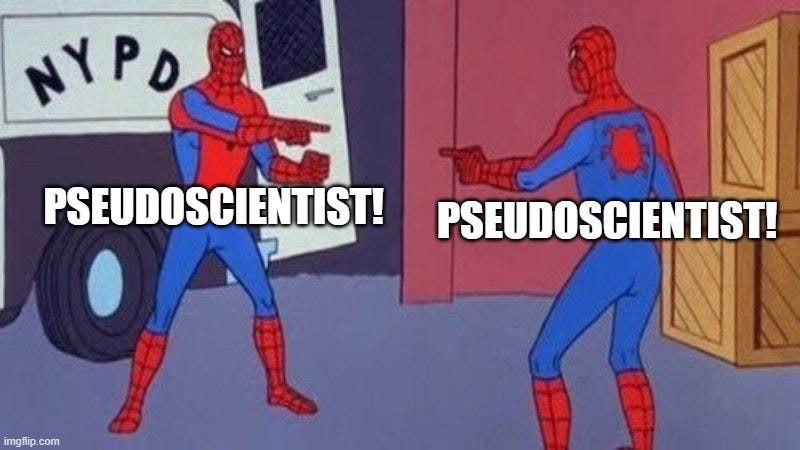
Steve Stewart-Williams: Exactly. Anyone can say, “You’re a pseudoscientist!” It’s like that Spider-Man meme where the two Spider-Men point accusingly at each other. The label alone doesn’t settle anything. You have to say what, specifically, is wrong with each claim.
Claims in evolutionary psychology aren’t all equally strong. Some are weak, some have been falsified – but some are very strong. The right approach is to avoid thinking “evolutionary psychology is all good” or “evolutionary psychology is all bad,” and instead to evaluate each assertion on its merits.
A Field That Can Be Wrong
Timur Sevincer: You said evolutionary hypotheses can be falsified. Could you give examples?
Steve Stewart-Williams: A famous example is the kin-selection explanation of same-sex sexual orientation, associated with E. O. Wilson. Same-sex sexual orientation is puzzling in evolutionary terms. Wilson suggested that it might be a form of kin altruism: instead of having children of one’s own, someone might help siblings or other relatives to have children, thereby passing on their genes indirectly through them.4 But people did the research, and the verdict is that this probably isn’t the explanation.5
Timur Sevincer: Another example might be the dual-mating or ovulatory-shift idea: the idea that women might seek investment from one kind of man and “good genes” from another, with preferences shifting around ovulation. There were T-shirt smell studies and other work that initially attracted considerable attention,67 though the literature has since become more contested. How would you evaluate the state of the evidence today?
Steve Stewart-Williams: I’m very skeptical of the ovulatory-shift hypothesis. To be fair, the debate isn’t over; there are still people on both sides of the issue. But I’m much more persuaded by the people who say that the evidence hasn’t borne it out.
Timur Sevincer: How does evolutionary psychology fare after the replication crisis?
Steve Stewart-Williams: It hasn’t emerged unscathed, but I think it fares fairly well. It does better than social psychology, though not as well as behaviour genetics. The most robust claims in the field are those grounded in well-established theories from evolutionary biology: sexual selection theory, parental investment theory, parent-offspring conflict theory, kin selection theory. These aren’t just free-floating speculations. They’re grounded in principles that have been demonstrated across many species. This is especially true for many sex differences.
Another reason the field has done well in certain areas is that it was seen as controversial from the outset. To persuade people, evolutionary psychologists have often had to clear a higher evidential bar. David Buss’s work on mate preferences, which found that men and women differ on average in how strongly they prioritize certain traits in long-term partners, used extensive cross-cultural evidence.89 Martin Daly and Margo Wilson’s work on homicide and step-parenthood, the so-called “Cinderella effect,” that children are at greater risk of abuse and violence from stepparents than from biological parents, drew on large archival datasets.10 The sex difference in interest in casual sex has multiple converging lines of evidence: cross-cultural evidence, real-world dating data, cross-species patterns, and links to prenatal hormonal exposure.11
Nikil Mukerji: There is an interesting complication here. A low replication rate can be a warning sign. But in some pseudoscientific or ideological literatures, one finds suspiciously high positive-result rates: everything seems to confirm the preferred story. So a perfect replication rate can be suspicious as well.
Steve Stewart-Williams: Yes. To do replication properly, you need open science practices, preregistration, methods that could falsify the hypothesis, and ideally multiple research groups, including people with different prior commitments. Even if a claim is falsifiable in principle, one isn’t really doing science unless one uses methods that could in principle falsify it.
Social psychology deserves credit here. The fact that we know about its replication problems shows that many in the field are testing their claims and trying to improve. A low replication rate isn’t fatal if researchers are actively checking their findings and weeding out false positives. The problem is that, until recently, they often weren’t.
The Ethical Trap
Nikil Mukerji: Some findings in evolutionary psychology are bound to annoy people, especially in certain political milieus. Are you concerned that this kind of science might play into the wrong hands? How do you deal with the ethics of communicating sex differences?
Steve Stewart-Williams: That’s a good and difficult question. Claims about sex differences can certainly be misused. They can be misused if people exaggerate the size of the differences. They can also be misused if people infer that, because a difference has an evolutionary basis, it’s therefore good or should be preserved. That can do harm. If we exaggerate differences, we may lower our expectations for one sex or the other in certain domains.
But I have two responses. First, the sexes do differ on average, and I think there’s an evolutionary contribution to some of those differences. We can’t just lie about that. The right response is to tell the truth carefully and responsibly.
That means emphasising that most human sex differences aren’t huge.1213 There’s a lot of overlap between the sexes. Everyone should get a fair chance. And the fact that something is natural, genetic, or partly shaped by evolution has no direct moral implications. Natural selection doesn’t tell us what’s right or wrong.
Second, denial can also do harm. It’s not the case that exaggerating sex differences is dangerous while minimising them is harmless. We can get this wrong in both directions.
Nikil Mukerji: So denial is wrong in principle, and one can also make a consequentialist case against it.
Steve Stewart-Williams: Exactly.
Timur Sevincer: This is also a communication problem. Many people hear “sex differences” and immediately think one is defending misogyny or fixed social roles. In my own teaching, I often begin by saying: there is usually substantial overlap between the sexes, most differences are small, evolutionary influences don’t make differences fixed or unmalleable, and a trait’s evolutionary origins don’t make it morally good.
Nikil Mukerji: And acknowledging average differences doesn’t necessarily make people conform to them. In some cases, it could even have the opposite effect: if people are aware of an average tendency, they may consciously decide not to follow it. Recognising statistical differences and encouraging individuality are not incompatible.
Steve Stewart-Williams: I think that’s right. It’s also important to take people’s concerns seriously. Some people worry that evolved sex differences will be used to revive old claims about male superiority or fixed gender roles. Given our history of anti-female sexism, that worry is understandable. But the right response isn’t to shut down the discussion. The right response is to discuss the evidence carefully.
Socialisation, Stereotypes, Patriarchy
Timur Sevincer: When people think about sex differences, they often default to three explanations: socialisation, stereotypes, and patriarchy. Boys and girls are raised differently; stereotypes become self-fulfilling; women are forced into roles by structures created by men. You deal with these explanations in A Billion Years of Sex Differences. Where do they fall short?
Steve Stewart-Williams: Well, let me start by saying that I think “fall short” is the right phrase. It’s not that they have no merit. It’s impossible to believe that socialisation has no impact on behaviour. Stereotypes have an impact. Cultural factors matter. But they’re not enough on their own.
Take parental treatment. It’s often invoked as an explanation for sex differences. But there’s research suggesting that, at least in the West, parents don’t treat sons and daughters particularly differently in many important ways.14 Behaviour genetics also suggests that, within the normal range, the shared family home doesn’t have a massive impact on how people turn out.15 This doesn’t mean genes explain everything. The environment matters too. But the simple parental-socialisation story is weaker than many people assume.16
On patriarchy, the gender-equality paradox is a serious problem for that theory. For many traits, sex differences are larger, not smaller, in wealthier, more individualistic, more gender-equal nations.1718 That’s the opposite of what one would expect if the differences were due to strict sex roles or patriarchy. I’m not saying that every difference follows this pattern, or that culture is irrelevant – in fact, the gender-equality paradox is itself a cultural effect. What I am saying, though, is that it challenges certain traditional sociocultural explanations for differences between the sexes.
On stereotypes, the work of Lee Jussim has been a major influence on me. Stereotypes can be self-fulfilling to some extent, but the main causal direction is usually from social reality to stereotype, not from stereotype to social reality.19 In the case of sex differences, stereotypes are partly shaped by actual average differences that people perceive in the world, and they correspond reasonably well to the actual sex differences.20 In some cases, those stereotypes might then amplify or galvanize the differences. But they don’t create them out of nothing.
Nikil Mukerji: There is a habit of reasoning that often gets in the way here. Instead of asking whether a claim is true, one asks: “What makes you say that?” and “Who does this help?” Truth recedes into the background.
Steve Stewart-Williams: That can become a form of conspiracy theorising. If someone says, “You only believe that because you’re a man,” or “You only believe that because you’re defending your group,” that’s a claim about motive. But even if the motive attribution were true, it wouldn’t show that the claim is false. It’s essentially just an ad hominem argument.
What Denial Costs
Timur Sevincer: Many people understand that exaggerating sex differences can do harm. What is less obvious to many is that downplaying differences can also do harm. Can you give examples?
Steve Stewart-Williams: Sure. I discuss various examples in the book. One is that, if we minimise sex differences in psychological disorders, we may fail to spot them in the less affected sex. ADHD often presents differently in girls than in boys, and the standard description fits boys better. That means girls with ADHD may be overlooked. Autism may also be overlooked in girls because it presents differently than in boys – for example, it tends to involve fewer repetitive behaviours. Conversely, depression in men more often involves substance use and aggression than in women, so male depression may be missed.
There are social and occupational examples as well. If we ignore average differences in occupational interests, we may assume that every gender gap in a field is due entirely to bias. Bias exists, but sex differences in interests also matter. Men are, on average, more interested in things and things-related jobs; women are, on average, more interested in people and helping professions.21 If we ignore that, we may misdiagnose the cause of gaps and pour resources into interventions that don’t address the real causes.
It can also lead to coercive policies. If one reserves positions for one sex, or chooses a less qualified candidate to achieve numerical parity, one reverses discrimination rather than removing it. On top of that, it casts doubt on the competence of the supposedly benefited group. Even beneficiaries themselves may wonder whether they really deserved the position. And portraying STEM as saturated with sexism may deter some girls and women who would otherwise enjoy those fields.
Discrimination exists. But exaggerating it, and ignoring the progress that has been made, can backfire.22 And we shouldn’t overlook the fact that there’s also evidence of discrimination against men in some hiring contexts.2324
The Slippery Word “Gender”
Nikil Mukerji: In the book, you are quite critical of the concept of gender. Could you explain why?
Steve Stewart-Williams: I don’t think it’s a very useful concept, partly because it’s not just one concept. Sometimes “gender” is just a synonym for sex. Sometimes it refers to masculinity and femininity. Sometimes it refers to sex differences supposedly due to nurture rather than nature. Sometimes it refers to social roles, stereotypes, gender identity, or clusters of personality traits.
The nurture-based definition is especially problematic. It often assumes what should be demonstrated: namely, that nurture is the sole cause of the difference. Many recurring male-female differences involve both nature and nurture. If one defines gender as the nurture part and sex as the nature part, most female-male differences become partly sex differences and partly gender differences. That’s an awkward way to frame things.
Other definitions have other problems. If “gender” means personality profiles, for instance, then the claim that there are many different genders collapses into the trivial observation that every person has a unique personality profile. At that point, we’re talking about personality, not something clearly linked to sex.
For these and other reasons, I prefer to talk about sex rather than gender. In biology, sex is defined by gametes: females are organised around the production of eggs; males around the production of sperm. Sex-linked traits such as chromosomes, genitals, hormones, masculinity, femininity, sex-typical behaviour, and personality traits don’t define sex. Instead, they’re among the many traits that evolved to facilitate reproduction via either eggs or sperm.
Why This Topic Can Set Rooms on Fire
Timur Sevincer: Why do sex differences, sexual behaviour, and evolution sometimes provoke such strong emotions? In principle, one could discuss them scientifically.
Steve Stewart-Williams: The topic is inherently combustible. A big part of the reason is our history of sexism against women. Early scientists made false and sexist claims about women’s intellectual abilities. So it’s understandable that people worry. If we open the door to evolved sex differences, are we going to slide back into Victorian ideas about male superiority and fixed roles?
But the science of sex differences actually refutes those early sexist claims. Shutting down the discussion is the wrong reaction. We should be able to say: Yes, some past claims were wrong and sexist; no, that doesn’t mean every claim about sex differences is wrong or sexist.
Unfortunately, a modern trend on campus and elsewhere is to fight unwelcome ideas not with arguments and evidence, but with accusations, complaints to authorities, protests, occupations of classrooms, and so on. These are intimidation tactics as much as anything else. It’s anti-intellectual. In principle, anyone with any view can use intimidation tactics. Thus, intimidation can’t sort out who’s right and who’s wrong.
I had my own taste of this. A paper I wrote on sex differences in STEM25 caused an online controversy and led to calls for retraction. The issue reached the equality, diversity, and inclusion (EDI) office at the University of Nottingham’s UK campus. They did not like the paper! To their credit, though, they defended my academic freedom, and I was promoted to full professor despite listing the paper as one of my main pieces of work. But the experience was still worrying. I didn’t seriously think I’d lose my job, but I did wonder whether expressing perfectly reasonable views about sex differences might make it difficult for me to get another academic job.
That was part of why I started my Substack, The Nature-Nurture-Nietzsche Newsletter. I wanted a fallback. If the worst came to the worst, I wanted another way to make a living. And it’s worked out well: I’m no longer financially dependent on my academic job. It’s a great position to be in. I’ve always tried to write honestly and openly about the topics I cover, even when knowing it might not be popular. But now I do so with a lot less trepidation.
Can Persuasion Still Work?
Nikil Mukerji: Some of these controversies are not only about evolutionary psychology itself, but also about deeper disagreements concerning evidence, reasoning, and the interpretation of scientific claims. How does one talk to people who have been taught that logic is a tool of oppression? They often fail to separate the truth of a claim from alleged motives for making it.
Steve Stewart-Williams: Even people who officially reject reason and evidence may still be moved by logical arguments. They might not change their minds immediately, but they may eventually. Social psychologists call that a sleeper effect, and it’s a well-documented phenomenon.
Nikil Mukerji: My suspicion is that another causal factor is needed. Some people change their minds after reality punches them in the face. Then they remember that someone had explained the matter differently.
Steve Stewart-Williams: That could well be right. But persuasion is still worth attempting. It won’t work on everyone. Nothing will work on everyone. But across history, humanity has moved away from superstition toward more scientific ways of thinking. That suggests that slow persuasion is possible.
Can Evolutionary Science Inform Moral Reasoning?
Nikil Mukerji: In A Billion Years of Sex Differences, you rightly reject the inference from “natural” to “good.” But David Sloan Wilson and colleagues26 argue that evolutionary psychologists often overcorrect here: Hume’s point is only that an ought cannot be derived exclusively from an is, not that natural facts have no ethical relevance. So when you say that the science of sex differences cannot answer policy questions because those are ultimately about values, how do you avoid turning a valid warning against “natural = good” into a stronger and false separation between facts and ethics? More concretely: should evolved sex differences alter our moral and political reasoning about fairness, coercion, individual freedom, and the costs of eliminating gender gaps — and if so, exactly how?
Steve Stewart-Williams: I don’t think anyone argues that evolved facts have no ethical relevance. They just argue that the fact that something has an evolutionary origin doesn’t necessarily mean it’s good – or bad, or anywhere in between. That’s all I argue, anyway.
An example: It might be the case that, if a given sex difference has an evolutionary origin, it would be hard to eliminate, and that doing so would do more harm than good. As a result, we might decide that we shouldn’t try to eliminate it. But the reason for that decision wouldn’t be that the sex difference is natural; it would be that trying to eliminate it would do more harm than good. In other words, we’d be dealing with a consequentialist argument, not an argument from nature.
Importantly, this cuts both ways. If eliminating a socially constructed sex difference would do more harm than good, then we shouldn’t do that either, even though the difference isn’t “natural.” And if eliminating a natural difference would boost general well-being, we should do it despite its natural origins. In itself, the nature-nurture question is irrelevant to the ethical question.
We can turn the tables here as well: Why should we exclude certain facts from our ethical reasoning just because they happen to have an evolutionary origin? To do so is to risk falling prey to an anti-naturalistic fallacy!
What Skeptics Should Do
Nikil Mukerji: What could skeptical organisations such as the GWUP do to support work on evolutionary psychology? One project might be to investigate the charge that evolutionary psychology is pseudoscience. If one calls a real science pseudoscience, one is denying it legitimate scientific status. That’s a form of science denial.
Steve Stewart-Williams: I hadn’t thought about it exactly that way, but it is interesting. Some contemporary criticisms of evolutionary psychology echo arguments made earlier by critics of sociobiology such as Stephen Jay Gould, Richard Lewontin, Stephen Rose, and others.
I do think there’s genuine science denial around evolutionary psychology, and around behaviour genetics as well. Both fields posit genetic or evolutionary contributions to behaviour, which many people dislike. The difficulty is that, although there’s science denial on both the right and left side of the political spectrum,27 academia is predominantly left-leaning, and thus left-leaning forms of science denial are less likely to be labeled as such. In that way, politics can intrude on science and suppress it.
Nikil Mukerji: Colin Wright suggested a useful skeptical task: look at what critics are actually saying, systematise their assertions, test whether they are representative of the literature, and present the strongest version rather than a straw man. That matters because critics often respond: “Nobody actually believes that.” Skeptics need textual evidence.
For the GWUP, this could mean identifying the sources and authors behind the claim that evolutionary psychology is pseudoscience, building a bibliography, and analysing representative claims.
Steve Stewart-Williams: That sounds like a worthwhile project. You have to be fair and careful, but also willing to call science denial science denial when that’s what it is.
Nikil Mukerji: That is a good place for skeptics to stand: not on the side of a political tribe, but on the side of careful distinctions, fair evidence, and criticism that applies in every direction.
Steve Stewart-Williams: Exactly. Evolutionary psychology isn’t perfect. No science is. Some hypotheses have failed, and others will fail in the future. But to say that the whole field is worthless or pseudoscientific isn’t to give credit to what it’s achieved. The better approach is to examine claims one by one, ask what evidence supports them, ask what evidence could refute them, and keep moral questions separate from scientific ones.

Prof. Steve Stewart-Williams
Steve Stewart-Williams is a professor of psychology and the author of A Billion Years of Sex Differences: How Evolution Shaped the Minds of Men and Women. The book explores the extent to which some average psychological differences between men and women reflect evolutionary influences.
Follow Steve on Twitter/X for more psychology, evolution, and science.
Further Reading
I cover the question of sex differences in career choice in depth in A Billion Years of Sex Differences. In addition, I’ve written several academic papers with Lewis Halsey on the topic.
The main one is this 2021 paper in the European Journal of Personality:
Stewart-Williams, S., & Halsey, L. G. (2021). Men, women and STEM: Why the differences and what should be done? European Journal of Personality, 35, 3-39. https://doi.org/10.1177/0890207020962326 [Free version]
This was published alongside two commentaries - one favorable; one critical.
Ceci, S. J., Kahn, S., & Williams, W. M. (2021). Stewart-Williams and Halsey argue persuasively that gender bias is just one of many causes of women’s underrepresentation in science. European Journal of Personality, 35, 40-44. https://doi.org/10.1177/0890207020976778
El-Hout, M., Garr-Schultz, A., & Cheryan, S. (2021). Beyond biology: The importance of cultural factors in explaining gender disparities in STEM preferences. European Journal of Personality, 35, 45-50. https://doi.org/10.1177/0890207020980934
Here’s our response to the critical commentary:
Stewart-Williams, S., & Halsey, L. G. (2022). Not biology or culture alone: Response to El-Hout et al. (2021). European Journal of Personality, 36, 991–996. https://doi.org/10.1177/08902070211022477 [Free version]
From the Archive
12 Things Everyone Should Know About Evolutionary Psychology

This is the latest post in my “12 Things Everyone Should Know” series. You can access the full collection here.
12 Things Everyone Should Know About Behavior Genetics

“The discovery of such big and often counterintuitive findings is a cause for celebration in psychology.”

Upgrade to a Paid Subscription
To help support my work, please consider upgrading to a paid subscription. A paid subscription will get you: (1) full access to all new posts and the archive, (2) full access to my “12 Things Everyone Should Know” posts, Linkfests, and other regular features, and (3) the ability to post comments and interact with me and the N3 Newsletter community.
On top of all that, you’ll be making it possible for me to take risks with the content I offer in the newsletter. I love being a psych prof, but I’m aware that some of the topics I write about - from the evolution of sex differences to the nature of intelligence to the excesses of wokeness - could potentially land me in hot water. Having the option to go full-time on Substack gives me the freedom and financial security to speak openly and honestly on any subject, without having to worry about being cancelled. So, by taking out a paid subscription, you’ll be helping support open and honest science writing.
Thanks!
Steve
Stewart-Williams, S. (2018). The ape that understood the universe: How the mind and culture evolve. Cambridge University Press.
Costello, W., Sedlacek, A. G. B., Durkee, P. K., Crosby, C. L., Hahnel-Peeters, R. K., & Buss, D. M. (2026). Evolutionary psychology hypotheses are testable and falsifiable. American Psychologist, 81, 1-24.
Frankfurt, H. G. (2005). On bullshit. Princeton University Press.
Wilson, E. O. (1978). On human nature. Harvard University Press.
Bobrow, D., & Bailey, J. M. (2001). Is male homosexuality maintained via kin selection? Evolution and Human Behavior, 22, 361-368.
Gangestad, S. W., & Thornhill, R. (1998). Menstrual cycle variation in women’s preferences for the scent of symmetrical men. Proceedings of the Royal Society of London. Series B: Biological Sciences, 265, 927-933.
Thornhill, R., & Gangestad, S. W. (2003). Evolutionary theory led to evidence for a male sex pheromone that signals symmetry. Psychological Inquiry, 14, 316-323.
Buss, D. M. (2003). Sexual strategies: A journey into controversy. Psychological Inquiry, 14, 219-226.
Walter, K. V., Conroy-Beam, D., Buss, D. M., Asao, K., & Sorokowska, A. (2020). Sex differences in mate preferences across 45 countries: A large-scale replication. Psychological Science, 31, 408-423.
Daly, M., & Wilson, M. (2008). Is the “Cinderella effect” controversial? In C. Crawford & D. Krebs (Eds.), Foundations of evolutionary psychology (pp. 383-400). Erlbaum.
Stewart-Williams, S. (2026). A billion years of sex differences: How evolution shaped the minds of men and women. Forum.
Stewart-Williams, S., & Thomas, A. G. (2013a). The ape that thought it was a peacock: Does evolutionary psychology exaggerate human sex differences? Psychological Inquiry, 24, 137-168.
Stewart-Williams, S., & Thomas, A. G. (2013b). The ape that kicked the hornet’s nest: Response to commentaries on “The Ape that Thought It Was a Peacock.” Psychological Inquiry, 24, 248-271.
Lytton, H., & Romney, D. M. (1991). Parents’ differential socialization of boys and girls: A meta-analysis. Psychological Bulletin, 109, 267-296.
Plomin, R., & Daniels, D. (1987). Why are children in the same family so different from one another? Behavioral and Brain Sciences, 10, 1-16.
Harris, J. R. (1995). Where is the child’s environment? A group socialization theory of development. Psychological Review, 102(3), 458-489.
Stoet, G., & Geary, D. C. (2018). The gender-equality paradox in science, technology, engineering, and mathematics education. Psychological Science, 29, 581-593.
Herlitz, A., Hönig, I., Hedebrant, K., & Asperholm, M. (2025). A systematic review and new analyses of the gender-equality paradox. Perspectives on Psychological Science, 20, 483-519.
Jussim, L., Crawford, J. T., Anglin, S. M., Stevens, S. T., & Duarte, J. L. (2016). Stereotype accuracy: One of the largest and most replicable effects in all of social psychology. In T. D. Nelson (Ed.), Handbook of prejudice, stereotyping, and discrimination (2nd ed., pp. 31-63). Psychology Press.
Swim, J. K. (1994). Perceived versus meta-analytic effect sizes: An assessment of the accuracy of gender stereotypes. Journal of Personality and Social Psychology, 66, 21-36.
Su, R., Rounds, J., & Armstrong, P. I. (2009). Men and things, women, and people. Psychological Bulletin, 135, 859-884.
Ceci, S. J., Kahn, S., & Williams, W. M. (2023). Exploring gender bias in six key domains of academic science: An adversarial collaboration. Psychological Science in the Public Interest, 24, 3-92.
Williams, W. M., & Ceci, S. J. (2015). National hiring experiments reveal 2:1 faculty preference for women on STEM tenure track. Proceedings of the National Academy of Sciences, 112, 5360-5365.
Schaerer, M., du Plessis, C., Yap, A. J., et al. (2023). On the trajectory of discrimination: A meta-analysis and forecasting survey capturing 44 years of field experiments on gender and hiring decisions. Organizational Behavior and Human Decision Processes, 179, 104290.
Stewart-Williams, S., & Halsey, L. G. (2021). Men, women and STEM: Why the differences and what should be done? European Journal of Personality, 35, 3-39.
Wilson, D. S., Dietrich, E., & Clark, A. B. (2003). On the inappropriate use of the naturalistic fallacy in evolutionary psychology. Biology and Philosophy, 18, 669-682.
Washburn, A. N., & Skitka, L. J. (2018). Science denial across the political divide: Liberals and conservatives are similarly motivated to deny attitude-inconsistent science. Social Psychological and Personality Science, 9, 972-980.
There has been an active bias against Ovulatory Shift since Martie Haselton began publishing her research, including P-hacking.
https://youtu.be/wn8pZLAP1lg?si=0t9XdIb7c_3j_LuS&t=1775
Excellent job by the interviewers. Very satisfying interview.
Steve, you mention sex differences in STEM can be chalked up to interests. But interests may reflect what one is good at, and proficiency or ability seems likely to be a better explanation for the sex imbalance in STEM - particularly for the "M" field, which is my own. What sort of experiment could tease apart these explanations?